
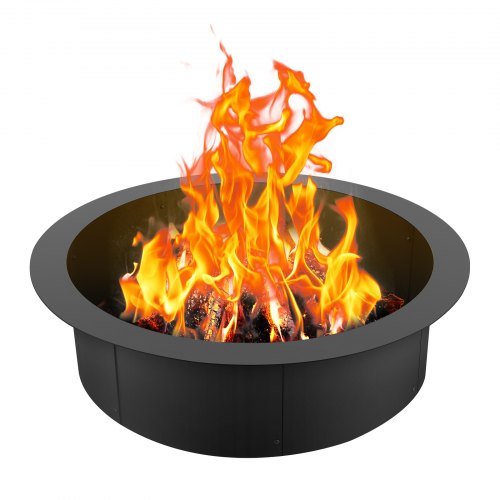
VEVOR Fire Pit Ring
30‑inch inner diameter, 10‑inch height, 2.5mm thick Q235 steel. Heavier, sturdier option for frequent use.
Overview
The VEVOR Fire Pit Ring is a mid‑sized, 36‑inch outer / 30‑inch inner diameter steel liner with 10‑inch high walls, made from Q235 carbon steel and supplied in seven sections. What sets it apart from the thinner, lighter rings on the market is the 2.5 mm (0.1 in) plate thickness — a heavier gauge intended to resist warping and stand up to frequent fires.
It’s a focused product: a plain, heavy‑duty fire pit insert rather than a finished bowl with accessories. That makes it a good fit for DIY installations — you can sit it above ground on a non‑combustible base or sink it into the ground as a lined fire pit. The compact internal diameter keeps wood loads modest, so the ring works well where space is limited and you don’t want an oversized blaze.
Who is this best for?
The VEVOR 36‑inch ring is aimed at buyers who want a durable, no‑frills fire pit insert with a relatively small footprint. Typical users include:
- Owners of smaller gardens, patios or terraces who need a compact fire option that won’t dominate the outdoor space.
- People who plan to use a fire pit frequently and therefore benefit from the greater durability of thicker steel.
- DIYers planning a custom build — the ring is a sensible liner for above‑ground or in‑ground installations when paired with a suitable base and surround.
- Anyone prioritising long‑term resilience over ultra‑lightweight portability; the thicker steel gives a solid, stable feel once installed.
It is less suitable for someone who wants an instant, decorative fire bowl with a grill, cover or spark screen included — this is a functional insert intended as part of a build.
Key features
- Inner diameter: approximately 30 inches (762 mm) — a compact burn area for small to medium gatherings.
- Outer diameter: approximately 36 inches (914.4 mm), so allow room around the ring for a safe clearance zone.
- Height: 10 inches (254 mm) — tall enough to contain flames and embers while keeping the profile relatively low.
- Material: Q235 carbon steel — a commonly used structural steel in fire pit manufacturing that responds well to heat cycling but will rust without protection.
- Thickness: 2.5 mm (0.1 in) — heavier than many budget rings, which helps resist warping from repeated heating and cooling.
- Construction: supplied as seven sections — easier to transport and assemble on site, but requires fastening or welding for a permanent installation if you want a single solid ring.
Practical evaluation
Before buying any fire pit ring, you want to match the physical dimensions and material to how you’ll actually use it. The VEVOR ring’s 30‑inch inner diameter means you’re working with a compact fire area. That helps in smaller gardens where a large pit would overwhelm the space, but it also limits the maximum length of logs you can use comfortably. Expect to use shorter splits or to position longer wood diagonally; very large logs won’t fit.
The 10‑inch wall height is a sensible compromise. It contains embers and helps direct radiant heat up rather than outwards, which is nice when you want a contained fire that won’t throw sparks across a patio. Taller walls are also useful if you occasionally build larger wood stacks, because there’s less chance of logs rolling out as the fire settles.
The standout practical feature is the plate thickness. At 2.5 mm the ring is thicker than many lightweight counterparts, which are often around 1.5 mm or thinner. Thicker steel heats and cools with less distortion, so you’ll see fewer warping issues over time if you light the pit regularly and use denser hardwoods. The heavier material also increases heat retention; the ring will absorb and radiate more stored heat into the seating area after the flames die down.
Being made of untreated carbon steel, the VEVOR ring will develop surface rust if left exposed to the elements — that’s normal and doesn’t mean the product is failing. Many owners either allow a natural patina to form or apply high‑temperature paints/coatings in the early weeks to slow surface corrosion. Bear in mind coatings wear with use and will require reapplication if appearance is important to you.
Installation wise, this is a true insert: you’ll need to decide whether you’ll sit it on paving, on a bed of compacted aggregate, or sink it partially/fully into the ground. If placed on a patio or close to combustible surfaces, a proper heat‑resistant base and clearance are essential — direct contact with turf or timber can lead to heat damage or, in extreme cases, fire risk. The ring’s weight is an advantage for stability but a disadvantage if you plan to move it frequently; its sectional construction helps get it into place but you should be prepared for manual handling or having help at installation.
As supplied, there’s no grill, lid or spark screen included. That’s not a fail — it keeps the price down and leaves room to add accessories tailored to your needs — but if you want a multipurpose pit for cooking and covered evenings you’ll need to budget for a compatible grate or screen separately. Buying a universal grill ring or having a local welder fabricate a small support lip are common options.
Strengths
- Thicker steel resists warping: 2.5 mm plate gives greater resistance to deformation from repeated heat cycles compared with thinner rings.
- Better long‑term durability: the heavier gauge is sensible for owners who intend to light fires frequently.
- Taller walls provide containment: 10‑inch height keeps embers and sparks more contained while improving perceived safety and heat direction.
- Compact footprint: the smaller inner diameter suits restricted gardens and patios where a larger pit would be out of scale.
- Solid feel once installed: heavier steel and sectioned assembly result in a stable install that sits firmly on a base.
- Good heat retention: thicker metal holds and radiates heat, which keeps the seating area warmer for longer after the flames die down.
Limitations
- Smaller inner diameter limits log size: If you like burning long rounds or big logs, this ring will force you to split wood to fit comfortably.
- Heavier to move and install: the thicker steel is less portable than thinner rings — assembly on site helps but plan for manual handling.
- Higher guide price than the thinnest options: the cost reflects the heavier build; if you only light a few times a year it may be over‑spec.
- No grill, cover or accessories supplied: you’ll need to purchase or fabricate a grate, lid or spark guard if you want cooking functionality or extra protection.
- Requires a proper base: to protect paving or lawn and reduce heat transfer you must install it on a suitable non‑combustible base — that’s an extra cost and labour.
Installation and safety considerations
Because the VEVOR ring is a heavy gauge steel insert rather than a fully finished bowl, installation choices shape both safety and performance. Here are practical points to check before you buy or during planning:
- Comparedance: Ensure at least a sensible safety gap to any buildings, fences, overhanging branches or combustible decking. The ring reduces lateral flame spread but does not remove the need for safe clearances.
- Base and heat protection: On paving use a dedicated heat‑resistant mat or lay a bed of compacted gravel and paver slabs beneath the ring to reduce heat transfer. On grass, build a stone or gravel base to protect the turf. Avoid direct placement on combustible surfaces.
- Ground burial: If you choose to sink the ring into the ground as a lined pit, dig a regular hole, add a compacted layer of gravel for drainage and consider a concrete or paving ring support if you want a permanent, low‑maintenance solution.
- Anchoring and joints: The ring arrives in seven sections. If you want a single sealed circle, plan for mechanical fasteners or welding. In many temporary or semi‑permanent installs, a tight sectional fit is adequate if the unit sits on a stable base.
- Spark control: Use a mesh screen or spark guard when burning resinous wood or if strong winds pick up embers; these are sold separately and are advisable for patio settings.
- Fire safety kit: Keep a bucket of sand, a fire blanket and a working garden hose or extinguisher nearby when in use.
Using it for barbecues and cooking
The VEVOR ring is primarily a fire pit liner rather than a dedicated barbecue, but with the right accessories it can double as a cook‑top. There isn’t a grill or cooking grate included, so you’ll need to add one — look for a heavy‑duty steel grate that spans the internal diameter or a rotisserie‑style frame that mounts over the ring.
When planning to cook, bear these practicalities in mind:
- The 30‑inch internal diameter gives enough room for a medium‑sized grill grate, but space for multiple pans or a large spit will be limited.
- Because the ring is steel and uninsulated, metal accessories can become very hot quickly; use suitable tools and heatproof gloves when handling grates or adjusting coals.
- Cooking directly on a clean metal grate on top of the ring is straightforward, but avoid cooking when there are large flames licking above the rim — wait for embers to form for even heat.
- If you want to use a pizza stone or other delicate cookware, consider a two‑stage approach: build hot coals to the side or move embers under a raised grate to create a more moderate, even cooking surface.
Maintenance and longevity
Carbon steel requires basic maintenance to keep a tidy appearance and avoid excessive corrosion. Expect surface rust to form gradually if the ring is left outdoors — many owners accept this as patina. If you prefer a cleaner look, apply a heat‑resistant metal paint or high‑temperature oiling/coating early on and reapply as required. Avoid paints not designed for high temperatures.
After each use let the ring cool naturally, brush out ash and debris and check the section joints for any movement. If you plan to leave the ring installed year‑round in a wet climate, consider a simple cover or a drip‑free shelter to reduce water pooling when not in use.
Pricing and value
The guide price for the VEVOR 36‑inch ring is shown as USD 74.99 — check the current price before buying because offers and currency changes can alter value. Relative to ultra‑budget, thin‑gauge rings, the VEVOR sits at the heavier end of mid‑range options. That higher initial spend is partly the trade‑off for greater thickness and the durability that brings.
Value depends on how you intend to use the pit. If you light fires fairly often, or if you plan a long‑term installed feature in your garden, the thicker steel should repay the premium by resisting warping and needing fewer replacements. Conversely, if you use a fire pit only occasionally or want a lightweight, portable unit you’ll store after each use, a thinner, cheaper ring might be the better choice.
Also factor in additional costs: base construction (gravel, paving, slabs), accessories (grill grate, spark screen, cover) and, if needed, welding or mechanical fasteners to make the sections into a single, permanent ring. Those extras can push the total project cost higher than the guide price alone.
Alternatives and when to choose something else
While the VEVOR ring is a sensible mid‑sized, heavy‑gauge insert, there are scenarios where another option might be preferable:
- Need a larger fire for social gatherings: If you often host big groups or want a visually larger flame, consider rings with a greater inner diameter. Larger pits let you burn longer logs and create a more dramatic focal point.
- Want an all‑in‑one bowl with accessories: If you prefer a finished fire bowl with a grill, cover and spark screen included, look at dedicated fire bowls or chimineas that come with those extras — they reduce the need to buy add‑ons.
- Portability is a priority: For camping or frequent repositioning, thinner and lighter rings are easier to transport and store.
- Preference for rust resistance without painting: For low maintenance consider stainless steel options or cast iron bowls; they cost more but can have different corrosion behaviour and aesthetic appeal.
When comparing thickness, note that 2.5 mm is a middle ground between inexpensive thin rings and heavy industrial bowls. It’s a good compromise if you want robustness without the expense and weight of very thick, heavy cast or stainless steel designs.
Final verdict
The VEVOR Fire Pit Ring (36‑inch outer, 30‑inch inner, 10‑inch height) is a pragmatic choice if you want a compact fire pit that will stand up to regular use. Its 2.5 mm carbon steel construction gives it a durability edge over thinner budget rings and helps reduce the risk of warping over repeated heating cycles. The 10‑inch walls provide sensible containment and the sectional design makes it easier to get the product into place.
It isn’t perfect for everyone. The limited internal diameter restricts log size, the ring is heavier to handle, and you’ll need to add a grill or spark screen if you want cooking capability or extra protection. It also requires a suitable non‑combustible base to protect ground surfaces. But for a small garden where you plan to light fires often, the VEVOR ring represents a robust, long‑living insert that will perform reliably if installed correctly and maintained.
In short: choose the VEVOR 36‑inch ring if you prioritise durability and a compact footprint and are prepared to complete a simple installation and buy any cooking or safety accessories separately. If you need a larger burn area, built‑in accessories, or maximum portability, consider other styles instead.
Note: offers and prices change — check the current price and shipping details before buying.
Ready to check VEVOR Fire Pit Ring, 36-Inch Outer/30-Inch Inner Diameter, 10inch Height 2.5mm Thick Fire Pit Insert, Heavy Duty Carbon Steel Liner DIY Campfire Ring above or In-Ground, for Outdoor Camping, Bonfires?
Check the latest offer before buying, then return to the main comparison if you want to compare it against the other shortlisted options.
Compare this with the full shortlist
Return to the full comparison guide to see how this product compares against the other shortlisted choices.