
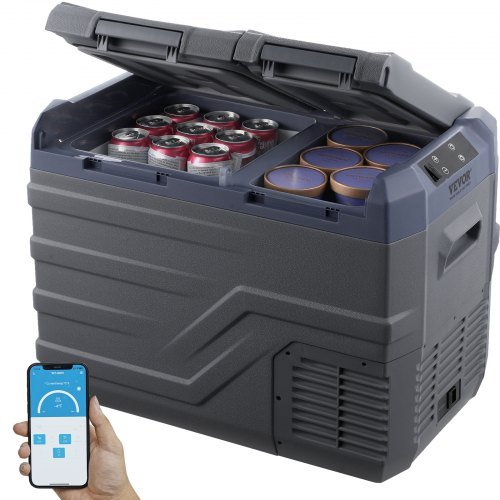
VEVOR Car Refrigerator
Large 32 L dual‑zone compressor fridge with AC/DC power and wide temperature range. Suits overnight or multi‑day trips where freezing and chilling are both required.
Overview
The VEVOR 32 L Car Refrigerator is a compressor-driven portable fridge designed to work from both vehicle power (12/24V DC) and mains (100–240V AC). Its headline feature is a dual-zone interior: you can set one compartment to chill while the other freezes. The unit uses a sturdy exterior shell (PP + HDPE) and a vacuum-formed HIPS inner liner, offers an adjustable temperature range from -20°C to 20°C (-4°F to 68°F) and is rated at around 60 W, with a manufacturer-stated noise level of up to 45 dB. At roughly 13.3 kg it’s not feather-light, but it has carry handles and is positioned as a flexible option for outdoor use, RVs and home topping-up.
This review pulls together the product features and practical considerations you should weigh up before buying. It’s written as a draft for a comparison site covering the VEVOR compressor range, so you’ll also find guidance on who benefits most from a 32-litre dual-zone unit and what alternatives to consider.
Who is this best for?
The VEVOR 32 L dual-zone fridge sits in a sweet spot between the smallest portable coolers and full-size caravan fridges. It’s best suited to:
- Couples or small groups on multi-day road trips who want fresh food and frozen items on the go.
- Van lifers and weekend campers who need a versatile box that can act as fridge and freezer at the same time.
- Families or small gatherings where you want to bring frozen goods for cooking as well as chilled drinks and perishables.
- Users who need a fridge that will run from both the vehicle and mains power—useful if you switch between driving and campsite hookups or want to use it at home occasionally.
It’s less ideal for hikers and anyone who prioritises ultra-lightweight portability. Solo commuters or people who only need to keep drinks cool during a short commute might find this capacity and feature set more than they require.
Key features
- 32-litre total capacity – practical for multi-day trips with room for fresh food, drinks and a reasonable amount of frozen items.
- Dual-zone layout – each compartment can be set independently, letting you freeze in one zone while chilling in the other.
- Wide temperature range – adjustable from -20°C to 20°C (-4°F to 68°F), which covers both freezing and refrigerated temperatures.
- Dual power inputs – works from 12/24V DC (vehicle) or 100–240V AC (mains), which adds flexibility for mixed-use scenarios.
- Compressor cooling – more effective and reliable than thermoelectric alternatives, especially in hot conditions and for freezing.
- Robust construction – exterior materials (PP + HDPE) with a vacuum-formed HIPS liner are designed for outdoor usage and frequent transport.
- Portable design with handles – at around 13.3 kg the fridge is portable but substantial; handles help with moving it around.
- Listed noise level and power draw – manufacturer quotes noise ≤ 45 dB and a 60 W power rating (see practical notes below on implications).
Practical evaluation
Capacity and layout: 32 litres is large enough for a few days’ worth of food for two people or a day or two for three to four people if you pack carefully. The dual-zone layout is especially useful if you want to carry frozen goods (meat, ice packs) and chilled items (drinks, dairy) at the same time. Think of it as replacing a small coolbox and a separate icebox in one package, with temperature control that should be more consistent than melting ice can offer.
Power and usage: The compressor design is an advantage if you expect to use the fridge in warm weather or need genuine freezing temperatures. Compressor units cool actively rather than relying on ambient conditions, so they’re better at holding low temperatures inside. The unit can be powered from your car’s 12 V socket or a 24 V system in larger vehicles, and it will also run from household power via the AC input. That flexibility is handy if you regularly park up on campsites with hookups or want to top up at home before a trip.
Energy and battery considerations: The declared power rating is 60 W. As a rough reference, at 12 V that equates to around 5 amps (60 W ÷ 12 V ≈ 5 A). That means the fridge will draw a non-trivial amount of current when the compressor is running. In practical terms, run time from a vehicle battery depends on how often the compressor cycles, ambient temperature, the initial contents’ temperature and how well insulated the fridge is. For long periods of use while parked, it’s sensible to run the vehicle occasionally, use a leisure battery or install a battery-protection device to avoid flattening your starter battery. The fridge does not include a dedicated battery—if you need extended off-grid use, consider adding a suitable leisure battery or solar setup.
Noise and placement: The manufacturer quotes a maximum noise figure of 45 dB. That level is comparable to a quiet conversation or low background noise at home; in a vehicle or van it should be unobtrusive, but it’s still worth placing the unit where its fan and compressor have room to breathe. Compressor fridges need ventilation to run efficiently; avoid stuffing it into a cramped space without airflow as that can increase the compressor workload and energy draw.
Build quality and portability: The combination of PP and HDPE on the exterior gives a hard-wearing shell that stands up to outdoor use, while a vacuum-formed HIPS inner liner is straightforward to clean. At ~13.3 kg it’s heavier than smaller portable coolers, so think about where you’ll store it in your vehicle and how often you’ll need to lift it. The handles make it manageable for short carries but won’t turn the unit into a lightweight carry-anywhere fridge.
Strengths
- Dual-zone flexibility: Being able to freeze and chill simultaneously removes the compromise of choosing between a freezer or fridge. It’s practical for meal planning and for people who want to bring frozen packs or frozen food and have chilled items ready to serve.
- Compressor performance: Compressor cooling handles hot ambient temperatures better than thermoelectric systems and reaches freezing temperatures reliably — useful if you’re carrying frozen goods or live in a warm climate.
- Multi-power capability: The DC and AC inputs make the unit adaptable for vehicle, campsite and home use, reducing the need to transfer goods between fridges when you arrive at a powered campsite.
- Reasonable noise level: Listed at up to 45 dB, it should be relatively unobtrusive inside a vehicle or van compared with louder compressor units.
- Durable materials: The exterior materials and inner liner are aimed at outdoor use and frequent transport; easy-to-clean internals are a practical plus for camping.
Limitations
- Weight and footprint: At about 13.3 kg and with a 32 L capacity, it occupies a meaningful amount of boot or van space. If you need a fridge you’ll carry often by hand, a smaller model will be easier to manage.
- Energy draw: The 60 W rating means it will draw several amps from a 12 V supply while cooling. Prolonged operation with the engine off can deplete a starter battery — a dedicated leisure battery, battery protector or periodic engine running is recommended for off-grid use.
- No battery or power management included: The fridge doesn’t come with its own battery pack or power protection features, so plan for separate accessories if you need safe off-grid power management (fuses, voltage cut-outs, isolators).
- May be overkill for solo users: If you’re mainly commuting with drinks or a packed lunch, the size and capability will be more than necessary and a compact single-zone unit could be cheaper and lighter.
- Accessories and warranty: The manufacturer’s listing doesn’t specify included accessories beyond handles and power compatibility in the summary. Check the retailer for details on power leads, baskets or divider accessories and for warranty terms before buying.
Pricing and value
The guide price provided is USD 245.90—check the retailer page for current pricing and availability, as offers and stock can change. For the features offered (dual-zone compressor cooling, 32 L capacity and dual power inputs) this sits in an accessible price band for buyers who need reliable cooling without stepping up to a larger fixed RV fridge.
When judging value, consider what you’d otherwise need to replace. A small mains fridge plus a separate freezer, or a higher-spec single-zone compressor unit, could cost more and take more space. The dual-zone convenience and compressor performance make this a reasonable proposition for users who need genuine freezing capability away from mains power.
However, value is user-dependent. If you rarely need a freezer or mostly use the unit while the vehicle is running, you might find equivalent value in a simpler single-zone compressor fridge that’s lighter or cheaper. Conversely, if you frequently cook for groups or spend long periods off-grid, investing in a leisure battery or inverter system will be necessary to get the most from this fridge—and that additional cost should figure in your value calculation.
Alternatives to consider
Before deciding, it’s worth weighing this VEVOR 32 L dual-zone option against a few alternatives depending on how you plan to use it:
- Smaller single-zone compressor fridges (VEVOR or similar): If you’re a solo traveller or mostly need chilled drinks and a sandwich, a 20 L or smaller single-zone unit will be lighter, cheaper and more portable.
- Larger single or dual-zone units: If you regularly cook for several people or need to store a week’s worth of supplies, a larger capacity fridge will reduce packing compromises. Consider whether your vehicle can accommodate the footprint and whether you’re prepared to manage the higher power draw.
- Armrest-style or low-profile car fridges: Some models are designed specifically to sit between seats or in armrest spaces and offer a more integrated fit for daily commuting but usually have smaller capacity and sometimes less freezing power.
- Thermoelectric coolers: These are lighter and often cheaper but struggle to cool below ambient temperature and will not freeze food. Consider them only if you only need to keep drinks slightly cooler than outside conditions and weight/cost are paramount.
- Invest in power accessories: Regardless of the fridge choice, if you plan to use it away from mains power regularly, factor in a leisure battery, battery monitor/protector and possibly a solar trickle charger or inverter to safely run the unit for extended periods.
When comparing models, pay attention to real-world factors such as interior layout (removable baskets and dividers), the presence and length of DC/AC lead(s), whether the unit includes a battery protector, how easy the lid is to open in tight spaces, and whether additional mounting options or tie-down points are available.
Final verdict
The VEVOR 32 L dual-zone compressor car refrigerator is a strong, practical choice for travellers who need flexibility. Its dual-zone setup, compressor cooling and dual-power inputs make it versatile for mixed-use scenarios: road trips, camper vans, weekend camping and even occasional home use. The broad temperature range and the ability to freeze as well as chill are the features that set it apart from simpler portable coolers.
That said, it is not a one-size-fits-all solution. The unit’s weight and footprint mean it’s best for people who have the space and don’t need to carry the fridge for long distances on foot. The 60 W power draw requires attention to battery management if you plan to use it off-grid for long stretches; the fridge itself does not include a battery or integrated power management features. For solo commuters or very light travellers, a smaller single-zone unit might be a better fit and more economical.
Overall, if you want reliable freezing and chilling on the move, the VEVOR 32 L unit is a compelling middle-ground option: more capable than compact thermoelectric coolers but far more portable than full-size caravan fridges. Check the retailer for the latest price, accessory bundling and warranty details before you buy, and plan any additional power kit you might need for extended off-grid use.
Note: offers and prices can change—check the retailer for the most up-to-date information before purchasing.
Compare this with the full shortlist
Return to the full comparison guide to see how this product compares against the other shortlisted choices.