
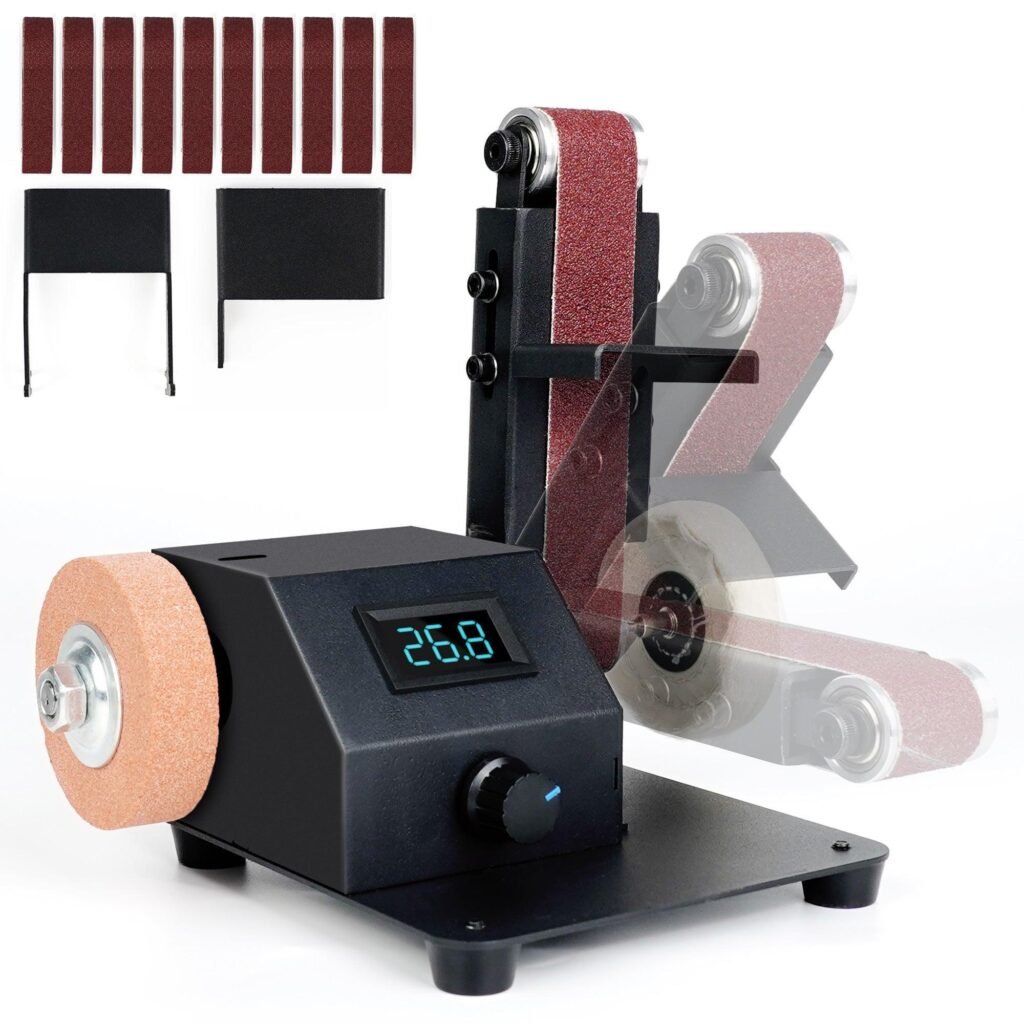
Twotrees Multi-function Belt Sander
Twotrees Belt Sander 【Dual Speed Adjustment】: Twotrees belt sander comes with variable speed adjustment and tachometer display The power configurator can also be adjusted in 7 spe…
Overview
The Twotrees Multi‑function Belt Sander is a handheld, interchangeable‑head tool designed to cover sanding, grinding and polishing without the footprint of several separate machines. It combines a belt sander body with a set of changeable attachments and stepless speed control so you can match motor RPM to the material and finish you’re working on. The design is compact and low profile, which Twotrees positions to help reach confined spaces where larger benchtop sanders won’t fit.
This is not presented as a commercial, continuous‑use machine. Instead, it’s aimed at DIYers, small workshop owners and hobbyists who value versatility and space saving. If your work is mainly large panels, heavy stock removal or full‑time production, a larger dedicated sander will usually outperform a multi‑tool like this. But for occasional sanding, shaping, blending welds or polishing small items, it promises to be an economical, flexible option.
Who is this best for?
The Twotrees Multi‑function Belt Sander is best suited to people who need a compact, do‑it‑all tool for light to medium workshop tasks. That includes:
- Hobby woodworkers and makers who move between shaping, sanding and finishing on small projects.
- Home DIYers who need a single tool for odd jobs — smoothing door edges, refurbishing furniture, or cleaning up metalwork.
- Small workshop owners who want to save space by replacing a handful of small dedicated machines with one multi‑task unit.
- Anyone who frequently works in tight or awkward spaces where benchtop tools won’t reach.
It’s less suitable for contractors or users who expect heavy, continuous throughput. The smaller work area and lighter duty design mean it won’t match the speed or lifespan of industrial benchtop sanders in demanding production environments.
Key features
From the manufacturer description, the main features you’ll find with this Twotrees model are:
- Handheld belt sander body: The base unit is a belt sander that provides portability and allows you to use the tool away from a bench or fixed position.
- Interchangeable attachments: Heads for sanding, grinding and polishing can be swapped, turning the single motor into multiple small tools.
- Stepless speed adjustment: A variable speed control lets you fine‑tune RPM to suit different materials and stages — rough stock removal, smoothing, or polishing.
- Compact, low‑profile design: The form factor makes it easier to reach inside tight spots and keeps the tool usable in constrained workspaces.
- Multi‑purpose approach: Intended as a replacement for several small dedicated tools to save space and cost in hobbyist setups.
Practical evaluation
Because this review is based on the product description rather than hands‑on testing, the practical evaluation focuses on realistic expectations and how the Twotrees multi‑function design will perform in common use cases. Consider the tool as an adaptable addition to a workshop rather than a primary production machine.
Speed control is a genuinely useful feature on a multipurpose tool. Different materials and stages of work benefit from different speeds — for example, lower RPMs reduce heat and remove less material when finishing, while higher speeds help with rapid stock removal on hardwood or rough metal. The stepless adjustment means you can dial in an intermediate speed rather than being limited to a few presets, which is helpful for delicate finishes or mixed material jobs.
Interchangeable attachments are the central selling point. Swapping from a small belt for edge sanding to a polishing pad for bringing up a finish on brass or steel gives a lot of flexibility. That said, changing attachments will interrupt workflow compared with having dedicated tools at the ready. For occasional tasks or mixed jobs where a single machine must do everything, this trade‑off is acceptable. For repetitive, high‑volume work, it becomes a limitation.
The compact, low‑profile design is another practical advantage. Benchtop sanders and grinders can be bulky and hard to position for awkward angles. A handheld unit lets you move around the workpiece and access tight corners. However, the smaller contact area and lower power (relative to benchtop machines) mean you may need more passes and greater operator control to achieve the same result. This requires patience and some technique, particularly on larger panels.
Durability and long‑term reliability are always a concern when one tool replaces several. Multi‑purpose units can suffer from compromises — lighter internals, simpler cooling, and smaller motors — which affect sustained duty. For home and hobby use, these are often acceptable trade‑offs. If you plan to run the machine for long continuous periods, or to use it daily on tough jobs, a heavier dedicated machine is a safer investment.
Strengths
- Versatile: Covers sanding, grinding and polishing without the need to buy separate dedicated machines. That versatility reduces kit clutter and is handy for mixed tasks.
- Speed control: Stepless adjustment allows you to match speed to material and task, improving control and results for a wider range of jobs.
- Compact size: The low‑profile, portable design makes it easier to reach confined or awkward spaces where benchtop options can’t work.
- Space saver: Replacing multiple small tools with one unit saves bench and storage space — useful in a small workshop or garage.
- Good for hobbyists: Suited to DIYers and hobbyists who value flexibility over continuous throughput and want a single, pocket‑friendly machine.
Limitations
- Not for heavy commercial use: The unit is not designed for continuous, industrial work. If your job requires extended daily use at high load, a dedicated benchtop sander will be more robust.
- Smaller work surface: Compared with benchtop belt sanders, the handheld format offers less contact area and lower raw removal speed, so large jobs take longer.
- Durability considerations: Multi‑function tools sometimes compromise long‑term durability versus single‑purpose machines. Expect lighter duty in continuous applications.
- Workflow interruptions: Switching attachments inevitably slows a multi‑function workflow compared with having multiple dedicated tools arranged at a bench.
- Accessory availability: Long‑term flexibility depends on attachment compatibility and how easy it is to source replacements or extras. Confirm aftermarket support and spare parts availability before relying on the tool as your only solution.
Pricing and value
The manufacturer lists this model as a space‑saving alternative to multiple dedicated machines. That’s the main value proposition — buying one versatile unit can be more economical than purchasing separate sanders, grinders and polishers, particularly for hobbyists or occasional users. However, pricing and shipping details vary by region and time, so it’s sensible to check the Twotrees website for current costs and delivery options before you buy.
Value depends on how you intend to use the tool. If you only need a sander for the odd repair or finishing job, this multi‑function unit will probably cover your needs better than multiple specialised items gathering dust. If your work includes heavy stock removal, long production runs or professionally demanding cycles, a heavyweight benchtop sander or separate dedicated tools will be worth the extra expense for performance and longevity.
When considering value, also factor in the cost and availability of consumables and attachments. Sanding belts, discs, polishing pads and grinding accessories wear out and will be recurring purchases. A good supply chain and compatibility with common accessories will improve ongoing value.
Alternatives to consider
Before you commit to a multi‑function handheld sander, it’s worth considering a few alternative approaches based on how you work and what results you need:
- Dedicated benchtop belt sander: If you primarily sand larger pieces or need high throughput, a benchtop sander offers greater removal rate, larger contact area and better stability for long runs.
- Random‑orbital sander: For finishing and avoiding sanding marks, an orbital sander is typically quicker and easier to use on panels and furniture. It won’t replace grinding or heavy stock removal, but it’s a strong complement for finishing work.
- Angle grinder with flap disc: For metalwork and aggressive stock removal, a robust angle grinder fitted with the correct flap disc can often outperform multi‑function lightweight units on weld clean‑up and shaping metal.
- Dedicated polishers: If your main requirement is high‑gloss polishing (automotive or metalwork), a purpose‑built polisher with a larger foam pad and higher continuous torque will produce more consistent results.
- Stacked workshop approach: If space allows, a blended approach of a small benchtop belt sander plus a handheld orbital or detail sander gives flexibility without leaning on a single multi‑purpose device.
Choosing between these options depends on your project mix. Many hobbyists find a two‑tool strategy — a compact benchtop sander for larger panels and a handheld for edges and awkward spots — strikes the best balance between effectiveness and cost.
Final verdict
The Twotrees Multi‑function Belt Sander is a practical and sensible option for hobbyists, makers and small workshop owners who need one compact machine to handle sanding, grinding and polishing tasks. Its stepless speed control and low‑profile handheld form make it flexible for a range of materials and for jobs in tight areas where larger machines won’t fit. For occasional or mixed use it’s an efficient way to replace several small tools and save bench space.
However, buyers should be honest about their workload. This model isn’t designed for heavy commercial use or continuous production. It will not match the removal rate, surface area or long‑term durability of larger, dedicated benchtop sanders and polishers. If your projects are large, repetitive or very demanding, you’ll get better performance and longevity from specialised equipment.
If you’re setting up a home workshop and you value flexibility, space saving and the ability to switch quickly between tasks, the Twotrees unit is a compelling choice. Check the Twotrees website for current pricing and shipping details to your area, and factor in the ongoing cost and availability of replacement belts, discs and pads before purchasing.
Offers and prices change — always verify current details on the manufacturer’s site or authorised retailers before making a purchase.
Ready to check Twotrees Multi-function Belt Sander | Stepless Speed Adjustment – US?
Check the latest offer before buying, then return to the main comparison if you want to compare it against the other shortlisted options.
Compare this with the full shortlist
Return to the full comparison guide to see how this product compares against the other shortlisted choices.