
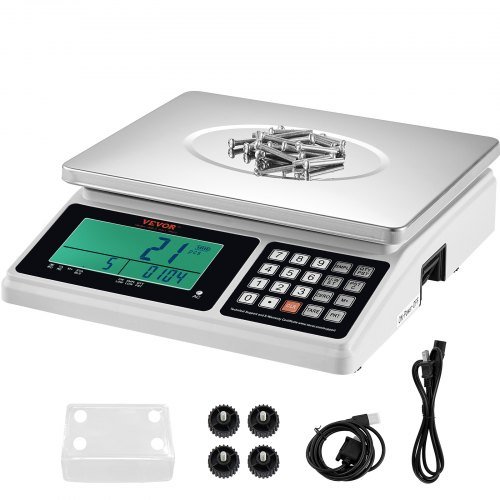
VEVOR Industrial Counting Scale
30 kg capacity with 1 g division. Good for counting larger batches of parts and coins where capacity and simplicity matter.
Overview
The VEVOR Industrial Counting Scale (30 kg x 1 g) is a no-frills digital counting solution designed for people who need to count heavy batches of small items without constant reweighing. With a maximum capacity of 30 kg and a resolution of 1 g, it sits toward the “high capacity, reasonable precision” end of the market. The scale shows weights and counts on a clear LCD screen and includes an RS232 port for connecting to printers or simple legacy systems — useful for basic record-keeping or printouts in a workshop or small retail setting.
This model is built around practical everyday use rather than advanced integrations or laboratory-level accuracy. If your primary need is to process large volumes of fasteners, bulk coins or larger small parts in one go, the 30 kg capacity is a clear advantage. If you’re counting very light components or need sub-gram precision, you should compare this unit with finer-resolution VEVOR models before buying.
Who is this best for?
Think of this VEVOR as a workhorse for environments where quantity and throughput matter more than ultra-fine precision. Typical users who will get the most from it include:
- Workshop and maintenance teams counting fasteners or replacement parts in bulk.
- Small retailers or market traders sorting and counting coins and token-style items.
- Hobbyists and small-scale manufacturers who need to inventory larger batches of components quickly.
- Inventory clerks who need a simple way to produce printed records via RS232 to a basic printer or legacy system.
If your work involves measuring tiny jewellery pieces, pharmaceutical components, or anything where fractions of a gram matter, this model’s 1 g resolution may be a limiting factor — look instead for models with 0.01 g or 0.1 g resolution.
Key features
- 30 kg maximum capacity — designed to handle substantial batches without the need to split into multiple weighs.
- 1 g resolution — provides clear per-piece figures for many common small parts and coins.
- Selectable units (g, kg, lb) — useful if you move between metric and imperial environments or need flexible readouts.
- LCD display — shows weight and count information in an easy-to-read format, which helps in busy or poorly lit workspaces.
- RS232 port — gives a simple way to connect to printers or older inventory systems for printed tickets or basic data capture.
Practical evaluation
Without claiming hands-on testing, we can outline how the features translate into everyday use and what to expect based on the specification.
Capacity versus resolution: The 30 kg capacity is the defining characteristic here — it allows you to place very large batches onto the platform and get an immediate total weight. From that total, the scale calculates piece counts based on the stored unit weight used for counting. For many workshops and coin-counting tasks this is exactly what you need: fewer lifts, quicker throughput and less handling of small components. The 1 g resolution means the smallest increment the scale reports is one gram. For many fasteners and coins this creates per-piece counts that are close enough for inventory, packing and simple retail counting.
Readability and simplicity: The LCD display is a practical choice — clear readouts matter when you’re working quickly and need to avoid misreading counts. The selectable units add a small but genuine convenience: being able to switch between grams, kilograms and pounds avoids manual conversions and makes the scale flexible across different workflows.
Connectivity: The RS232 port is a nod to practicality rather than modern connectivity. Many small businesses still use basic thermal printers or legacy systems that accept RS232 input; the presence of this port means the scale can integrate into those setups without extra software layers. However, it’s important to note that RS232 is an older standard. If you expect to link the scale directly to a modern PC or cloud-based inventory system you may need additional converters, cables or middleware — the product description doesn’t promise included accessories for that purpose.
Portability and power: The supplied material doesn’t specify battery operation, mains adaptor details or portability features. If you need to take the scale to different sites frequently, check the retailer listing for power options and whether a battery or protective transport case is included or available.
Strengths
- High capacity for large batches: 30 kg lets you count large volumes of fasteners or bulk coins in one go, saving time and handling.
- Practical resolution: 1 g resolution is a sensible trade-off for many everyday counting tasks — it gives actionable per-piece counts for common items without the higher costs of laboratory-grade scales.
- Unit flexibility: The option to toggle between g, kg and lb makes the scale suitable for different markets and users.
- RS232 connectivity: The port is handy for pairing with printers or older inventory systems without bespoke software, making it straightforward to create printed records.
- Compared LCD readout: Simple, legible feedback supports fast, error-minimised operation in busy workflows.
Limitations
- Resolution limits very small parts: At 1 g increments the scale won’t give sub-gram accuracy. Very light parts may register poorly or introduce counting error if precise per-piece mass is below the effective sensitivity.
- Less precise at low weights: High-capacity scales frequently trade off low-end precision; counts based on very small reference weights can be less reliable than those from fine-resolution models.
- RS232 is dated: The inclusion of RS232 is useful for some setups but lacks the convenience of USB, Ethernet or Bluetooth for modern PC or cloud integrations. You may need additional adapters or software to use it with newer systems.
- Accessory ambiguity: No clear statement about included cables, printers or software. Buyers should assume you may need to purchase extras for printing or PC integration.
- Unknown power options: There’s no detail provided about battery operation or portability. If you need to use the scale in the field, confirm power options with the retailer.
Pricing and value
The product listing notes that prices vary by retailer and configuration. That’s important: the final value proposition depends on what’s bundled with the scale — power adapters, cables or printers can change the upfront cost significantly. Because the model focuses on capacity and basic connectivity rather than high-resolution measurement or advanced software, its best value shows up where those are priorities: busy workshops, coin-sorting tasks and inventory scenarios that favour throughput over laboratory precision.
When assessing value, consider the total cost of ownership. If you need RS232 connectivity and the scale does not include the necessary printer or cable, add those costs into your comparison. Likewise, if you anticipate needing finer accuracy for very light parts, the cheaper higher-capacity option may become a false economy if you have to buy a second, more precise scale.
Finally, factor in potential maintenance and replacement parts. A practical, robust scale used in an industrial environment will be subject to knocks and dirt. Confirm warranty terms and the retailer’s support options before purchase — the product notes don’t specify warranty details, so this is worth checking.
Alternatives to consider
Within VEVOR’s own product range there are models that prioritise finer resolution or different capacity ranges. If the 30 kg / 1 g balance doesn’t match your needs exactly, look for:
- A VEVOR model with lower maximum capacity and higher resolution (for example 6–15 kg capacity with 0.1 g or 0.01 g resolution) if you need accurate counts of very light parts or jewellery items.
- A smaller-capacity VEVOR counting scale if you only ever process small batches and want better low-end precision.
- Models with modern connectivity (USB, Ethernet or Bluetooth) if you plan to integrate the scale directly with a PC, tablet or cloud inventory system without adapters.
Outside of VEVOR, other brands offer counting scales covering similar capacity ranges but with different software ecosystems, supported printers and warranties. When comparing, weigh up the cost of included accessories, the availability of drivers or support for your operating system, and the vendor’s reputation for after-sales care.
Final verdict
The VEVOR Industrial Counting Scale (30 kg x 1 g) is a straightforward, practical instrument for anyone whose priority is counting large batches of small parts quickly and reliably. Its 30 kg capacity removes the need for repeated weighing of large volumes, while the 1 g resolution is adequate for many common use cases — fasteners, coin sorting and bulk inventory checks. The RS232 port and clear LCD display give sensible, tried-and-tested options for printing and reading results without complexity.
That said, the model is not for everyone. If you need sub-gram precision or expect tight accuracy when working at low weights, look at VEVOR’s finer-resolution models. Also check what accessories are included before buying: RS232 cables, printers and power adaptors may not be supplied and could add to the overall cost. Finally, confirm warranty and support details with the retailer so you know how the purchase will be backed in a workshop environment.
In short: choose this scale if you want a workmanlike, high-capacity counting tool that fits traditional workshop and basic retail setups. If your work calls for finer accuracy, modern connectivity or field portability, review other VEVOR options or competing brands that match those specific requirements.
Note: Offers and prices change — check the current retailer listings for the latest cost, available bundles and warranty terms before buying.
Compare this with the full shortlist
Return to the full comparison guide to see how this product compares against the other shortlisted choices.