
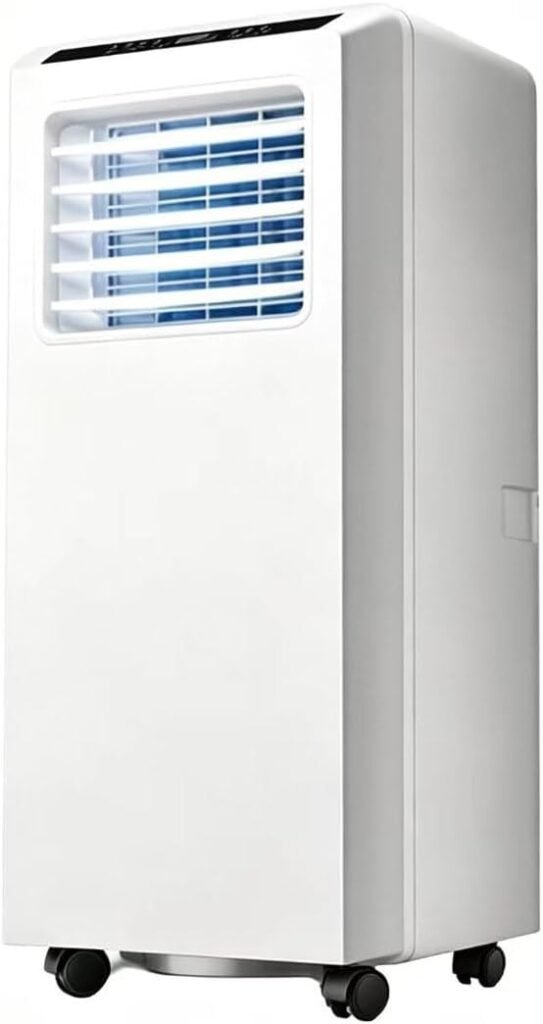
Portable Air Conditioner 9000 BTU with Dehumidifier
9,000 BTU portable AC with three speeds, dehumidifier function, R290 refrigerant and no drainage required; compact and supplied with an exhaust hose and window kit.
Overview
This portable air conditioner — marketed here as Model B — is designed for people who need straightforward cooling without permanent installation. It offers a 9,000 BTU cooling capacity that the manufacturer positions for rooms around 20 m². Alongside standard air‑conditioning it includes a dehumidifier mode, a fan option and a 24‑hour programmable timer. The unit uses R290 refrigerant and promises a no‑drain operation for typical use, while a handheld remote and three fan speeds round out the convenience features.
The pitch is simple: a compact, easy‑to‑move solution for bedrooms, home offices or small living spaces where you don’t want to commit to a fixed system. This review walks through the features, practical benefits and limitations so you can decide whether this kind of portable unit makes sense for your needs.
Who is this best for?
This Model B portable air conditioner is most useful for people in the following situations:
- Renters who cannot fit a window or split system and need a temporary or seasonal cooling option.
- Home‑office users and bedroom occupants seeking targeted cooling for a single room up to around 20 m².
- Anyone wanting a small, moveable unit that also helps reduce humidity — for example in basements, small living rooms or compact flats.
- Those who value simple setup: if you want to avoid drilling, permanent plumbing or a complex installation, a portable unit offers low effort and immediate use.
Conversely, this won’t be the right choice for people needing whole‑house cooling, for larger open‑plan spaces, or for households where low noise and top energy efficiency are priorities. It’s also not aimed at buyers who expect the same airflow control or long‑term running economy as a fixed air‑conditioning system.
Key features
- 9,000 BTU cooling capacity — intended for spaces of roughly 20 m².
- Three operating modes — air‑conditioning, dehumidifier and fan.
- 24‑hour programmable timer — schedule on/off periods to match your routine and save energy.
- Handheld remote control — lets you change settings from across the room.
- Three wind‑speed settings — basic airflow control without a lot of fine adjustment.
- No‑drain operation — designed to run without continuous drainage in typical conditions; may need occasional emptying if humidity is high.
- R290 refrigerant — selected for efficiency characteristics common in newer portable units.
- Compact and portable — easy to move between rooms, suitable for seasonal use and temporary cooling needs.
Practical evaluation
Below I run through how this unit will behave in everyday situations and what to expect from setup, running and maintenance. This isn’t based on hands‑on testing of this specific model but on the product’s stated features and typical behaviour of similar portable air conditioners.
Setup and installation
One of the main advantages of Model B is its simplicity. The unit is designed for plug‑in use and doesn’t require permanent plumbing or structural changes. You’ll typically need to fit the exhaust hose into a window kit (or a suitable vent) to expel hot air. The no‑drain design means you don’t have to attach a continuous drainage pipe in normal conditions; however, in particularly humid climates or during extended operation the internal collection tray may fill and require manual emptying.
Because it’s portable and compact, it’s generally easy to wheel from room to room. Bear in mind that you’ll need access to a window or outlet for the exhaust hose wherever you use it. Also plan where you’ll store the unit and hose in the off‑season, as the kit takes up some space.
Cooling performance and suitability
At 9,000 BTU the unit is sized for small rooms (roughly 20 m²). In a well‑insulated bedroom or office this capacity can provide comfortable cooling for one or two occupants, especially if the room is not exposed to direct sun for long periods. For larger or open‑plan areas you’ll likely find the unit struggles to maintain low temperatures during very hot weather.
Portable air conditioners naturally face limits compared with split systems or fixed units. They typically lose some efficiency due to the exhaust hose and the need to remove warm air from the room. Expect good short‑term relief on warm days, but be realistic about chronic high temperatures or poorly insulated rooms — in those cases a more powerful or permanent solution is usually better.
Dehumidifier and fan modes
The built‑in dehumidifier is useful in damp conditions or during muggy spells when lowering humidity helps perceived comfort as much as reducing actual temperature. Using the dehumidifier can make the room feel fresher and can reduce condensation problems in basements or older homes.
The fan mode is a simple option for circulating air without engaging the compressor. It’s handy for mild evenings or to distribute cooled air more evenly after the unit has run. With only three fan speeds you won’t get very granular airflow control, but the options cover low, medium and high needs in most small rooms.
Controls, timer and remote
The programmable 24‑hour timer is a genuinely practical feature. It lets you switch the unit on or off according to your daily routine — useful for cooling a bedroom before sleep or ensuring the room is comfortable when you return home. The handheld remote adds convenience when the unit is positioned out of reach or behind furniture.
Look out for the usual electronic controls on the unit itself in case the remote gets misplaced. A simple, intuitive control layout is common on these products, and the remote will typically mirror the key functions: mode, temperature, fan speed and timer.
Noise and running costs
Portable air conditioners are noisier than fixed split systems because they combine the compressor and fan in one cabinet inside the room. Expect a noticeable hum while the compressor runs and louder airflow at the higher fan setting. If low noise is essential — for example in nurseries or light sleepers — check noise specifications on retailer listings and consider a quieter split or a larger, quieter portable model.
Running costs depend on how often and at what settings you use the unit, local electricity prices and the climate. R290 refrigerant can be an efficient choice, but portable units still consume a fair amount of power when cooling for extended periods. Using the timer, setting the thermostat sensibly and combining the unit with simple heat‑reduction steps (blinds, curtains, ventilation at cooler times of day) will help control energy use.
Strengths
- Portability — easy to move between rooms, making it ideal for temporary or seasonal use, and for renters who can’t install permanent systems.
- Straightforward setup — no permanent plumbing required and no complex installation; you only need to fit the exhaust hose.
- Dehumidifier function — adds value by improving comfort in muggy conditions and reducing room humidity as well as temperature.
- Convenient scheduling — the 24‑hour timer helps manage run times and avoid wasted energy when cooling isn’t needed.
- Remote control — useful for adjusting settings without getting up, particularly in bedrooms and living rooms.
- Modern refrigerant — R290 offers an efficiency profile commonly preferred in newer portable models.
Limitations
- Room size limits — 9,000 BTU is best suited to small rooms (around 20 m²); it isn’t intended for whole‑house or large open spaces.
- No‑drain not always maintenance‑free — while designed to run without continuous drainage, high humidity can fill the internal tray and require manual emptying.
- Limited fan settings — only three speeds provide less fine control over airflow compared with models offering more levels or variable fan control.
- Noise and efficiency trade‑offs — portable units usually can’t match the quiet operation or running efficiency of fixed split systems.
- R290 handling considerations — R290 is more flammable than some older refrigerants; servicing or repairs may require technicians familiar with R290 systems and appropriate safety procedures.
- Performance in extreme heat — like most portable units, performance will be limited in very hot climates or poorly insulated rooms.
Pricing and value
The exact price and availability vary between retailers, so it’s worth checking current listings before you buy. What to weigh when considering value:
- Initial cost versus usage — if you need cooling only for a few months a year or you move regularly, a portable unit can be more economical than installing a fixed system.
- Running costs — consider the power draw and how long you’ll run the unit each day. Using the timer and moderate thermostat settings will reduce energy consumption.
- Added value features — the dehumidifier, timer and remote increase day‑to‑day convenience and can make the unit feel like better value compared with very basic models.
- Expected lifetime and servicing — factor in potential servicing, especially because R290 systems sometimes require technicians trained to handle that refrigerant safely.
For a buyer who needs a flexible, no‑installation cooling solution for a small room, Model B represents a practical balance of features. If you prioritise silent operation or maximum efficiency across a whole house, a permanent system will usually offer better long‑term value despite higher upfront costs.
Note: offers and prices can change; check current retailer listings for the latest deals and delivery options before buying.
Alternatives to consider
If you’re evaluating cooling options, consider the following alternatives depending on your priorities:
- Larger portable units (higher BTU) — if you have a larger room or an open plan area, a higher‑capacity portable model will provide stronger cooling but will be bulkier and may use more power.
- Window or through‑wall units — these can be more efficient and quieter than portable models, but they require a suitable window or a cut‑out and may not be permitted in some rentals.
- Split systems (wall‑mounted) — more expensive to install but generally quieter, more efficient and better for whole‑house comfort management. Best for long‑term needs in owner‑occupied homes.
- Evaporative coolers (swamp coolers) — suitable in dry climates for energy‑efficient cooling, but less effective where humidity is high.
- Dehumidifiers or fans — if cooling needs are modest, a dedicated dehumidifier or a high‑quality fan combined with thermal blinds might be a lower‑cost option to improve comfort.
Choosing between these depends on the room size, how long you’ll need cooling, your tolerance for noise, and whether you can carry out installation work.
Final verdict
Model B — the Portable Air Conditioner 9,000 BTU with dehumidifier and timer — is a sensible, no‑nonsense option for people who need a compact, movable cooling solution for a small room. Its strengths are clear: simple setup, portability, a useful dehumidifier mode and a convenient 24‑hour timer plus remote control. These features make it particularly attractive to renters, seasonal users and anyone seeking targeted cooling without the bother of installation.
However, the unit has the expected limitations of a portable air conditioner. It’s best suited to rooms up to about 20 m², the no‑drain feature is not a guarantee against occasional manual emptying in humid conditions, and the three fan speeds limit airflow fine‑tuning. Noise and running efficiency remain trade‑offs compared with fixed split systems. Also, owners should be aware that R290, while efficient, is a flammable refrigerant and requires appropriate care if servicing is ever needed.
Overall, if you want an affordable and flexible way to keep a single bedroom, home office or small living room comfortable, Model B offers a balanced set of features at a sensible level of convenience. If your needs are for whole‑home cooling, very quiet operation, or the ultimate in energy efficiency, you’ll likely be better served by a permanently installed split system or a higher‑capacity unit.
Remember to check current prices and retailer details before you buy, as offers and availability can change.
Ready to check Portable Air Conditioner 9000 BTU with Dehumidifier, 20 m² (Model B) | 24H Timer, Remote Control, 3 Wind Speeds, No Drainage Required, R290 Refrigerant?
Check the latest offer before buying, then return to the main comparison if you want to compare it against the other shortlisted options.
Compare this with the full shortlist
Return to the full comparison guide to see how this product compares against the other shortlisted choices.