
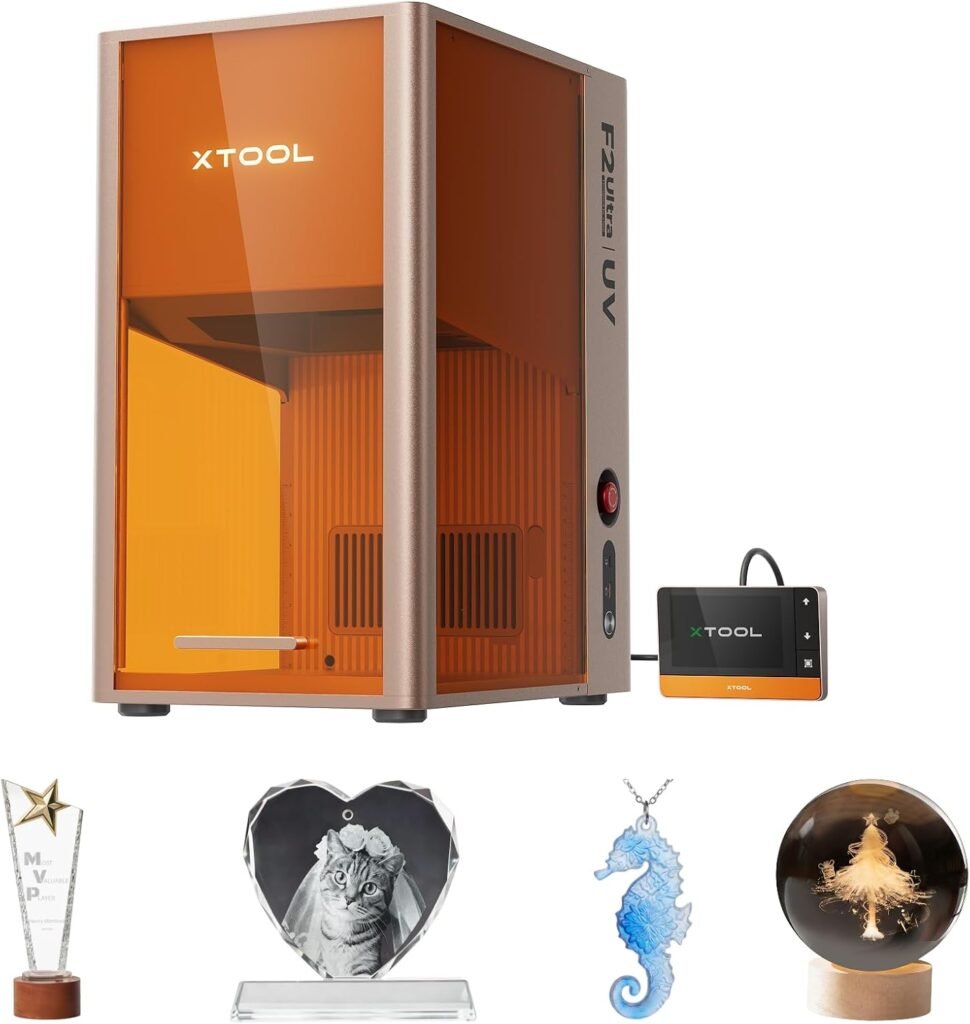
xTool F2 Ultra UV Laser Engraver Only for…
UV-focused system designed for 3D internal glass engraving and fine work on fragile or transparent materials — intended for commercial users.
Overview
The xTool F2 Ultra is a purpose-built machine aimed at professional and commercial engraving workflows. At its heart is a 5W ultraviolet (UV) laser head tuned for fine detail and glass work, backed by dual 48MP cameras and an AI-assisted 2D-to-3D software pipeline that converts flat artwork into depth‑mapped engraving jobs. With a stated top travel speed of up to 15,000 mm/s, the F2 Ultra is positioned to handle higher-throughput workloads while maintaining alignment and repeatability across runs.
This review pulls together the product’s stated features and practical considerations to help you decide whether it suits a small production studio, a bespoke glass business, or another commercial application. I haven’t tested this unit hands‑on in the workshop; the analysis here is based on the manufacturer’s published capabilities and the kinds of workflows those features support.
Who is this best for?
The xTool F2 Ultra is primarily for businesses and professional users who need precision engraved decoration on glass or similarly demanding substrates. Typical use cases include bespoke drinkware, awards and trophies, decorative inner-glass engraving, architectural samples and other commercial products where fine detail and repeatability matter.
If you run a small workshop that fulfils repeat orders, a giftware business requiring complex imagery inside glass, or a production line that benefits from fast job turnaround, the F2 Ultra’s features—high-resolution cameras, a UV laser optimised for detail and AI-assisted software—are aimed squarely at those needs. Conversely, if you’re a casual hobbyist, maker or someone who only engraves occasionally, the F2 Ultra is likely over‑specified and costly for your requirements.
Key features
- 5W ultraviolet (UV) laser head optimised for fine detail and glass engraving.
- AI-assisted 2D-to-3D software workflow to convert flat artwork into depth‑mapped engravings suitable for inner glass effects.
- Dual 48MP cameras for high-resolution job preview, alignment and precise positioning.
- Top stated travel speed up to 15,000 mm/s to support higher production throughput.
- Designed and positioned for professional and commercial use with a focus on precision and repeatability.
Practical evaluation
What stands out about the F2 Ultra is how the hardware and software are presented as a package aimed at solving practical production problems. Dual 48MP cameras make alignment and job previewing much easier than relying on a single low‑resolution camera or on manual positioning, particularly when you need to place detailed artwork relative to printed or etched reference marks on the workpiece. For tasks like engraving complex images into a glass surface where placement is critical, that kind of imaging can save time and reduce costly errors.
The 5W UV laser head indicates the machine is optimised for high‑detail work. UV wavelengths interact with certain substrates differently to infrared lasers; they can produce cleaner, crisper marks on glass and on some specialty materials. This makes the F2 Ultra a sensible choice where inner glass or micro‑detail engraving is the aim. However, UV lasers are less universally compatible than general-purpose diodes: material choice matters. Not all plastics, coatings or substrates will respond well to UV energy, and some materials can produce hazardous fumes when lasered, so you need to verify compatibility before committing to production runs.
Speed matters in a commercial setting, and the stated 15,000 mm/s travel speed is attractive on paper. In practice, the real-world throughput you achieve will depend on the detail level of the artwork, the engraving depth you need, the material, and how well-optimised your workflow is (fixturing, staging, camera alignment and post-processing). Higher top speeds are most beneficial when you’re repeating relatively small, shallow engravings across many parts; for deep or extremely detailed jobs the time savings will be smaller.
Software is another decisive component. The F2 Ultra’s AI-assisted 2D-to-3D workflow aims to convert flat designs into convincing depth-mapped engravings. That can be a major productivity gain if the conversion works reliably and gives predictable results across different image types. AI tools often need tuning and operator oversight to avoid artefacts or unexpected depth interpretations, so factor in a learning curve as you integrate the software into your production chain.
Repeatability and precision are repeatedly emphasised by xTool; for a commercial machine that promise matters more than sheer headline speed. If you rely on consistent placement across multiple jobs or batch production, the combination of imaging, solid mechanics and controlled software workflows will be the deciding factor. That said, for any commercial purchase you should verify details about service, spare parts and authorised repair options in your region — downtime costs money, and the commercial positioning implies those considerations are part of the expected purchasing decision.
Strengths
- High-resolution imaging for accurate alignment: Dual 48MP cameras simplify positioning and visual job verification, reducing setup time for complex or irregular workpieces.
- UV laser tuned for fine detail and glass: A 5W ultraviolet head is well-suited to delicate engraving tasks and inner-glass effects that don’t respond as well to standard infrared diodes.
- AI-assisted 2D-to-3D conversion: The software focus on converting flat artwork into depth-mapped files can speed the production of convincing 3D engravings from 2D designs.
- Production-minded speed: A high top travel speed can translate into better throughput for repeatable, shallow engravings and high-volume work.
- Commercial focus: The feature set is designed for repeatability and precision, which aligns with business needs rather than casual hobby use.
Limitations
- Not designed for hobbyists: The F2 Ultra is positioned at the professional end of the market and may be overkill for occasional or entry-level users.
- Material limitations and safety: UV lasers interact differently with materials and may be unsuitable for some substrates. They can also produce hazardous by-products, so adequate ventilation and safety measures are essential.
- Potential extra costs for commercial readiness: To use this in a business environment you should budget for safe enclosures, fume extraction, fixturing, and possibly authorised service plans—costs not included in the headline product price.
- Service and spares are critical: For production use, local support, spare parts availability and repair turnaround times matter; confirm these before buying.
- Claims vs reality: The 15,000 mm/s figure is a top travel speed — practical engraving times will vary with detail, depth and material. Verify real-world throughput for your specific workload.
Buying considerations and setup guidance
Before purchasing a machine like the xTool F2 Ultra, balance the headline features against the realities of your workflow. Ask your supplier for answers to questions such as: Which specific glass types, coatings and other substrates are supported? What fume extraction and enclosure requirements does the laser demand? Is the AI 2D-to-3D conversion included in the base package or sold as a licence? What training and technical support does the vendor provide for commercial customers?
Plan your workspace. UV lasers require controlled environments: a certified enclosure or interlocks, appropriate extraction and filtration, and clear operational procedures to keep operators safe. If you’re retrofitting the F2 Ultra into an existing shop, factor in the time and expense of installing the right extraction and safety systems. If you’re building a new line, include layout for loading/unloading, part staging and consistent fixturing to make the most of the unit’s precision and camera-assisted alignment.
Think about jigs and fixturing early. Higher engraving speeds and fine detail magnify the effect of any slop in part holding. Investing in repeatable clamps, masks or location pins is a small cost compared with the time and waste saved when parts come out aligned and ready for finishing. For glass engraving in particular, supporting the workpiece properly is important to avoid stress fractures or movement during long jobs.
Finally, consider post-processing. Depending on the effect you want—matte inner‑glass dots, polished contrast or painted fills—you may need additional steps after engraving. Ensure the overall process time and labour per part still make sense for your business model.
Alternatives to consider
When evaluating any single product it’s sensible to consider alternatives that occupy neighbouring market positions. If your needs are strictly hobbyist or prototyping, lower‑power desktop diode lasers or hybrid units may be more cost‑effective and easier to support. If you work primarily with wood, acrylics and softer plastics, an infrared diode or fibre laser could be a better fit.
For other commercial glass‑centric needs, there are machines from specialist suppliers that focus on inner-glass engraving or that offer different laser wavelengths and head configurations. When comparing options look beyond raw power: check camera resolution, software capabilities (especially for converting artwork to depth maps), available accessories such as rotary attachments, and service/support offerings in your country.
Whichever direction you go, insist on demonstrable examples from the vendor showing real work on the same substrates you plan to use, and request references from other commercial users if possible. That will give you greater confidence in how the machine behaves with your specific materials and designs.
Pricing and value
The xTool F2 Ultra sits at the premium end of the market; it’s aimed at commercial buyers rather than hobbyists. The purchase price is only one part of the total cost of ownership. For a commercial engraving setup you should budget for installation, safety enclosures and ventilation, ongoing maintenance, consumables, and potential downtime contingencies.
Value here depends on whether the F2 Ultra’s strengths—high-resolution cameras, UV engraving capability and AI-assisted 3D workflow—translate into faster turnaround, fewer mistakes and higher-quality finished pieces for your operation. If those benefits help you win higher-value work or increase throughput meaningfully, the unit can justify a premium price. If your volume or material mix doesn’t take advantage of these specialisms, a less specialised machine may be a better value.
Because prices, promotions and business purchasing options can change, check the manufacturer’s site or authorised dealers for current costs and any business-oriented packages such as extended warranties or on-site support plans. Ask suppliers to provide a full quote that includes recommended safety and extraction equipment so you can compare total installed costs rather than just the headline price.
Final verdict
The xTool F2 Ultra is a clearly professional tool: it brings together a 5W UV laser, high-resolution dual cameras and AI-powered software to address the specific needs of businesses working with fine glass engraving and detailed substrates. For an operator who needs repeatable placement, precise inner-glass effects and a software pipeline that can turn 2D artwork into convincing 3D engravings, the F2 Ultra’s feature set is compelling.
That said, the benefits are most relevant to commercial users who will fully exploit the machine’s imaging, speed and software capabilities. Hobbyists, casual users or shops that don’t regularly work with glass might find the machine over-specified relative to their needs. Equally important are non‑headline costs: safety infrastructure, ventilation, fixturing and service arrangements are essential parts of a viable production installation and should be factored into any buying decision.
If you’re considering the xTool F2 Ultra, get detailed answers from the vendor about supported materials, safety requirements and local support, and ask to see sample work on your intended substrates. Verify the software licensing terms and whether AI conversion features require ongoing subscriptions. With the right workspace, support and workflows, the F2 Ultra is positioned to be a powerful tool for precision glass engraving and commercial detail work.
Note: Offers and prices can change—check the manufacturer’s site or authorised retailers for current information before buying.
Ready to check xTool F2 Ultra UV Laser Engraver Only for Professionals in Commercial Use, 5W UV Laser, 3D Inner and Fine Glass Engraving, Dual 48MP Cameras, 15,000 mm/s High Speed, AI Powered 2D-to-3D Software?
Check the latest offer before buying, then return to the main comparison if you want to compare it against the other shortlisted options.
Compare this with the full shortlist
Return to the full comparison guide to see how this product compares against the other shortlisted choices.