
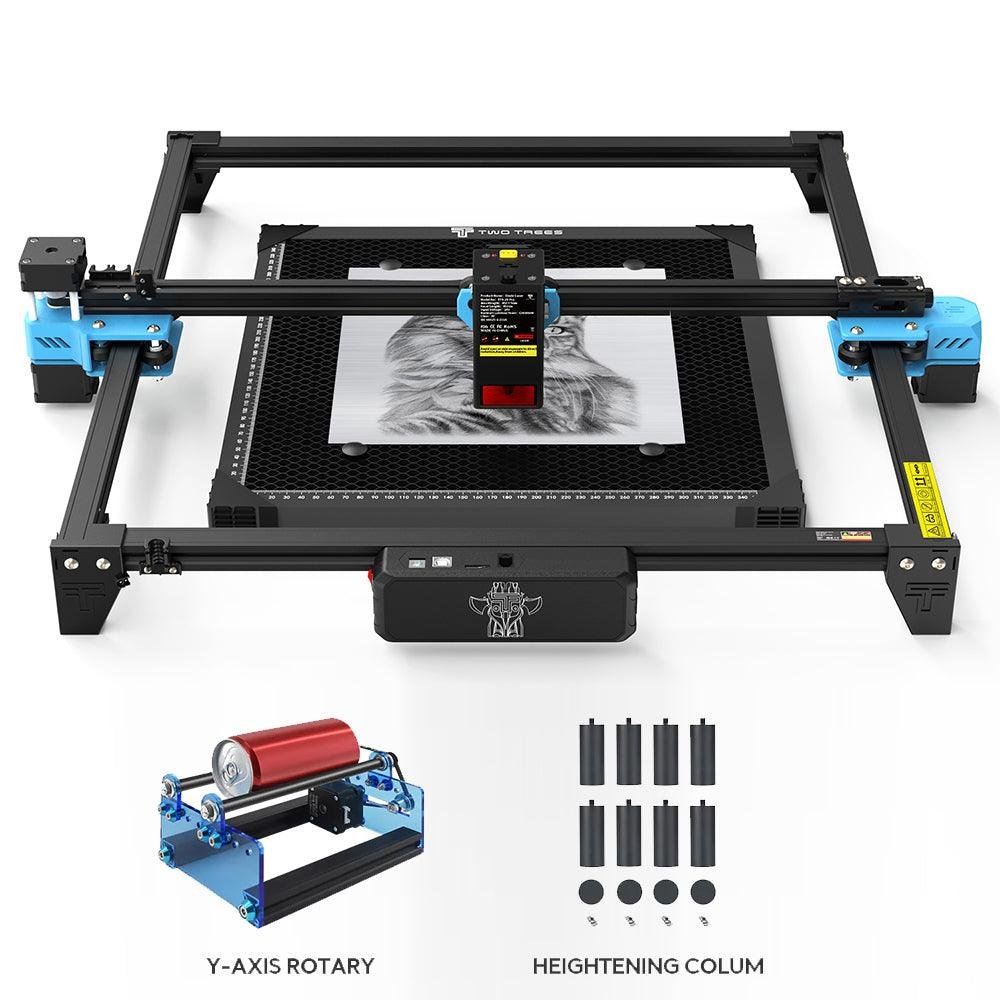
Twotrees TTS-20 Pro 20W Laser Engraver Machine -…
20W diode laser with a 418×418mm bed, faster cutting capacity and support for rotary accessories — suited to larger signs and higher throughput work.
Overview
The Twotrees TTS-20 Pro is a larger, higher‑power variant in Twotrees’ entry‑level line of diode laser engravers. Where compact machines focus on small hobby projects, the TTS‑20 Pro brings a 20W diode, a generous 418×418mm working area and support for rotary attachments — including a Y‑axis rotary — so you can work on cups, tumblers and other cylindrical items. It keeps the same software compatibility as Twotrees’ smaller models (LightBurn and LaserGRBL) and advertises faster engraving speeds and improved cutting capability for common materials such as wood and acrylic.
This review lays out what the TTS‑20 Pro is actually good for, where it makes sense to spend extra compared with smaller, cheaper engravers, and the practical trade-offs to consider before buying one for a workshop or small business.
Who is this best for?
The TTS‑20 Pro is aimed at makers, hobbyists who want to scale up, and small businesses that need more capacity than compact desktop engravers can provide. It’s especially relevant if any of the following apply:
- You regularly work on medium‑sized panels, signage or multiple small items and want a larger bed so you can engrave more in a single run.
- You need stronger cutting power than typical 5–10W diode machines provide, to reduce the number of passes on wood or acrylic and improve throughput.
- You want to add rotary capability for cylindrical objects — the TTS‑20 Pro supports Y‑axis rotary attachments for cups and tumblers.
- You’re running a small workshop or Etsy‑style business where faster job turnaround and the ability to handle larger items matter more than a compact footprint.
It’s not the best fit if you have very limited bench space, if you need the ultra‑fine focal spot of some smaller diode heads for microscopic engraving, or if you require continuous industrial production levels that are better served by larger CO2 or fibre laser systems.
Key features
The TTS‑20 Pro’s headline features are straightforward and geared towards capacity and versatility rather than packing the smallest possible footprint:
- 20W diode laser — more powerful than many entry‑level diodes, intended to give faster engraving and improved cutting on common materials.
- Large 418×418mm working area — broad enough for larger signs, longer panels and small batches of items at once.
- Rotary support including Y‑axis rotary options — designed to let you work on cylindrical objects such as cups and bottles.
- 13 × 0.145mm laser spot — a practical spot size for making visible detail at larger scales (note: slightly larger than some compact machines, which may trade off the tiniest engraving detail for coverage and speed).
- Up to 30,000mm/min engraving speed — a spec aimed at boosting throughput on repeat jobs and larger designs.
- Software compatibility — works with LightBurn and LaserGRBL across common operating systems, keeping workflow options flexible.
Practical evaluation
Because the TTS‑20 Pro is presented as a step up in power and size, its advantages become apparent when you consider how real projects differ from one‑off hobby items. A larger bed means fewer awkward tiling jobs and simpler alignment when engraving panels or batch runs of multiple pieces. With a 418×418mm area you can position several items at once or take on single larger pieces that smaller machines would split into sections.
The 20W diode brings a noticeable change in capability compared with lower‑power diodes. In practical terms, this usually means fewer passes to cut through thin hardwoods, plywood and acrylic, and faster engraving speeds for the same raster detail. That improves throughput for small businesses or makers fulfilling multiple orders. It also reduces heat‑build up per pass, which can help achieve cleaner cuts and edges, although the TTS‑20 Pro is still a diode laser and has limits compared with CO2 cutters for thicker or dense materials.
Rotary support is a genuine plus if you plan to personalise cylindrical items. The availability of a Y‑axis rotary attachment means you can typically automate rotation while the head moves across the object, which is cleaner and easier to align than ad‑hoc manual rotary rigs. For small businesses offering engraved tumblers, cups or bottles, that feature alone extends the range of sellable products substantially without needing a separate specialised rotary engraver.
Workflow is straightforward because the machine is compatible with LightBurn and LaserGRBL — two widely used packages in the maker community. LightBurn, in particular, is a full‑featured, paid option that supports job nesting, power/ speed optimisation and common image processing tools; LaserGRBL is a free alternative for simpler tasks. Being able to use either makes the TTS‑20 Pro flexible for different skill levels and budgets.
That said, the larger diode and bed size bring practical considerations. The machine takes up more bench space and is bulkier to store. Increased power can produce more fumes and debris when cutting certain materials, so a proper extraction fan or ventilation plan is recommended — especially if you intend to run longer cuts or batch jobs. Safety controls, suitable eyewear and material safety knowledge remain essential; the TTS‑20 Pro raises the stakes compared with tiny hobby lasers.
Strengths
- More capable cutting and faster engraving: The 20W diode reduces pass counts and increases throughput compared with lower‑power diodes, making the TTS‑20 Pro a better match for small business workloads.
- Large working area: The 418×418mm bed accommodates bigger items and batch layouts, saving time and simplifying setup for multi‑item jobs.
- Rotary support adds versatility: Y‑axis rotary attachments let you engrave cylinders without complex manual setups, opening up products such as cups and tumblers.
- Software compatibility: Works with LightBurn and LaserGRBL, giving you access to advanced layout, optimisation and image processing tools or a simple free workflow.
- Good middle ground: For makers who have outgrown sub‑10W hobby machines but aren’t ready for a CO2 cutter, the TTS‑20 Pro strikes a pragmatic balance of power, area and cost.
Limitations
- Larger footprint: The machine requires more bench space and room for storage, which may be a problem in tight work areas.
- Higher cost than compact options: The TTS‑20 Pro is positioned as a premium entry‑level 20W option and typically commands a higher price than TTS‑10 variants.
- Diode laser limits: While 20W improves cutting on many materials, diode lasers still lag behind CO2 systems when it comes to thicker materials, certain plastics, and high‑volume industrial cutting.
- Laser spot size: The advertised 13 × 0.145mm spot is slightly larger than the finest diode heads; this can affect the absolute limit of ultra‑fine detail at very small scales.
- Ventilation and safety: Increased power means more fumes and particulates during cutting, so robust extraction and sensible safety measures are essential.
Materials, capabilities and realistic expectations
With a 20W diode you can expect solid results on commonly engraved or cut materials such as soft and some hardwoods, plywood, MDF, leather, and acrylic sheets up to modest thicknesses depending on pass count. Engraving detail for logos, text and artwork is suitable for most commercial and craft applications. However, certain materials — like PVC — should always be avoided because they produce hazardous chlorine gas when lasered; others such as metals will generally require pre‑treatment or an additional laser type (or specialist marking paste) to mark effectively.
It’s important to set realistic expectations: the TTS‑20 Pro improves cutting and speed compared with lower‑power diodes, but it isn’t a drop‑in replacement for a CO2 cutter. For persistent production of thick materials, high‑volume cutting or where edge quality must meet industrial standards, a CO2 machine will still be a better match. The TTS‑20 Pro, though, is well suited to higher‑volume hobby work, prototyping, signage, gifts and personalised products where the balance of cost, size and power matters.
Setup, workflow and software
The TTS‑20 Pro supports both LightBurn and LaserGRBL, which covers a broad range of user needs. LightBurn is feature rich — useful for layout, nesting multiple pieces, and optimising power/speed to reduce runtime — while LaserGRBL is a competent free alternative for simpler jobs. That compatibility makes it easier for users to transfer skills from smaller Twotrees machines or jump into more advanced workflows as needs grow.
From a practical perspective, a few setup considerations matter: ensure you have a stable, adequately large workbench; plan for ventilation and any extraction equipment; and allow some time to dial in focus, power and speed for new materials. The larger bed makes positioning easier, but it also means you should plan jobs to make optimal use of the area — nesting smaller pieces can deliver much better throughput for batch work.
Alternatives and when to consider them
The TTS‑20 Pro sits between compact entry‑level diode engravers and larger CO2 systems. Consider the following alternatives depending on your priorities:
- Compact 5–10W diode engravers — better if you need a lightweight, very small footprint machine and primarily work on tiny items or are price conscious. They won’t cut as well or offer the bed size the TTS‑20 Pro has, but they are easier to store and often cheaper.
- Larger CO2 systems — worth considering if you require frequent cutting of thick materials, very high edge quality, or continuous industrial throughput. These cost more and take more space but suit production environments better.
- Other 20W diode machines from different brands — depending on local availability, warranty, build quality and community support you may find alternatives that trade features such as enclosure, software bundles or accessory kits.
Choosing between staying with a compact diode (like a TTS‑10 variant) and stepping up to the TTS‑20 Pro comes down to the scale of work, materials and space. If you sell engraved gifts or make signage and want to increase batch sizes or handle cups and tumblers without complex workarounds, the TTS‑20 Pro is a pragmatic next step. If your projects are small, occasional or very detail‑focused, a smaller unit may still be the better match.
Pricing and value
The TTS‑20 Pro is positioned as a premium entry‑level 20W option. That means you’re paying more than for compact 10W‑class machines, but you’re gaining a larger working area, greater cutting power and expanded versatility. For small businesses and makers who will make regular use of the larger bed and rotary capabilities, that additional cost can translate directly into time saved and new product opportunities.
Value depends on how you plan to use the machine. If the larger bed and rotary support let you process multiple items in a single job or add new cylindrical product lines, the TTS‑20 Pro can quickly pay for itself through increased productivity. Conversely, if you rarely need the larger surface area or rotary features, the premium may be hard to justify.
Note: prices and offers can change — check current listings and shipping details before making a purchase decision.
Final verdict
The Twotrees TTS‑20 Pro is a sensible and pragmatic upgrade for makers and small businesses that have outgrown compact diode engravers and need a larger working area, stronger cutting capability and rotary support for cylindrical work. It fills a clear niche between small hobby machines and much larger CO2 systems, offering improved throughput, batch capability and the flexibility to expand into personalised drinkware without buying a dedicated rotary unit.
It’s not without trade‑offs: you’ll need more bench space, a bigger budget than smaller models, and sensible ventilation and safety measures when cutting. The 20W diode remains limited compared with CO2 lasers for thick materials and industrial workloads, and the slightly larger laser spot size means absolute ultra‑fine detail work may favour alternative heads.
Overall, if your workshop needs a practical, more capable diode engraver that can handle larger jobs and open up rotary engraving, the TTS‑20 Pro is a strong contender. It offers a balanced set of features for growing makers and small businesses who want a single machine that raises capacity without leaping into the expense and scale of CO2 systems.
Reminder: product offers and prices change — always check the current listing and shipping terms before buying.
Ready to check Twotrees TTS-20 Pro 20W Laser Engraver Machine – US / Y-Axis Rotary / Risers?
Check the latest offer before buying, then return to the main comparison if you want to compare it against the other shortlisted options.
Compare this with the full shortlist
Return to the full comparison guide to see how this product compares against the other shortlisted choices.