
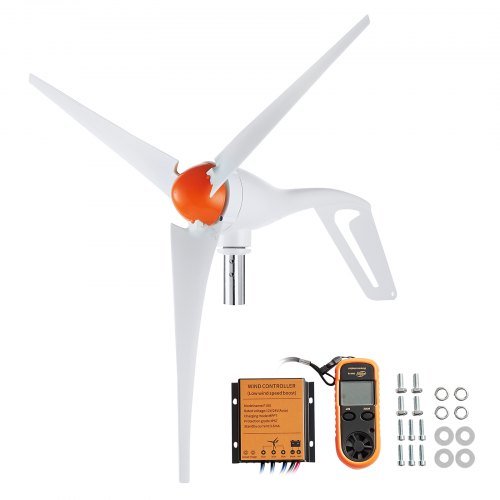
VEVOR 500W Wind Turbine Generator with Anemometer
500W, 12V three-blade turbine with MPPT controller and anemometer; aimed at DIY off-grid installs and mobile use.
Overview
The VEVOR 500W Wind Turbine Kit is a compact wind generator package aimed at DIY renewables users who want to add wind charging to a small off‑grid system. It combines a 1.2m (47in) three‑blade rotor with a 12V alternator and an MPPT controller, and the kit includes an anemometer and basic accessories for assembly. The manufacturer quotes a low start‑up wind speed (about 2.5 m/s) and a rated power figure of 500W under specified conditions; noise and other figures are supplied by the maker.
This is a product to consider if you need a lightweight, transportable option for topping up leisure batteries on a boat or RV, or want a budget entry point for small home or farm battery systems. It is not a plug‑and‑play AC generator: expect to provide a tower or mount, wiring, fusing and a battery management plan to get the most from it.
Who is this best for?
The VEVOR 500W kit suits several user types, provided you understand its limitations and installation demands:
- DIY owners converting a caravan, boat or small cabin who want a compact, DC‑charging wind option to supplement solar.
- Hobbyists and first‑time wind system builders looking for an affordable way to experiment with wind charging before investing in larger turbines or a full hybrid system.
- Small rural properties or outbuildings that need occasional battery top‑up and have modest power demands.
It is less suitable for users who expect continuous, household‑level AC power or who want a fully supported, turnkey installation. The kit charges 12V battery banks directly — no inverter is provided — and the 500W rating is a peak figure that depends on higher wind speeds and ideal siting.
Key features
- 500W rated output (manufacturer‑specified conditions).
- 12V system compatibility — intended for typical leisure/house batteries.
- Three‑blade rotor, 1.2m diameter (47in).
- Included MPPT controller to improve charging efficiency across variable wind speeds.
- Anemometer included for measuring local wind speeds and monitoring site performance.
- Low quoted start‑up speed of approximately 2.5 m/s, helping generation in lighter breezes.
- Manufacturer noise figure stated at around 55 dB on the spec sheet.
Those core elements make the VEVOR kit a straightforward package for DC charging. The inclusion of an MPPT controller and an anemometer are particularly useful in a budget kit — MPPT helps extract more usable energy from fluctuating wind, and the anemometer helps you assess and improve siting.
Practical evaluation
There are a few practical points to weigh before deciding on this kit. First, the 500W label is a rated or peak figure, typically given at a particular wind speed and air density. Real‑world energy production will depend heavily on the local wind regime and how high and unobstructed your mount is. In many suburban and sheltered rural sites, average power will be substantially lower than the rated value.
The kit’s 12V design means it is intended to charge small battery banks directly. That makes it ideal for leisure batteries used on boats, motorhomes and small cabins, but you must plan forward if you expect to run AC appliances. An inverter and suitably sized battery bank will be required for 230V use, and neither is supplied in the kit. Also factor in charge control, battery capacity and the balance between solar and wind if you are combining systems.
Assembly and installation are aimed at a DIY audience. The package contains routine accessories for assembly, but critical elements such as a tower or mast, cable runs, battery fusing and possibly earthing will need to be sourced separately. If you are unfamiliar with electrical safety around battery systems and wind generators, get guidance from a qualified installer or electrician.
The MPPT controller included is a genuine advantage on smaller turbines. Unlike a simple dump controller that diverts excess power, MPPT (maximum power point tracking) adjusts the electrical load to extract more power across a wider range of wind speeds and rotor RPMs. For a turbine with a relatively low start‑up speed, MPPT can make a meaningful difference to usable energy output — especially in variable or lighter winds.
Noise is another practical consideration. The manufacturer lists a noise figure of roughly 55 dB, which is moderate, but actual perceived noise depends on installation height, local topography and nearby buildings. If you plan to install the turbine close to living spaces, test local noise expectations and consider mounting height and orientation to mitigate any disturbance.
Strengths
- Compact and lightweight: The modest rotor diameter and 12V design keep the turbine physically small, which simplifies handling and mounting compared with larger systems.
- MPPT included: Having a maximum power point tracker in the kit increases the likelihood of usable charge in variable winds versus a basic controller.
- Low start‑up speed: The quoted ~2.5 m/s start speed helps the turbine begin producing in lighter breezes that are common in many UK locations.
- Anemometer provided: Including a device to measure wind speed is a useful addition for siting and monitoring performance rather than guessing on conditions.
- Good entry point: The kit represents an affordable way to add wind charging to small systems without buying separate components piecemeal.
Limitations
- Rated power is a peak figure: The 500W specification is manufacturer‑rated and is not the same as continuous output; real energy yield varies with local wind speeds.
- 12V DC only: The kit does not include an inverter, so it will not provide AC power without additional equipment.
- Extra hardware required: Tower/mast, cabling, fusing, possibly earthing and an inverter are not included and add to the cost and complexity of installation.
- Documentation and support: The product is aimed at DIY installers, and manufacturer support may be limited — plan for self‑sourcing parts and troubleshooting.
- Noise and vibration: The quoted noise figure may differ in real installations. Mounting, nearby structures and rotor behaviour can affect perceived sound and vibration.
Pricing and value
The kit is presented as an affordable entry‑level wind charging option for 12V battery systems. The inclusion of an MPPT controller and an anemometer adds tangible value compared with bare motor‑only kits that require separate controllers. For a buyer who needs small, DC charging capabilities and is comfortable installing their own mount and wiring, the package can represent good value.
However, total system cost should be calculated before purchase. You will likely need to buy or reuse a tower or mast, suitable cabling and fuses, and if you want household power you will need an inverter and possibly a larger battery bank. Factor in installation time, any professional labour for electrical work, and the potential need for a concrete foundation or guying for the mast if you plan a permanent install.
Also remember that the 500W figure is conditional. If your local winds are light, the energy return over a year may be modest. Compare the likely annual energy yield from your site (using anemometer readings and local wind data) with the combined costs to assess whether wind alone — or a hybrid with solar — meets your needs.
Alternatives and complementary options
If you want more continuous, household‑level AC power, a larger turbine or a hybrid setup that pairs wind with solar and a battery/inverter system will be more appropriate. Bigger turbines need sturdier towers and more complex electrical protection, but they can deliver higher average outputs where wind is consistently strong.
For users who favour simplicity and low maintenance, a small solar array is often a quieter, lower‑maintenance option if your site has good sun exposure. In many cases, combining a modest solar array with this VEVOR turbine gives better year‑round performance: wind tends to be stronger overnight and in winter, while solar peaks during days and summer months.
If you want a wind kit with integrated AC output, look for systems that include an inverter and more comprehensive charge management. Those are typically more expensive and heavier, but they save on add‑on purchases and can simplify installation if you need 230V appliances.
Practical buying advice
Before you buy, follow these practical steps to avoid surprises:
- Use an anemometer (the kit includes one) to measure local wind speeds at the intended mounting height for several weeks if possible. Short‑term readings can be misleading due to wind gusts and local turbulence.
- Plan the tower: a higher mount generally yields better performance but requires stronger foundations and guying. Consider local planning rules and neighbour impact for height and noise.
- Check battery capacity and management: a wind turbine charges intermittently. Ensure your batteries can accept the charging profile and have appropriate charge control, fusing and, if necessary, diversion loads to prevent overcharging.
- Factor in cabling and electrical safety: wire gauge, fuses and earthing are important for safety and to reduce losses. Long cable runs reduce effective power delivered to batteries.
- Decide on AC needs: if you require household sockets, budget for a suitable inverter and consider whether it can handle peak loads from motors or kettles.
- Read the documentation and warranty terms carefully: know what support the retailer provides and what warranty coverage exists for the alternator, controller and blades.
Final verdict
The VEVOR 500W Wind Turbine Kit is a sensible, budget‑minded option for anyone looking to add small‑scale wind charging to a 12V battery system. Its compact rotor, included MPPT controller and anemometer make it better equipped than a bare motor‑only unit, especially for users who plan to DIY the rest of the installation. The relatively low quoted start‑up speed increases the chance of useful generation in lighter wind conditions common across much of the UK.
That said, buyers need realistic expectations. The 500W rating is a manufacturer peak figure — not continuous output — and real energy yield depends on siting, mast height and local wind availability. The kit does not provide AC power and does not include the tower, cabling or safety components you will need for a complete, reliable system. If you understand those limitations and budget for the extra hardware and possible professional help with electrical work, the VEVOR kit is a practical entry point into small wind generation.
Check local wind data for your site and compare estimated annual energy production against the costs of additional equipment. If you want to experiment with wind charging or top up batteries in an off‑grid leisure system, this kit is a sound starting point. For household‑level power or long‑term reliability in challenging locations, consider larger turbines or a combined wind‑solar approach with a properly sized battery and inverter.
Note: offers and prices can change — check current availability and the retailer page before buying.
Ready to check VEVOR 500W Wind Turbine Generator with Anemometer, 12V Wind Turbine Kit, 3-Blade Wind Power Generator, MPPT Controller & Adjustable Windward Direction, Suitable for Home, Farm, RVs, Boats?
Check the latest offer before buying, then return to the main comparison if you want to compare it against the other shortlisted options.
Compare this with the full shortlist
Return to the full comparison guide to see how this product compares against the other shortlisted choices.