
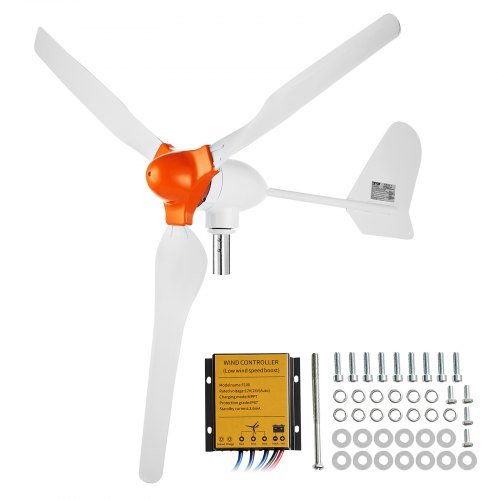
VEVOR 800W Wind Turbine Generator
Higher-rated 800W 12V kit with larger 1.5m rotor — better suited to windier sites or users wanting more peak power.
Overview
The VEVOR 800W Wind Turbine Generator is a higher‑capacity DIY kit aimed at homeowners, smallholdings, RV/boat owners and anyone looking to add wind generation to an off‑grid or hybrid system. At its heart is a 1.5m (59in) three‑blade rotor and a rated peak output of 800W, designed to charge 12V battery banks directly. Unlike smaller hobby turbines, this model includes an MPPT (maximum power point tracking) controller to improve charging efficiency across a wider range of winds and an adjustable yaw mechanism to help the rotor face the wind.
Manufacturer claims include a relatively low start‑up wind speed of about 2.5 m/s and a noise figure in the region of 58dB on the specification sheet. That places this turbine between garden‑scale micro‑turbines and larger domestic machines: big enough to give useful charging in decent winds, but small enough that it remains attainable for competent DIY installers prepared to fit a suitable mast or tower and electrical protection.
Who is this best for?
This turbine suits people who already understand the basics of off‑grid electrics or who are willing to engage a qualified electrician and installer. It’s not a plug‑and‑play solution for tenants or users who cannot secure a robust mounting point.
- Owners of cabins, smallholdings or boats who get steady winds and want a wind complement to an existing solar array.
- DIYers comfortable with tower selection, earthing, overcurrent protection and battery charging systems for 12V banks.
- People seeking a step up from small 100–500W turbines — the larger rotor and 800W peak rating mean faster charging in stronger winds.
- Anyone who needs a complete kit that already includes an MPPT charge controller for better charging performance.
If you live in an exposed, consistently windy location — coastal properties, hilltops or farmland — the VEVOR 800W can be a practical choice. If your site is sheltered with low average winds, a smaller turbine or a different approach (larger turbine on a taller tower, or prioritising solar) may be more sensible.
Key features
- Rated power: 800W peak output (manufacturer rating).
- System voltage: 12V — designed for direct battery charging.
- Rotor diameter: 1.5m (59in) — larger swept area than many micro wind turbines.
- MPPT controller included: improves charge efficiency and helps harvest more energy across variable winds.
- Start‑up wind speed: approximately 2.5 m/s — relatively low, so it should begin generating in modest breezes.
- Adjustable windward direction (yaw): helps the rotor track wind direction and maintain better alignment.
- Manufacturer noise figure: around 58dB on the spec sheet — noticeable but not industrial level.
Practical evaluation
Because this review relies on the manufacturer’s specification and typical buyer experience rather than hands‑on testing, practical evaluation here focuses on realistic expectations, installation considerations and how the turbine is likely to perform in common scenarios.
Output and real energy yield: the 800W figure is a peak, not a continuous guarantee. Actual energy produced depends heavily on site wind speed distribution, tower height and local turbulence. The larger 1.5m rotor raises the swept area compared with smaller models, which means it can capture more energy when the wind picks up — but only if the rotor is positioned in reasonably clean wind. In practice a well‑sited installation in an exposed location will return useful charge to a 12V battery bank and will charge faster than smaller turbines during stronger winds. If you live in a low‑wind valley or behind tall buildings and trees, yields will be much lower.
MPPT controller advantages: including an MPPT charge controller is a significant practical benefit. MPPT maximises the turbine’s power delivery by matching the turbine’s operating point to the battery voltage, especially as wind speed varies. This helps you get more usable charge into the batteries than a basic regulator would, reducing wasted energy and prolonging useful charging in marginal winds. For a 12V system, that can make the difference between the turbine topping up a battery bank and it being effectively idle for long periods.
Noise and neighbours: the spec sheet lists manufacturer noise at roughly 58dB. That’s not silent — comparable to background conversation in a small room — and may be noticeable near living spaces, particularly at night or in still conditions where the turbine may be one of the few noise sources. If you have close neighbours or sensitive occupants, check local planning rules and position the mast so noise and shadowing aren’t a nuisance.
Mounting and tower needs: at this power and rotor size the turbine is heavier and exerts more dynamic loads than smaller micro turbines. Expect to invest in a proper mast or tower rated for the turbine’s weight, wind load and expected gusts. Guyed masts can be a cost‑effective choice for open sites; freestanding towers need stronger foundations and usually professional installation. The kit doesn’t include an inverter or full AC system; if you want household mains supply you will need a suitable inverter and correctly configured battery/inverter system.
Electrical safety and compliance: installation will require appropriate fusing, earthing and a correct battery charging setup. It’s sensible to involve an installer or electrician to confirm cable sizing, overcurrent protection and safe connections between turbine, MPPT controller and battery bank. The MPPT controller simplifies charge management but does not remove legal and safety obligations — check local regulations and warranty terms.
Strengths
- Higher peak output: With an 800W rating the turbine can charge batteries more quickly in suitable winds than smaller hobby models.
- Larger rotor: The 1.5m diameter increases swept area and energy capture when winds are adequate.
- MPPT controller included: Improves charging efficiency and helps deliver more usable energy across variable winds.
- Adjustable yaw: Helps keep the rotor facing the wind, improving energy capture without complex electronics.
- Complete kit approach: Aimed at DIY assembly, so you get the main turbine and controller together rather than sourcing parts separately.
- Suitable as a solar complement: Wind commonly peaks at different times to solar, so this can extend daily and seasonal generation when used alongside PV.
Limitations
- Peak versus average output: 800W is a peak specification; average energy depends on wind distribution and tower height.
- Heavier and bulkier: Requires a sturdier mount and stronger foundations than smaller turbines, adding to overall project cost.
- Noise: Manufacturer noise figures are higher than some smaller models and could be noticeable close to living spaces.
- No inverter included: The kit is for 12V battery charging only; you’ll need to provide an inverter and AC distribution if you want mains power.
- Installation extras: Safety hardware, earthing, cabling and tower installation are not included and add cost and complexity.
- Warranty and aftercare: These vary by seller. Check the retailer’s support terms before purchase.
Pricing and value
The guide price listed alongside the product information was USD 177.90 — check the retailer for the latest price and stock. At that sort of price point the VEVOR 800W offers strong upfront value compared with buying turbine and controller separately, particularly since the MPPT controller is included. However, the headline cost is only part of the picture.
To turn this turbine into a functioning generation system you’ll usually need a suitable mast or tower (and installation labour if you’re not doing it yourself), appropriate cabling and safety components, an inverter if you want AC output, and a battery bank sized to accept the turbine’s output. Those items add materially to total project cost. If you already have a battery bank and some balance‑of‑system parts in place, the kit becomes more attractive. For buyers starting from scratch, budget for the full system rather than the turbine alone.
Value also depends on site suitability. In a consistently windy location the higher rotor and MPPT controller can deliver a clear return in terms of energy produced. In a low‑wind urban garden the same money might be better spent on a larger solar array or on a turbine with a taller mounting solution. Think of the 800W kit as a component in a system — its value comes from how well it matches your wind resource, tower capacity and battery system.
Alternatives and complementary options
If you’re evaluating this turbine as one option among several, consider the following practical alternatives and complements rather than specific competing models.
- Smaller turbines (e.g. 500W class): Easier to mount and usually quieter. Better for constrained gardens or lower budgets, but they produce less energy in strong winds.
- Higher‑tower installations: A smaller turbine on a taller tower may outperform a larger turbine mounted low in a turbulent site. Tower height often matters more than rotor size for average yield.
- Systems with integrated inverter/charger: If you want AC output without sourcing extra kit, look at packages that include inverters or hybrid charge controllers designed for wind+solar.
- Solar PV complement: Wind and solar generate at different times; combining them can smooth daily and seasonal generation and reduce battery cycling.
- Professional installation: For peace of mind, particularly with heavier turbines, a certified installer can specify a safe tower, perform correct earthing and ensure cable sizing and protections are compliant.
Choosing between these depends on your site, budget and technical comfort. If you already have a 12V battery bank and a place to mount a sturdy mast, the VEVOR 800W steers you toward faster charging without hunting for a separate MPPT controller.
Final verdict
The VEVOR 800W Wind Turbine Generator is a sensible mid‑range kit for owners who have decent wind at their site and the ability to mount the turbine correctly. Its 1.5m rotor and 800W peak output put it above micro‑turbines in terms of potential energy yield, and the included MPPT controller is a practical advantage that improves charging efficiency for a 12V system.
That said, the turbine is not a magic bullet. Real‑world output depends mainly on wind resource and tower height. The machine requires a sturdier mount than smaller units, and installation costs and safety obligations are significant factors in the overall project. Noise is modestly higher than smaller models and the kit does not include an inverter for AC power.
If you have a windy location, an existing battery system or are willing to invest in the right tower and electrical work, the VEVOR 800W represents good value for a do‑it‑yourself turbine that includes MPPT functionality. If your site is sheltered or you need a turnkey AC solution, consider alternatives such as different turbine sizes, taller towers or combined inverter/charger systems.
Note: product offers and prices change — always check the retailer page for the latest price, stock status and warranty details before buying.
Ready to check VEVOR 800W Wind Turbine Generator, 12V Wind Turbine Kit, 3-Blade Wind Power Generator with MPPT Controller, Adjustable Windward Direction & 2.5m/s Start Wind Speed, Suitable for Home, Farm, RVs, Boats?
Check the latest offer before buying, then return to the main comparison if you want to compare it against the other shortlisted options.
Compare this with the full shortlist
Return to the full comparison guide to see how this product compares against the other shortlisted choices.