
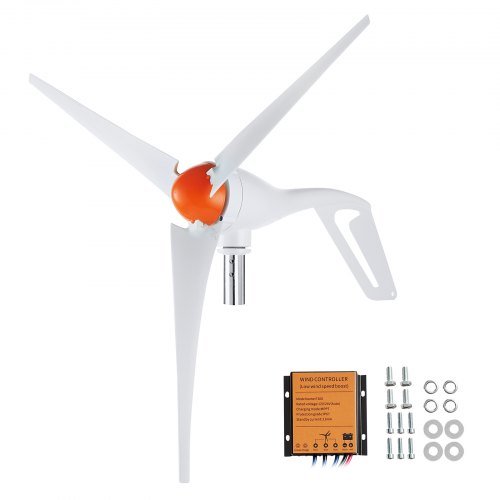
VEVOR 500W Wind Turbine Generator
500W turbine configured for 24V systems; three-blade rotor and MPPT controller make it suitable for medium-sized battery banks.
Overview
The VEVOR 500W Wind Turbine Kit in its 24V form is a compact, entry-level turbine aimed at DIY off-grid projects: small homes, farms, caravans, boats and remote battery banks. The package centres on a 1.2m (about 47in) three‑blade rotor, an MPPT (maximum power point tracking) controller, and a genhead designed to start in relatively light wind (manufacturer lists a start‑up wind speed of around 2.5 m/s). The 24V system voltage is the key distinction from the 12V variant — it lowers current at the same power levels, which can reduce cable losses and allow smaller conductor sizes on longer cable runs from the tower to the battery bank.
Rated at a manufacturer peak of 500W, this is clearly a small turbine: it won’t replace mains power or cover large household loads by itself. What it can do is contribute useful energy to a modest off‑grid setup or hybrid system when paired with batteries and an inverter. The inclusion of an MPPT controller is a welcome feature for this class of turbine because it helps extract more energy across a range of wind speeds than a simple fixed‑voltage charge controller.
Who is this best for?
This kit is aimed at DIYers and budget‑conscious buyers who already have some familiarity with small renewable systems or who are prepared to learn. Typical use cases include topping up a 24V battery bank on a small off‑grid cabin, supporting lighting and small appliances in a workshop, or adding renewable charging capacity to an RV, boat or farm outbuilding.
The 24V configuration makes it particularly suitable where a 24V battery bank or 24V inverter/charge controller is already in place. If you’re planning a system with a long cable run between turbine base and batteries, the reduced current at 24V helps reduce voltage drop and can let you use thinner, less expensive cables compared with a 12V setup for the same wattage.
It’s not a plug‑and‑play whole‑house solution. Buyers who want guaranteed nightly autonomy for a family home, or who expect significant AC output without a properly sized inverter and battery bank, should consider larger systems or professional design and installation.
Key features
- Rated power: manufacturer peak rating 500W (note: peak rating, not guaranteed continuous output).
- System voltage: 24V — designed for 24V battery banks to reduce current and cable losses.
- Rotor: three blades, 1.2m (approx. 47in) diameter — compact and lighter mounting requirements.
- MPPT controller included — helps optimise charging performance across changing wind conditions.
- Start‑up wind speed: around 2.5 m/s — relatively low for capturing light winds.
- Adjustable windward direction — allows alignment to prevailing winds during installation.
- Manufacturer noise figure given at roughly 55dB on the spec sheet — typical for small turbines at moderate speeds.
Practical evaluation
There are two practical factors that matter most when evaluating a small turbine like this: the electrical system integration and the site/tower choice. The VEVOR package comes with the genhead, blades and MPPT controller, but buyers should not assume it includes everything needed to produce usable AC power to their home.
Electrical integration: The turbine is a DC charging source that feeds a 24V battery bank. To run household AC appliances you’ll need a correctly sized inverter and a suitable battery bank with enough capacity and management (fuses, battery monitoring, isolation). The MPPT controller supplied will help the turbine deliver more consistent charging, but you still must ensure the controller, wiring and fuses are rated for 24V operation. If you already have a 24V inverter or charge controller, this turbine will be easier to add to your system — if not, factor in the additional hardware and cost.
Site and mounting: The compact 1.2m rotor means the turbine is lighter and easier to mount than larger machines, but small turbines are also more sensitive to local turbulence from buildings and trees. To get meaningful energy, it needs a reasonably clear wind exposure and a mast or tower tall enough to be above local obstructions. Mast, foundation and installation hardware are usually not included in these kits and are additional costs. If you plan a long cable run from the tower to a remote battery bank, the 24V model’s lower current helps reduce conductor size and cost — a real advantage for rural sites.
Noise and neighbours: The manufacturer lists a noise figure of roughly 55dB. In practice, small turbines can be noticeable at close range, especially in still conditions. If you have nearby neighbours or will place the turbine close to living areas, consider the likely noise at typical wind speeds and check local planning rules, which can vary widely.
Durability and support: Retail packages like this are targeted at hobbyists and small off‑grid users, and the level of installation guidance or aftercare can be limited compared with branded, fully installed systems. If you’re not comfortable with mechanical assembly, wiring DC systems or commissioning a turbine, consider engaging an installer or at least confirming the scope of support from the seller before purchase.
Strengths
- 24V configuration reduces current for the same power output, which is helpful on longer cable runs and with existing 24V systems.
- MPPT controller included — improves charging efficiency and helps extract more energy across varying wind speeds than a fixed controller.
- Low start‑up speed (around 2.5 m/s) — better at capturing light winds than some small turbines that need stronger gusts to begin charging.
- Compact rotor and three‑blade design keep the unit relatively light and easier to mount compared with larger turbines.
- Affordable entry‑point guide price compared with larger turbines, making it accessible for DIYers or supplementary charging.
Limitations
- 500W is a peak manufacturer rating — real average output will be lower and depends entirely on local wind conditions, tower height and system losses.
- Kit does not include tower, foundations or all installation hardware; these are additional costs and require some planning and possibly permissions.
- No AC output — you’ll need a battery bank and inverter to run household appliances, and the turbine doesn’t replace those components.
- Support and installation guidance from online retailers can be limited; buyers should be confident with mechanical assembly and DC electrical systems or be ready to hire help.
- Check compatibility with existing charge controllers/inverters — although an MPPT controller is included, you must ensure the rest of your system supports 24V inputs and appropriate charging profiles.
Pricing and value
The VEVOR 500W (24V) kit is offered at an entry‑level guide price. For buyers on a modest budget who need a 24V charging source and a compact turbine, it represents a cost‑effective way to add wind charging to a small system. However, total installed cost will be notably higher once you add a mast or tower, cabling and connectors, battery bank (or integration into an existing one), and possibly an inverter for AC loads.
Value depends strongly on how much wind your site receives and whether you can make use of the 24V configuration. If you already run a 24V battery system, the turbine can be a comparatively inexpensive add‑on. If you need to build a 24V battery and inverter from scratch, compare the combined cost of that infrastructure plus this turbine with alternative renewable sources (such as solar PV panels) or larger turbines that may have better energy yield for the same installed cost.
Also factor in non‑monetary costs such as time for assembly and ongoing maintenance. Small turbines require periodic checks, blade inspections and attention to electrical connections — something to budget into long‑term ownership.
Alternatives to consider
If you’re unsure whether a 24V 500W turbine is the right fit, consider the following alternatives and how they match your priorities:
- A 12V variant of this same 500W kit — if your system is 12V and you don’t want to reconfigure to 24V, the 12V model avoids extra conversion equipment, though it will draw higher current for the same power and may need thicker cables.
- Larger turbines (such as 800W models) — higher rated power can offer better energy capture in windier sites, but they are heavier, need stronger towers and cost more; evaluate whether the increased yield outweighs the extra installation complexity and cost for your site.
- Solar PV panels — in many small off‑grid installations, a modest solar array combined with batteries and a small wind turbine can be a more balanced hybrid solution, smoothing generation through day/night cycles and seasonal variation.
- Professionally installed micro‑turbine systems — if you want guaranteed performance and a warranty, a locally installed system from a specialist will cost more upfront but reduce the installation and commissioning risk compared with a DIY kit.
Final verdict
The VEVOR 500W Wind Turbine (24V) is a practical, budget‑oriented option for DIY renewables projects where a compact turbine and a 24V battery system are desirable. Its strengths are sensible for its class: a modest rotor that is easier to mount, an included MPPT controller that improves charging efficiency, and a 24V configuration that helps reduce cable sizes and losses on longer runs. The relatively low start‑up wind speed is also an advantage for capturing light breezes.
That said, prospective buyers should be realistic about what a 500W peak rating means in practice. This is not a replacement for mains power and won’t reliably run high‑draw household appliances without a properly sized battery bank and inverter. Installation hardware, tower and wiring are additional costs, and the retailer’s support may be limited compared with full professional suppliers. Noise and local planning requirements are practical considerations too — small turbines still produce audible noise at close range and may need permission in some areas.
If you already run a 24V system or need an affordable way to add wind charging to a small off‑grid setup, this kit is a sensible starter option. If you need higher sustained output, prefer a turnkey installation, or lack confidence with DC systems, a larger professionally supplied turbine or alternative renewable options may be a better long‑term fit.
Note: offers and prices can change — check the retailer listing for the latest price and stock before buying.
Ready to check VEVOR 500W Wind Turbine Generator, 24V Wind Turbine Kit, 3-Blade Wind Power Generator with MPPT Controller, Adjustable Windward Direction & 2.5m/s Start Wind Speed, Suitable for Home, Farm, RVs, Boats?
Check the latest offer before buying, then return to the main comparison if you want to compare it against the other shortlisted options.
Compare this with the full shortlist
Return to the full comparison guide to see how this product compares against the other shortlisted choices.