
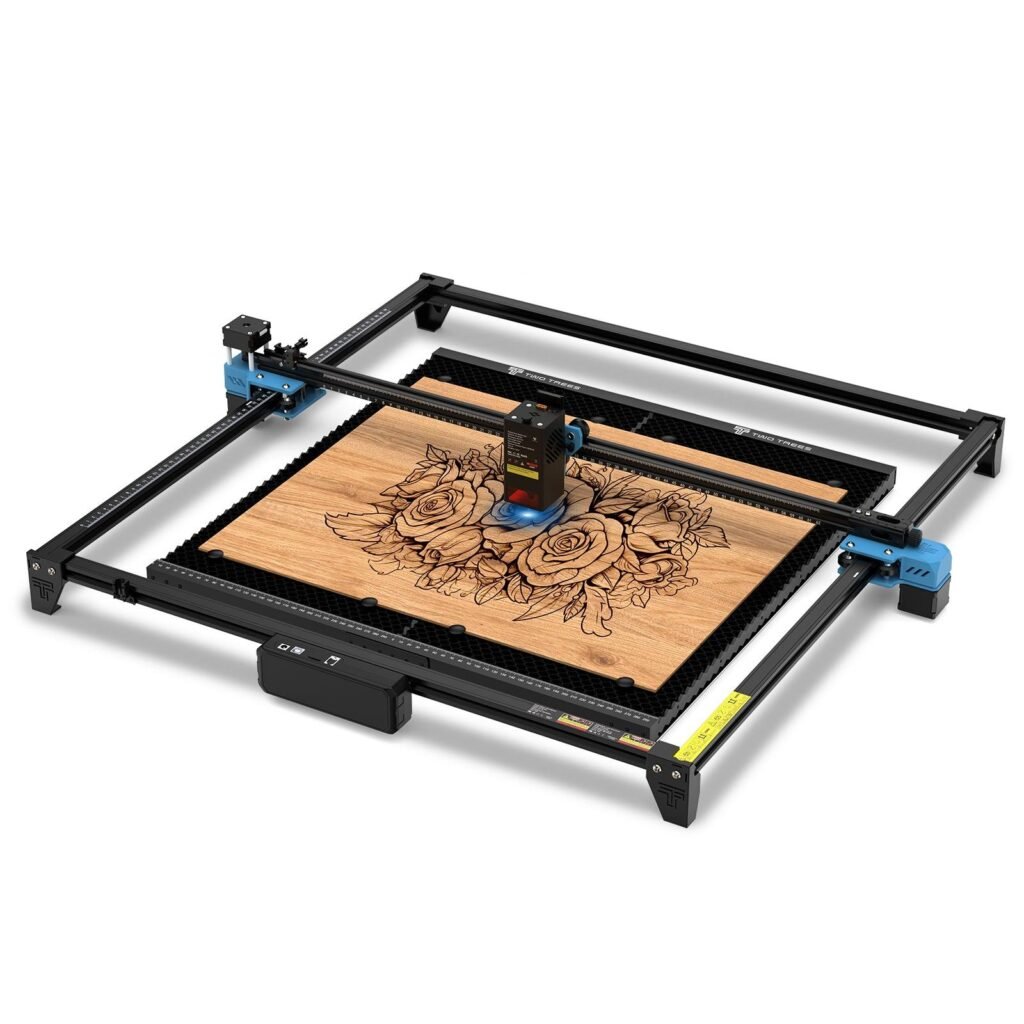
Twotrees TTS-20 Max Laser Engraver – UK
20W diode model with a large working area and a high‑speed motion system for batch work.
Overview
The TwoTrees TTS‑20 Max is a desktop diode laser engraver that aims to balance a larger working area with a 20W output and a faster motion system. Rather than chasing raw laser power, TwoTrees has positioned this model around throughput and usable workspace: the frame is sized for bigger pieces, the mechanics are stiffened to tolerate higher speeds, and the open‑frame layout makes it straightforward to position odd‑shaped items or longer parts.
This is a machine designed for hobbyists stepping up into serious maker work, through to small businesses that need reliable repeatability for batches of wood, acrylic and leather parts. It’s important to be clear about what a 20W diode laser can and can’t do: it’s effective for surface engraving and for cutting thinner materials, but it won’t match higher‑power CO2 or fibre lasers for deep cutting or very thick materials. The TTS‑20 Max therefore should be considered in the context of workflow and material choices where bed size and speed matter more than brute force.
Who is this best for?
Think of the TTS‑20 Max as a production‑aware desktop engraver. It’s best suited to:
- Makers and hobbyists who regularly work with larger pieces — cabinet doors, longer panels, signage, or several items laid out for batch engraving.
- Small business owners who need quicker turnaround on repetitive engraving or light cutting tasks for wood, acrylic, leather and similar materials.
- Workshops that already understand laser safety and extraction and want an open, accessible bed for awkward shapes rather than a sealed, compact unit.
It is less suitable for people who need deep cutting on thick stock (for example, thick hardwoods or several millimetres of thick acrylic) or who prioritise a fully enclosed laser for safety and odour control right out of the box. Likewise, if your priority is ultra‑fine micro‑engraving detail rather than speed and size, there are specialist units that will serve that need better.
Key features
Below are the features that define the TTS‑20 Max and what they mean in practice:
- 20W diode laser — Advertised as a 20W diode, this is a common power class for desktop diode lasers. It’s capable of cutting and engraving common hobbyist materials: plywood, MDF, acrylic, leather, cardboard and some plastics. As with all diode lasers, cutting depth and speed are limited compared with higher‑power systems.
- Large working area — The machine’s bed is larger than typical compact hobby engravers. That extra space makes it practical to engrave longer items or to arrange multiple smaller pieces for batch runs without precise repositioning.
- High‑speed motion system — Upgraded motion hardware and a stiffer frame are used to reduce vibration and allow faster passes. This improves throughput for repetitive jobs and helps maintain consistent engraving quality at higher speeds.
- Open‑frame design — An unsealed bed makes it easy to place oddly shaped objects, insert tall items, or use the machine with external accessories such as rotary devices (where supported). The trade‑off is that you need to manage extraction and safety yourself.
- Material suitability — Designed primarily with woodworking, acrylic cutting and leather work in mind. It’s a practical choice for makers producing signs, inlays, personalised items and small production runs.
Practical evaluation
Because this review relies on verified product facts rather than first‑hand testing, focus is placed on the real world implications of those facts. The TTS‑20 Max’s large bed and faster mechanics are the most useful aspects for anyone thinking about workflow.
Large bed: If you regularly work with items that exceed the beds of smaller hobby machines, the TTS‑20 Max avoids the need to split designs into panels or to faff with repositioning on multiple passes. That saves both setup time and the risk of alignment errors, particularly when doing batch engraving — you can lay out multiple identical items, register them once and run the job repeatedly.
High speed motion and a stiffer frame: Faster travel and better rigidity reduce vibration and motion artefacts that commonly degrade engraving quality at higher feed rates. For repetitive production work this is valuable: it allows you to trade speed for a modest drop in per‑item time without losing legibility or pattern fidelity. That said, precision at very small scales (micro‑engraving) depends more on laser spot size and focus characteristics than on motion alone; the TTS‑20 Max is optimised for larger format throughput rather than microscopic detail.
Open‑frame layout: Accessibility is a real-world convenience. Placing a finished wooden plank or an irregular leather shape is much easier than with a boxed chamber. The downside is obvious: fumes, particulates and reflections require a proper extraction setup and safe working practice. TwoTrees’ open approach makes the unit flexible, but you should budget for an extractor and appropriate PPE if you plan to run regular cutting jobs.
Material handling and cut depth: A 20W diode works well for engraving and cutting thin sheets — think thin plywood, veneer, craft acrylic and leather. If your projects include thick hardwoods, dense plastics or deep kerf cuts, expect slower passes, multiple passes for full depth, or the need for a higher‑power CO2 system. In short, choose the TTS‑20 Max when bed size and speed matter within the material limits of a diode laser.
Strengths
- Workspace suited to larger items and batch production — A genuinely larger bed reduces setups and helps with repeatable positioning, which is especially helpful for small business workflows.
- Faster throughput — The high‑speed motion system and stiffer frame let you run jobs quicker without as much vibration artefact, improving productivity.
- Open access — Easier to use with odd‑shaped items and external accessories. This can be a practical advantage in a busy workshop where you materialise prototypes and finished parts of varying sizes.
- Versatile for typical maker materials — Good match for wood, acrylic, leather and similar materials used in signage, small furniture accents, personalised gifts and light production work.
Limitations
- Power ceiling — At 20W, the laser is capable but not class‑leading for depth of cut. If you need thick material cutting or heavy‑duty fabrication, a higher‑power CO2 or fibre laser will be necessary.
- Open‑frame safety and extraction — The lack of enclosure makes it essential to invest in appropriate extraction and to observe laser safety procedures. The unit is not a turnkey enclosed solution for odour and fume control.
- Accessory verification — Some buyers target add‑ons such as rotary attachments or enclosures; these may be available as accessories or bundles, but you should verify the exact options and compatibility on the retailer’s page before buying.
- Not tailored for micro‑engraving — If your priority is ultra‑fine detail at microscopic scales, there are specialised systems better optimised for that task.
Pricing and value
The TTS‑20 Max occupies a middle ground in the hobby‑and‑small business market: it costs more than compact 5–10W hobby engravers but less than high‑power sealed CO2 machines. The guide price listed with the product is an indicator rather than a fixed amount — retailers frequently adjust pricing, and there may be different bundles that include useful extras such as rotary jigs or riser kits.
Value should be judged against what you need for your workflow. If you routinely handle long or multiple items and need improved throughput, the larger bed and higher‑speed motion translate directly into time saved. That can make the purchase economical for small businesses when contrasted with the time cost of subdividing jobs on smaller machines. Conversely, if you rarely work above smaller bed sizes, you might find similar capability at lower cost from compact models.
Budget for extras: Because the unit is open‑frame, you should factor in an extraction/fume management solution and, depending on your usage, safety enclosures or shields. If you plan to use a rotary attachment, confirm compatibility and whether the accessory is included in the retailer bundle or sold separately. These add‑ons add to the total cost of ownership and are important for safe, productive use.
Note: offers and prices can change. Check the retailer’s page for the latest price, availability and bundle options before you buy.
Alternatives worth considering
While this review focuses on the TTS‑20 Max, similar projects or budgets might lead you to consider a few alternative directions:
- Lower‑cost compact diode engravers — If your projects are mainly small and you don’t need the larger bed, compact 10W or 15W units will be cheaper and still capable of most engraving tasks. They’re a sensible option for hobbyists with limited space.
- Higher‑power CO2 desktop systems — For deeper cuts in thicker wood, acrylic or for faster thick‑material production, a CO2 laser with higher wattage will outperform a 20W diode. CO2 machines are, however, usually more expensive and often larger.
- Sealed‑chamber diode or hybrid units — If enclosure, odour control and safety are top priorities, look for models that include a sealed cabinet or integrated extraction. These reduce setup time for compliant workshop operation at the expense of some accessibility for odd‑shaped items.
- Rotary‑ready packages — If you plan to do many cylindrical items (bottles, cups), seek machines with a verified rotary attachment in the bundle. Confirm compatibility and whether calibration tools are included.
Choosing between these alternatives comes back to the balance of bed size, cut depth and workflow. The TTS‑20 Max sits neatly for users who want a bigger bed and faster throughput but who accept the material limitations of a diode laser.
Final verdict
The TwoTrees TTS‑20 Max is a pragmatic choice for makers and small businesses that need a larger working area and higher throughput without stepping up to a much more expensive CO2 system. Its strengths are clear: a larger bed that simplifies layout and batch runs, a stiffer frame and upgraded motion hardware that together support faster jobs, and an open frame that makes positioning flexible and straightforward.
Those advantages come with trade‑offs. The 20W diode limits cutting depth versus higher‑power lasers, and the open‑frame design requires you to manage extraction and laser safety yourself. Buyers should therefore plan for an extractor and any necessary accessories such as rotary devices or enclosures and check the retailer for available bundles. If you need deep cuts in thick materials or an enclosed turnkey solution, a different machine type will be a better fit.
Overall, if your projects are primarily wood, acrylic and leather work where bed size and faster turnaround matter, the TTS‑20 Max is a well‑targeted option. It’s a sensible upgrade for a maker moving toward small‑scale production, or for a workshop that values accessibility and speed in a desktop format. Just be sure to verify bundle options and budget for extraction and safety equipment before you buy.
Ready to check Twotrees TTS-20 Max Laser Engraver – UK?
Check the latest offer before buying, then return to the main comparison if you want to compare it against the other shortlisted options.
Compare this with the full shortlist
Return to the full comparison guide to see how this product compares against the other shortlisted choices.