
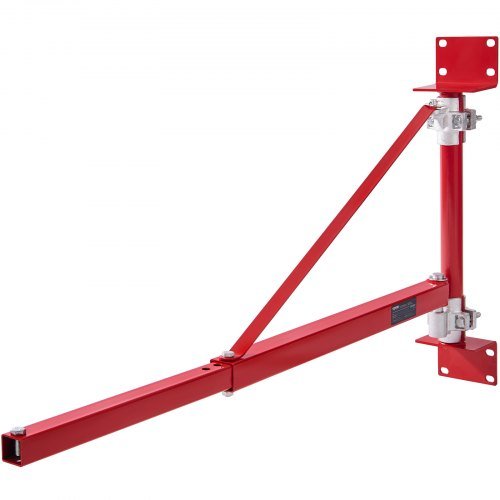
VEVOR Electric Hoist Support Arm
Compact steel swing-arm rated to around 300 kg (660 lb) with 180° swivel — lighter and more compact for less demanding lifting jobs.
Overview
The VEVOR Electric Hoist Support Arm (model HST‑750) is a purpose‑built swing‑arm designed to carry winch‑style electric hoists in home garages and small workshops. Built from carbon steel tubing with a triangular support arrangement, it offers a 300 kg (around 661 lb) maximum rated load and a 180° swivel so you can position the hoist where it’s needed. At roughly 12.9 kg and with a compact footprint, this smaller‑capacity arm aims to strike a balance between strength and ease of installation for modest lifting jobs — think engine blocks, small machinery, or bulky workshop items that are awkward to lift by hand.
This review pulls together the verified specifications and practical buyer guidance so you can decide whether this VEVOR swing‑arm will suit your garage setup and lifting needs. We don’t claim hands‑on testing; instead, we describe likely real‑world use, installation considerations and where the arm fits in a typical workshop toolkit.
Who is this best for?
The VEVOR 660 lb (≈300 kg) swing‑arm is aimed at DIYers, hobbyists and small‑business users who need a compact, reasonably capable mounting solution for an electric winch hoist. It’s particularly well suited to:
- Owners of single‑bay or limited‑space garages where a full heavy‑duty gantry or ceiling‑mounted system would be impractical.
- Users who routinely lift moderate loads — engines, transmissions, motorcycle frames, garden machinery and smaller workshop machines — rather than very heavy commercial items.
- People who prefer a lighter support arm that is easier to handle during installation and adjustment.
If your typical lifts are heavier than a few hundred kilos, or you require a long reach or heavy industrial duty, this smaller VEVOR arm will be a limiting factor. Equally, any installation where the anchor point or fixings are suspect should be avoided — the rated capacity assumes a solid mounting and appropriate fixings.
Key features
- Rated maximum load: approximately 661.39 lbs (around 300 kg). This is the safe working load for the assembly and should not be exceeded.
- Construction: carbon steel tubular frame with a triangular support design for rigidity and stability.
- Rotation: 180° swivel to allow flexible hoist positioning across a useful arc.
- Extension tube: the hoist mounting tube extends roughly 365 mm from the swivel point — a moderate reach for most small workshop tasks.
- Overall dimensions (extended): approximately 1285 x 150 x 755 mm — compact enough for many garages and tighter spaces.
- Product weight: around 12.9 kg — considerably lighter and easier to manoeuvre than heavier capacity arms.
- Intended use: designed specifically for winch‑style electric hoists — check the hoist’s attachment method for compatibility.
Practical evaluation
Although we haven’t physically tested this specific arm here, the spec sheet and the design choices point to a clear set of practical strengths and limits. The carbon steel tubing and triangular bracing are familiar engineering choices for balancing stiffness with a compact form; triangular supports reduce flex without adding a lot of bulk or weight. At about 12.9 kg the arm is manageable for one or two people to hold while securing it in place, which lowers the barrier to installation compared with heavier, industrial arms.
The 180° swivel is one of the more useful practical features. In a workshop with limited floor space, being able to rotate the hoist from one workbench to another or move it clear of the door without relocating the whole mounting point saves time and effort. The roughly 365 mm extension tube provides enough clearance for awkward lifts such as pulling an engine from a narrow bay, but it’s not a long‑reach arm — if you regularly need to put loads further from the mounting pillar, you’ll want a longer extension or a different mounting approach.
Compatibility with your electric hoist is a common practical sticking point. This arm is intended for winch‑style hoists that attach to a tube‑end; you’ll need to confirm the tube diameter and the hoist’s fixing arrangement match. In some cases adaptor brackets or a different hoist mounting plate may be necessary; the product page should be checked for included fittings and dimensions before you buy.
Another real‑world consideration is the mounting surface. The rating assumes a solid, correctly fixed installation — ideally steel or substantial timber beams or masonry with appropriate bolts. Using the arm on a weak or inadequately fixed mount will reduce its safe capacity and create a safety risk. If you’re unsure about the structure you plan to mount to, get a builder or structural adviser to inspect it before installation.
Strengths
- Lighter and easier to handle: At about 12.9 kg the arm is significantly less cumbersome than heavier models, which helps during installation and if you ever need to reposition it.
- Compact footprint: The modest overall size and extension make it a good fit for tighter garages and work areas where large gantries or long‑reach arms would be impractical.
- 180° rotation: The swivel gives useful flexibility, letting one mounting point serve multiple workstations or clear access routes without needing to remove the hoist.
- Appropriate capacity for many domestic tasks: Around 300 kg is suitable for most hobbyist and light workshop lifting jobs — engines, small machinery and general heavy‑lifting chores around the workshop.
- Generally good value proposition: The guide price sits comfortably below heavier, industrial arms — a clear saving if you don’t need maximum capacity.
Limitations
- Lower maximum capacity: At approximately 300 kg this arm won’t suit users who need to handle heavier industrial loads. Overloading or attempting lifts near the limit repeatedly may also accelerate wear.
- Moderate reach: The extension tube of about 365 mm is useful for many lifts but can be limiting when you need to clear larger obstructions or work further from the mounting point.
- Mounting requirements: The safe working load depends on a secure mounting point and the correct choice of fixings. Some users will need to upgrade their anchor point, which adds cost and complexity.
- Compatibility checks needed: The arm is intended for winch‑style hoists; however, not all hoists attach the same way. Confirm the tube end and hoist attachment are compatible before purchase — adaptors may be needed.
- Not the beefiest construction for long‑term heavy use: Some buyers who plan repeated heavy‑duty use may prefer thicker tubework or a higher‑capacity model for greater long‑term durability.
Installation and safety considerations
Installation is straightforward in principle but demands attention to safety. The arm is lighter than larger units so two people can manage it during mounting, however the actual fixing method determines overall safety. Use appropriate expansion bolts or structural fixings for the material you’re attaching to, and follow the torque recommendations of the fixings rather than improvising with undersized bolts. If the product page doesn’t make the included fixings clear, assume you’ll need to supply your own heavy‑duty bolts and washers suited to the mounting surface.
Always check the hoist‑to‑arm connection. Confirm the tube diameter and the hoist’s clamp or bracket are compatible. If there’s any doubt, consult the hoist manufacturer for recommended mounting plates or adaptors. Remember that the arm rating is only meaningful when the entire system — arm, hoist, mount and fixings — is adequate for the load.
Routine checks are sensible: inspect for loose bolts, corrosion at joints, and any deformation after heavy lifts. Keep the swivel mechanism clear of debris and ensure it rotates freely — restricted movement under load can cause unexpected stresses.
Pricing and value
The VEVOR swing‑arm is positioned as a lower‑cost option compared with heavier industrial supports. The guide price supplied is USD 59.90, though you should check the retailer for the current price and any additional shipping or import costs. That price point makes the arm attractive for hobbyists and small workshop owners who need a capable hoist mounting without the bulk or cost of heavy‑duty alternatives.
Value is a practical balance here. If you regularly lift items well within the 300 kg limit and your mounting structure is sound, this arm gives good functionality — rotation, adequate reach for many tasks, and a lighter product weight that reduces installation effort. But if your needs trend toward heavier, frequent lifting, or you need a long reach or rugged industrial usage, the cheaper upfront cost may not be the best long‑term investment; spending more on a higher capacity arm or an engineered gantry could save time and reduce risk.
Also factor in possible extra costs: upgraded fixings, any necessary hoist mounting adaptors, professional installation if your mounting beam needs reinforcement, and periodic inspections. These add up and should be considered when judging overall value.
Alternatives to consider
If the VEVOR 660 lb arm looks close to what you need but not quite right, here are sensible alternatives to consider depending on your priorities:
- Higher‑capacity swing arms: If you foresee lifting regularly close to or above 300 kg, look at heavier VEVOR models or other manufacturers’ arms with higher rated loads. These will typically have thicker tubework and a higher mass, making them more suitable for repeated heavy work.
- Fixed‑position mounting arms: For users who do not need rotation but want very high rigidity, a fixed mount can be simpler and sometimes cheaper while offering good load characteristics.
- Portable engine cranes/gantries: If you want mobility and don’t want to modify a building structure, a portable gantry or engine crane may be a better match. They avoid the need for a structural mounting point and often carry higher capacities.
- Ceiling‑mounted trolleys and rails: Where clear span and permanent capacity are required across a wider area, a ceiling rail system can keep the load well supported and moveable across a bay — but installation is more involved and typically pricier.
Choosing between these depends on the type of lifts you do, the permanence of installation you’re willing to accept, and the structure of your workshop or garage. For many hobbyists the VEVOR 660 lb swing‑arm will be the sweet spot; for light commercial users, a heavier or differently mounted system may be wiser.
Final verdict
The VEVOR Electric Hoist Support Arm HST‑750 is a compact, well‑priced option for homeowners and light workshop users who need a manageable, rotatable mounting for a winch‑style electric hoist. Its carbon steel tubular frame and triangular bracing give a sensible balance of rigidity and low weight. The 180° swivel and moderate extension make it flexible enough for most garage tasks, and the lighter product weight reduces the physical effort involved in handling and installation.
However, the roughly 300 kg maximum load and moderate reach limit its suitability for heavier or more demanding industrial uses. Pay attention to mounting strength, bolt selection and hoist compatibility — the arm’s rated capacity only applies when the complete system is correctly installed. If you regularly lift heavier items, need a longer reach, or have doubts about your mounting structure, you should look at higher‑capacity models or alternative mounting approaches.
In short: this VEVOR arm is a practical, sensible choice for modest lifting tasks in constrained spaces. It’s good value when matched to the right hoist and a solid mounting point, but not the right tool for consistently heavy industrial work.
Note: offers and prices can change — check the retailer page for current pricing, availability and details of included parts or warranty before buying.
Ready to check VEVOR Electric Hoist Support Arm, 660 lbs Max Load Capacity, Electric Hoist Holder Swing Arm with Pole, Steel Hoist Frame, 180° Swivel Scaffold Hoist Lifting Arm, Winch Hoist Arm for Workshop, Garage?
Check the latest offer before buying, then return to the main comparison if you want to compare it against the other shortlisted options.
Compare this with the full shortlist
Return to the full comparison guide to see how this product compares against the other shortlisted choices.