
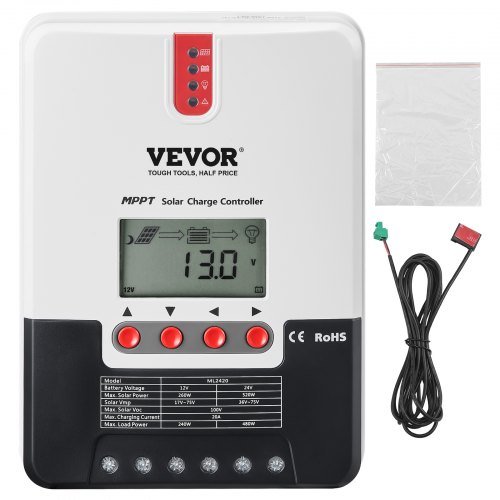
VEVOR 20A MPPT Solar Charge Controller
20A MPPT controller suitable for 12V/24V systems; LCD display, temperature sensor cable and MPPT efficiency ≥98%. Good value for small arrays.
Overview
The VEVOR 20A MPPT solar charge controller is a small, budget-friendly regulator designed for modest off-grid solar systems. It supports 12V and 24V battery banks with automatic detection, offers an MPPT efficiency rated at 98% or better, and accepts a maximum open-circuit voltage (Voc) of 100V DC. The controller includes an LCD display and a temperature sensor cable to help manage charging behaviour and communicates via RS232 by default, with an optional external Bluetooth module for remote monitoring.
This review covers what the VEVOR 20A does well, where it is most useful, and the practical limits you should consider when planning a system around it. The information here is drawn from the product specification and common installation practice — it does not rely on hands-on testing.
Who is this best for?
The VEVOR 20A MPPT controller is aimed at anyone fitting a small solar installation where space, cost and simplicity matter. Typical use cases include:
- Caravans, motorhomes and boats running a single 12V or 24V battery bank.
- Small home backup systems or sheds where panel arrays are limited to a few hundred watts.
- DIY solar starters or secondary systems where a compact controller with basic monitoring is acceptable.
It is not intended for larger residential array feeding high-capacity battery banks or systems that require built-in advanced communications (such as integrated Bluetooth or Wi‑Fi), high continuous current capability, or three-stage multi-battery management beyond standard charging profiles.
Key features
- 20A maximum charging current: Suitable for small banks; defines the overall charging capability and the size of panel array you can connect.
- 12V/24V auto-detection: The controller will automatically configure itself for these common battery voltages.
- MPPT efficiency ≥98%: The maximum power point tracking is claimed to be highly efficient, helping to harvest more energy than a PWM controller in many conditions.
- Rated input power: 260W at 12V and 520W at 24V — practical limits for panel array sizing.
- Max Voc 100V DC: Places limits on panel stringing; you must ensure your array open-circuit voltage stays below this value, especially in cold conditions.
- LCD display and temperature sensor: Local display gives status and settings; the temperature sensor improves battery charging accuracy.
- RS232 communications with optional Bluetooth module: Basic wired data port by default; remote monitoring requires an add-on module.
- Common charging modes: Fast, balance and float stages to support typical battery chemistries (sealed/AGM, gel, flooded and lithium are listed).
Practical evaluation
Choosing a charge controller is about matching it to your battery, panels and the role you want the system to play. The VEVOR 20A’s spec sheet makes its intended position clear: an economical MPPT option for smaller systems. Below I break down the real-world implications of its most important specifications.
System sizing and panel limits
The rated input power — 260W for 12V and 520W for 24V — is the key figure for array size. Those numbers reflect a practical upper limit on how much panel capacity the controller can manage continuously at the given battery voltage. For a 12V battery bank you should plan your panel array so its maximum power (not just nominal) stays at or below the controller rating, allowing for panel tolerances and partial shading. For a 24V system you can fit roughly double the panel power before hitting the controller limit.
The maximum open-circuit voltage of 100V DC also matters when wiring panels in series. If you string multiple panels together to reach suitable voltage, make sure the array’s Voc in cold conditions will not surpass 100V — exceeding the Voc limit risks damaging the controller. This constraint reduces flexibility if you want to run high-voltage strings or multiple series strings in parallel.
Battery compatibility and charging behaviour
The unit supports sealed (AGM), gel, flooded and lithium batteries and offers the usual charge stages — fast (bulk), balance (absorption) and float. The inclusion of a temperature sensor is important: it lets the controller compensate charging voltages based on battery temperature, improving battery life and performance in changing climates. This is more sophisticated than a basic PWM controller and useful if your battery sees wide temperature swings, as in a caravan kept in winter or a boat exposed to sun and wind.
Automatic 12V/24V detection simplifies setup, though if you have a more complex battery bank (for example multiple battery banks or higher nominal voltages) this controller is not suited. Also, while the spec lists lithium, it’s prudent to verify the charging algorithm and settings for your particular lithium chemistry and battery management system (BMS) — modern lithium batteries often require specific charge voltages and charge cut-off behaviour.
Installation and cabling considerations
The VEVOR 20A is a compact unit, which helps in tight installations aboard boats or in small camping vans. However, a few practical points bear repeating. First, MPPT controllers operate with higher currents on the battery side than the panel side for a given power level, so cable gauge matters. Use appropriately sized cables and good-quality, fused connections to prevent voltage drops and reduce fire risk. The controller may require external fuses or circuit protection — check the seller’s documentation and local electrical regulations before you install.
Second, the RS232 port is functional for data logging or integration with other systems but is older technology compared with built-in Bluetooth or Wi‑Fi. If you want remote monitoring, budget for the optional Bluetooth module, and ensure any monitoring software you plan to use is compatible.
Monitoring and user interface
The built-in LCD display provides immediate local visibility of system status and charging mode. That’s handy for quick checks without connecting a phone or laptop. Remote monitoring requires the optional Bluetooth module; if you expect to manage or troubleshoot remotely, confirm the availability and features of that module before you buy. Many buyers find a local display sufficient for small, low-maintenance systems where daily remote monitoring is unnecessary.
Strengths
- Compact and cost-effective: The physical size and guide price place this controller squarely as an attractive option for small, budget-conscious installs.
- MPPT advantage: The MPPT algorithm and high claimed efficiency (≥98%) should recover more energy from modest arrays compared with PWM controllers, particularly in variable light and cooler temperatures.
- Temperature sensing: Inclusion of a temperature sensor is a real plus for battery longevity where temperature compensation is needed.
- Compared local display: The LCD makes it easy to check system status at a glance, useful for boats and caravans without remote connectivity.
- Simple voltage auto-detection: Automatic 12V/24V selection reduces setup complexity for typical small installations.
Limitations
- Current limit — 20A: This is the defining limitation. It rules the controller out for medium or large battery banks or systems where you expect to regularly handle more than 260W into a 12V battery.
- RS232 communications by default: Integrated Bluetooth would be more convenient; the optional module is an extra cost and adds complexity.
- Max Voc 100V: Limits panel stringing options and can be restrictive if you prefer higher-voltage arrays for cable savings or longer runs.
- Installation extras likely required: Expect to budget for appropriate fuses, breakers and suitably rated cabling; these are typically not included and are essential for safety and compliance.
- Documentation and support vary: Verify warranty terms, included accessories and support options with the seller before purchase; these details commonly differ by seller and region.
Pricing and value
The VEVOR 20A MPPT sits at the budget end of MPPT controllers while offering many of the core advantages of MPPT technology: better energy harvest than PWM, temperature compensation and a local display. For small systems its feature set represents good value — you get MPPT efficiency, a temperature sensor and an easy-to-read LCD for a modest outlay.
That said, price is only part of the equation. You should factor in the cost of a Bluetooth module if you need remote monitoring, plus quality cabling, fuses and potentially professional installation to meet local electrical codes. Where buyers try to save money by skimping on wiring or protection, the risk of poor performance or safety issues increases. In short: the controller itself can be good value for small installations, but you must budget sensibly for the supporting hardware.
Note: product prices and availability can change — check the latest listing and any seller documentation before you buy.
Alternatives and when to consider them
If your system needs exceed the VEVOR 20A’s limits, consider these general alternatives and decisions rather than specific model names (since individual offerings and seller support vary):
- Higher current MPPT controllers (30–60A+): If you plan on larger arrays, bigger battery banks, or future expandability, step up to a controller with higher continuous charging current. These give more headroom and can support larger panel arrays without straining the unit.
- Integrated communications models: If remote monitoring is important, look for controllers with built-in Bluetooth or Wi‑Fi. This removes the need for add-ons and usually gives a smoother, app-based monitoring experience.
- High Voc controllers: For longer runs or higher-voltage strings, a controller with a higher Voc rating expands wiring flexibility and can reduce cable size on the panel side.
- Units with more battery profiles or user-configurable settings: For complex battery chemistry or precision charging needs (e.g. certain lithium chemistries), look for controllers that explicitly document support and fine-grained settings for those batteries.
For many caravan or small-boat owners, however, the VEVOR 20A hits the sweet spot: small, affordable, and efficient. If those factors match your priorities, you may not need more sophisticated or expensive hardware.
Final verdict
The VEVOR 20A MPPT solar charge controller is a sensible, no-frills MPPT option for small off-grid solar systems. Its strengths are clear: compact size, MPPT efficiency, a temperature sensor and a readable local display — all useful for caravans, small boats and modest backup systems. It will typically outperform a PWM regulator in energy harvest and battery care under variable conditions.
But it is important to be honest about its limits. The 20A current rating and rated input power constrain array size and charging capability; the 100V Voc ceiling restricts some panel configurations; and the default RS232 interface means you may pay extra for the Bluetooth module if you want wireless monitoring. Additionally, safe installation requires suitable fusing and appropriately sized cables, which are commonly not provided with the controller.
If you have a small solar array and want an economical MPPT controller with sensible battery features, the VEVOR 20A is worth considering. If you expect to expand, run higher power, or need built-in wireless monitoring, look at higher-current or more feature-rich controllers instead.
Finally, remember that offers and prices can change — check the current listing and double-check seller-provided specifications, warranty terms and included accessories before you buy.
Ready to check VEVOR 20A MPPT Solar Charge Controller, 12V / 24V Auto DC Input, Solar Panel Regulator Charger with LCD Display Temperature Sensor Cable, for Sealed(AGM), Gel, Flooded and Lithium Battery Charging?
Check the latest offer before buying, then return to the main comparison if you want to compare it against the other shortlisted options.
Compare this with the full shortlist
Return to the full comparison guide to see how this product compares against the other shortlisted choices.