
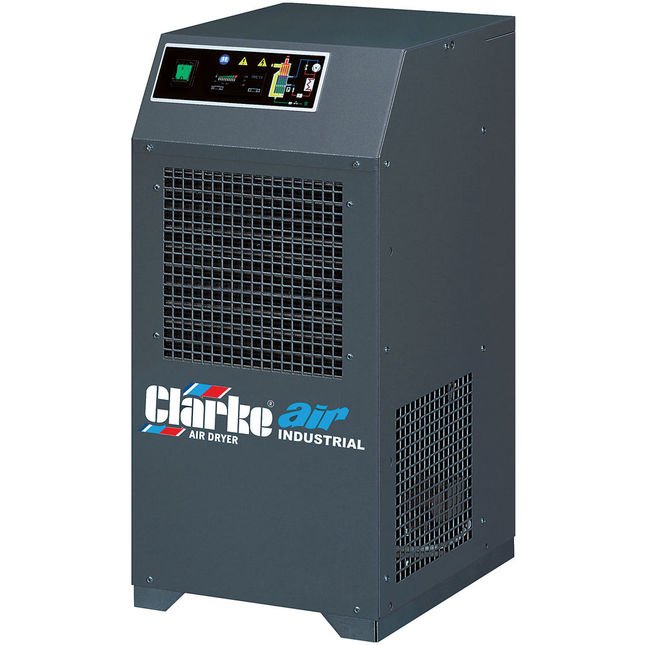
Clarke CRD80 283cfm Air Dryer (230V)
A refrigerant air dryer designed to remove humidity from compressed air in industrial or busy workshop environments, with easy‑access panels for maintenance.
Overview
The Clarke CRD80 is a refrigerant air dryer intended for fixed 230V installations in larger workshops and small industrial settings. Unlike small desiccant or on‑tool moisture traps aimed at DIY tinkering, this is a system component: it sits inline on your compressed‑air installation to remove humidity before the air reaches tools, spray equipment and processes sensitive to moisture. Clarke describes the CRD80 as a high‑performance unit that uses a combination heat exchanger to improve drying efficiency while keeping pressure loss low through the system. It also features simple controls and removable panels to make inspection and maintenance more practical.
If you use pneumatic tools regularly, run air‑assisted painting or operate any process where water in the lines causes corrosion, inconsistent tool performance or paint defects, a dedicated refrigerated dryer such as the CRD80 becomes a serious consideration. This review summarises what the Clarke CRD80 offers, who it is appropriate for, practical installation and maintenance points, and how to weigh its strengths and limitations when budgeting for a workshop compressed‑air system upgrade.
Who is this best for?
The Clarke CRD80 is aimed at workshops and facilities running larger compressors and centralised air systems rather than occasional DIYers working with hand tools. Typical buyers are:
- Motor repair shops, bodyshops and garages that use pneumatic tools continuously and need consistent, dry air to avoid tool damage and corrosion.
- Workshops that use paint booths or spray equipment where moisture in the lines leads to blemishes, fisheyes or inconsistent finishes.
- Small industrial or light manufacturing facilities where compressed air feeds sensitive instrumentation or pneumatic actuators that are susceptible to moisture and condensate.
- Facilities upgrading from point‑of‑use traps to a centralised drying solution for reliability and lower overall maintenance on multiple downstream tools.
It is not intended as a portable or bench‑top accessory for hobbyists, nor is it a substitute for specialist low‑temperature or process‑industry drying systems. If you only use a few air tools intermittently, a smaller fridge dryer or inline filters might be more cost‑effective.
Key features
- Refrigerant drying mechanism — The CRD80 uses refrigeration to condense and remove water from compressed air. Refrigerant dryers are effective at removing bulk moisture down to a typical dew point suitable for general workshop applications.
- Combination heat exchanger — The model uses a combined heat exchange arrangement intended to improve efficiency and reduce the pressure loss the dryer introduces to the system. Lower pressure drop means compressors don’t have to work harder to maintain delivery pressure downstream.
- Removable panels for inspection and maintenance — Accessible panels make it easier to check internal components and perform routine tasks without full disassembly, which is useful for workshops with planned maintenance regimes.
- Compared, simple controls and display — The unit offers straightforward controls for operation and monitoring. This is not a highly automated industrial controller, but it’s user‑friendly for workshop staff.
- Designed for continuous use — Built to be part of a fixed 230V installation, the CRD80 is intended for continuous operation in larger workshops where downtime or moisture problems have real cost implications.
Practical evaluation
Because this review is based on verified product facts rather than hands‑on testing, the practical assessment focuses on likely performance and real‑world considerations when integrating a unit like the Clarke CRD80 into a workshop. Refrigerant dryers are a well‑established solution for reducing moisture in compressed air to levels that are acceptable for most pneumatic tools and paintwork. The CRD80’s emphasis on a combination heat exchanger and low pressure loss addresses two of the most important practical concerns: ongoing operating cost and retained compressor efficiency.
In practice, you should expect a refrigerated dryer such as the CRD80 to sit after your receiver tank and before the distribution manifold or point of use. It will condense water from the air, which then needs to be drained — many systems use automatic condensate drains. The CRD80’s removable panels will make visual checks and occasional servicing simpler than units where components are less accessible, but the exact servicing interval and requirements (filter changes, refrigerant checks, drain maintenance) depend on your compressor duty cycle and environmental conditions.
Installation is a significant consideration. Although the CRD80 is not a large industrial skidded package, it does require a fixed location, suitable space for airflow around the condenser and the right pipework and electrical supply. If you don’t have someone comfortable with refrigerant systems or pressure‑bearing air plumbing, you should budget for professional installation and commissioning. Correct installation ensures the dryer operates efficiently and helps protect downstream equipment and coatings processes.
Another practical point is matching the dryer’s capacity to your compressor. The product description doesn’t include detailed flow or connection size data in the supplied facts, so you must confirm ratings (flow capacity, inlet/outlet connections, maximum operating pressure and expected pressure drop) with the retailer or manufacturer before buying. An undersized dryer will be a bottleneck and won’t protect downstream processes effectively; an oversized one is wasteful and may not condense as efficiently at very low loads.
Strengths
- Effective moisture removal for workshop use — Refrigerated dryers are proven to cut humidity to levels that protect pneumatic tools, prevent internal corrosion and reduce paint defects, and the CRD80 is positioned for that role.
- Designed to keep pressure loss low — The combination heat exchanger is a practical feature. Lower pressure drop reduces energy waste because the compressor doesn’t need to run harder to maintain pressure downstream.
- Accessible for inspection and maintenance — Removable panels are a convenience in busy workshops where downtime for checks and service must be efficient.
- Compared controls — Simple, understandable controls are a plus for workshop environments where specialist operators may not be on hand at all times.
- Built for continuous/heavy use — The design intent is for workshops and facilities that rely on compressed air all day, every day, which suggests parts and build quality appropriate for that environment.
Limitations
- Not for casual DIY use — This is a system‑level product. If you’re a hobbyist or only use a few air tools occasionally, a smaller or point‑of‑use option is likely to be more cost‑effective.
- Installation requirements — It needs a fixed electrical supply and proper pipework connections; you may need an electrician and a qualified fitter to install and commission the unit safely.
- Higher upfront cost — The guide price provided places this dryer at the higher end of workshop accessories. It’s an investment that needs to be justified by regular compressed‑air use or by the value of protecting downstream processes.
- Extra servicing considerations — While panels are accessible, refrigerant systems require periodic servicing that is more specialist than changing a filter on a small inline trap. Spare parts and service expertise may be more specialist than generic workshop tools.
- Confirm specs before purchase — The brief product facts do not list flow or connection sizes, so you must confirm those details against your compressor and system requirements to avoid mismatched performance.
Pricing and value
The supplied guide price for the Clarke CRD80 is GBP 3,118.80. That places the unit in the investment category for workshop equipment rather than a small accessory purchase. Whether this represents good value depends on your needs. For a busy garage or bodyshop where moisture in the air is causing frequent tool problems, corrosion or paint quality issues, a centralised refrigerated dryer can pay for itself in reduced downtime, longer tool life and fewer reworks on finishes.
Value also depends on total cost of ownership: factor in installation, any additional plumbing or electrical work, routine servicing and potential spare parts. Compare those ongoing costs against the alternative approaches — point‑of‑use dryers, desiccant units for low‑dewpoint needs, or improved condensate traps and filtration — to decide whether the CRD80’s combination of features, accessibility and emphasis on low pressure loss suits your workshop budget.
If you are replacing an existing dryer or upgrading from no dryer, include the potential savings from reduced tool failure, fewer paint rejects and less pipework corrosion in your calculations. Talk to the retailer or a compressor specialist about matching the CRD80’s capacity to your compressor so that you are not under‑ or over‑specifying the unit.
Price note: offers and prices can change, so check the retailer page for the latest price and availability before you buy.
Alternatives and when to consider them
Although the Clarke CRD80 is a sensible choice for a medium‑duty workshop setting, there are alternatives depending on your priorities:
- Smaller refrigerated dryers — If you run a single compressor for a small workshop or only need to protect a small number of tools, smaller refrigerant dryers offer lower upfront cost and simpler installation.
- Desiccant dryers — For applications requiring very low dew points (for example, some instrument air uses or very cold environments) desiccant dryers are more suitable than refrigerated units. They are more complex to service but deliver drier air.
- Point‑of‑use filtration and air line traps — If your main issue is intermittent condensate or you only need dry air at a few tools, a combination of automatic drains, coalescing filters and small inline dryers can be more economical.
- Combined compressed‑air packages — For new installations, some suppliers offer matched compressor, receiver and dryer packages sized and commissioned together. That route reduces the risk of mismatched capacity and can simplify warranties and servicing.
If you are unsure which route to take, speak to a compressor specialist or the supplier with details of your compressor’s flow capacity (m3/min or cfm), operating pressure and the number of downstream connections or tools. Avoid buying solely on headline price; matching capacity and serviceability to your workload will determine long‑term satisfaction.
Final verdict
The Clarke CRD80 is a purpose‑built refrigerated air dryer targeted at larger workshops and small industrial sites that rely on compressed air for continuous or heavy use. Its combination heat exchanger and attention to keeping pressure loss down are practical design choices that address two common workshop realities: operating cost and system efficiency. Removable panels and simple controls are welcome for routine checks and day‑to‑day operation.
It is not a product for the casual DIYer. The CRD80 requires fixed installation, correct matching to compressor flow rates and routine servicing that is more specialist than changing an inline trap. If your workshop frequently uses pneumatic tools or runs spray equipment, investing in a refrigerated dryer can reduce tool wear and paint rejects — and the CRD80 fits that role. For smaller users, or where extremely low dew points are required, consider the alternative technologies or smaller units.
Before buying, confirm the dryer’s flow and connection specifications against your compressor, budget for installation and servicing, and weigh the likely savings from fewer tool failures and improved process reliability. Offers and prices change, so check the retailer page for the latest price and availability.
Overall, the Clarke CRD80 looks like a robust, workshop‑focused refrigerated dryer option for those who need reliable moisture control at system scale. If your operation depends on dry, consistent compressed air and you have the space and budget for a fixed installation, it deserves consideration.
Ready to check Clarke CRD80 283cfm Air Dryer (230V)?
Check the latest offer before buying, then return to the main comparison if you want to compare it against the other shortlisted options.
Compare this with the full shortlist
Return to the full comparison guide to see how this product compares against the other shortlisted choices.