
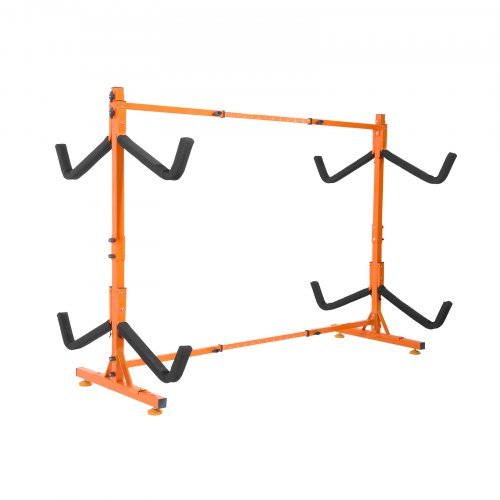
VEVOR Freestanding Kayak Storage Rack
A heavy-duty freestanding steel rack that holds four boats, with padded arms and adjustable width for a variety of hulls.
Overview
The VEVOR Freestanding Kayak Storage Rack is a floor‑standing solution for organising multiple kayaks, canoes or paddleboards. Built from Q235B steel with an anti‑rust coating and fitted with padded support arms, it’s designed to hold up to four boats and to suit a variety of hull widths. Because it sits on the ground it avoids any ceiling fixings or pulleys, making it a practical option for garages, sheds or light commercial storage areas where easy access and straightforward installation matter.
This review looks at the rack’s design and features, who it’s best for, and practical considerations such as footprint, corrosion resistance and long‑term durability. The aim is to help you decide whether a freestanding multi‑boat rack like this is the right way to store your craft compared with ceiling systems or single‑boat floor cradles.
Who is this best for?
The VEVOR freestanding rack is aimed at households, small clubs or light commercial operations that need tidy, accessible storage for multiple boats. If you own several kayaks, family boats or a mix of kayaks and SUPs and want them kept organised and ready to use, a freestanding solution removes the need for ceiling anchors or lift equipment.
It’s particularly suitable if you have a garage, workshop or garden shed with enough floor area to spare. The rack is also a good option for anyone who prefers not to make holes in a ceiling or who needs the flexibility to move the rack occasionally — for example to reconfigure a garage layout or to store boats outdoors temporarily (with attention to corrosion risk; see the Practical evaluation section).
Key features
- Capacity for up to four kayaks, canoes or SUPs.
- Constructed from Q235B steel with an anti‑rust coating.
- Padded support arms to protect hulls and reduce pressure points.
- Adjustable width, roughly 48.4–71.8 inches (about 123–182 cm) to accommodate different boat profiles.
- Support arm length around 21.2 inches (approx. 54 cm), useful for wider hulls.
- Overall product dimensions approximately 1260 × 1070 × 1375 mm.
- Advertised load capacity up to 220 lbs (around 100 kg) — check the retailer page for latest specifics.
Practical evaluation
This freestanding rack is straightforward in concept: a steel frame with multiple padded arms that hold boats horizontally. That simplicity is its strength, but it also defines the trade‑offs you should consider.
Space and footprint: the rack’s dimensions and arm length mean it takes up a meaningful amount of floor space. If you have a double garage or a dedicated storage room, that’s likely acceptable. In a single garage with a car and other gear, the rack can quickly compete for space. Think about door clearances, workbenches and access pathways before buying — placing the rack against a wall rather than in the middle of a room usually works best.
Assembly and handling: the rack arrives as multiple parts and requires assembly using bolts. It’s not a complicated build, but the steel sections are heavier than aluminium alternatives, and you may want two people for safe assembly and positioning. The manufacturer’s fixings suit typical floor setups, but if you have an unusual surface (very soft concrete, uneven shed floor, or a wooden floor with limited anchoring options) you might need different floor fixings or additional stabilisation.
Protection for your boats: padded support arms are a welcome touch because they reduce the risk of pressure points that can deform softer hulls over time. The arm length is generous enough to support broader boats and SUPs; however, always position boats so weight is distributed across more than one arm rather than centred on a single padded point.
Adjustability: the width adjustment (roughly 48–72 inches) allows the rack to accept a range of hull shapes and to create more clearance between boats if you prefer. That flexibility makes it suitable for mixed fleets where kayaks and SUPs differ in beam and profile.
Corrosion and outdoor use: the rack is made from Q235B steel with an anti‑rust coating, which should perform well indoors and in sheltered spaces. If you’re thinking about leaving the rack outdoors or in a damp boathouse, expect that any steel product will need occasional inspection and maintenance — especially at joints and bolt heads where coatings can wear. Regular checks for surface rust and prompt touch‑up with suitable coatings will extend service life.
Strengths
- High multi‑boat capacity — stores up to four kayaks or SUPs, helping families or small clubs keep a fleet organised.
- Padded arms protect boat hulls, which is particularly important for softer plastic or composite boats that can develop pressure marks.
- Adjustable width and long support arms accommodate a range of hull widths, from narrow touring kayaks to wider recreational hulls and SUPs.
- Robust Q235B steel construction gives the rack a durable feel and a good load margin for heavier boats.
- Floor‑standing design avoids ceiling fixings, rope systems or lifts — useful if your ceiling isn’t suitable for anchors or you prefer easy access to boats.
Limitations
- Footprint — the rack requires significant floor space. If indoor space is tight, a ceiling hoist or wall cradle might be a better fit.
- Weight and assembly — the steel parts are relatively heavy and the item needs assembly with multiple bolts; two people may be necessary for safe handling.
- Corrosion risk outdoors — while the anti‑rust coating helps, regular maintenance is needed if the rack is exposed to the elements or coastal air.
- Manufacturer fixings may not suit all floor types — check your floor before relying on the supplied anchoring hardware.
- Potential to obstruct other stored items — consider clearances for doors, access and any equipment stored nearby.
Pricing and value
The VEVOR freestanding rack is positioned as an affordable heavy‑duty option for multi‑boat storage. A guide price is listed in the product data but prices and offers change, so check the retailer page for the most recent figure before you buy. For the money you get a robust steel frame, padded arms and the ability to store four craft — features that would cost more if you were fitting ceiling hoists for multiple boats or buying multiple single‑boat cradles.
Value comes from what you need to store and how you use the space. If you prioritise easy access — getting boats in and out without hauling them to the ceiling — a freestanding rack like this removes friction and makes day‑to‑day use simpler. If space is at a premium and you rarely use all boats at once, a ceiling hoist can free the floor. Think about how frequently you launch and whether you’ll need to move the rack: the VEVOR is a good middle ground where durability and accessibility matter most.
Alternatives to consider
When choosing storage for kayaks and SUPs you have several distinct routes, and the best one depends on your priorities:
- Ceiling hoists: These free up the floor entirely and are ideal if garage space is limited. They require secure ceiling fixing and usually more work to lift and attach boats, but they keep boats out of the way.
- Wall cradles and hooks: Wall storage can be compact and economical, holding one or two boats high on the wall. Good for single‑boat households, though less practical for multiple large craft.
- Single‑boat floor cradles: Smaller than a multi‑boat stand and easier to move; they work well if you only have one or two boats and want dedicated cradles for each craft.
- Other freestanding multi‑boat racks: Available in different materials such as aluminium (lighter and more corrosion resistant) or treated steel with thicker coatings for coastal use. Compare based on capacity, arm protection and ease of assembly.
If you need to store a mixed fleet but want to reduce floor footprint, a combination approach works well: use a ceiling hoist for infrequently used boats and a freestanding rack for the vessels you grab most often.
Maintenance and care tips
To keep a steel freestanding rack in good condition, regular, simple maintenance pays off. Wipe down the frame periodically to remove dirt and salt residues if you’re near the coast. Inspect the padded arms for wear and ensure bolts remain tight — vibration, movement and repeated loading can loosen fastenings over time. If you spot any chipped coating or surface rust, treat it promptly with a rust inhibitor or touch‑up paint suitable for steel. For outdoor or damp locations, consider additional sacrificial protection such as a breathable cover that does not trap moisture against the hulls.
Practical buying considerations
Measure twice before ordering. Know the width and length of your boats, the planned location in your garage or shed and any door or garage‑opener clearance you need. Think about how you’ll load and unload boats: freestanding racks are convenient because you don’t need ladders, but you do need room to manoeuvre the boats into position.
Check the anchor and fixing requirements for your floor. If you’re placing the rack on a concrete garage floor, suitable anchor bolts are straightforward. For wooden floors or uneven surfaces, you may need to reinforce the flooring or choose a different mounting approach. Confirm the manufacturer’s supplied fixings and plan for any supplemental fastenings you might need.
Final verdict
The VEVOR Freestanding Kayak Storage Rack is a capable, no‑nonsense choice for anyone who needs to store up to four kayaks or SUPs in a garage, shed or light commercial space. Its solid Q235B steel construction, padded arms and adjustable width make it versatile for a range of craft and offer a good balance of durability and protection for your hulls.
This rack suits families, small clubs and users who prioritise easy access and straightforward installation without working at height. The main trade‑offs are its floor footprint, the heavier assembly, and the need to watch corrosion if you keep it outdoors. If you have the floor space and want a tidy, practical multi‑boat solution, the VEVOR stand represents sensible value. If floor space is tight or you prefer to keep the floor clear, consider ceiling hoists or wall cradles instead.
Note: offers and prices change — check the retailer page for current availability and the latest price before you buy.
Ready to check VEVOR Freestanding Kayak Storage Rack, Kayak Stand for 4 Kayak Canoe Paddleboard, Heavy-duty Steel Kayak Hanger Holder with Padded Arms and Adjustable Width, 220LBS Max Load, for Indoor Outdoor Garage?
Check the latest offer before buying, then return to the main comparison if you want to compare it against the other shortlisted options.
Compare this with the full shortlist
Return to the full comparison guide to see how this product compares against the other shortlisted choices.