
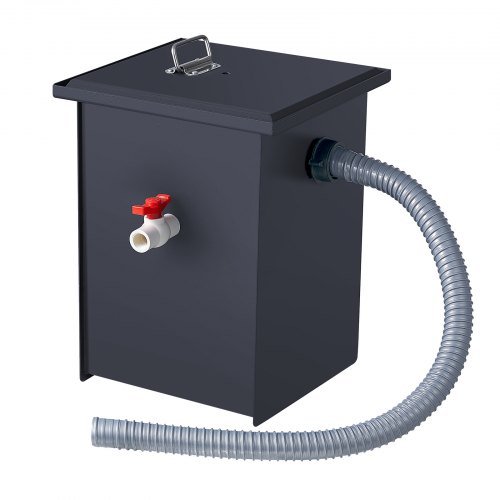
VEVOR Commercial Grease Trap
Smallest and most compact option with a 4.64 GPM flow rate and 8 lb capacity — ideal for tight spaces and low grease volumes.
Overview
The VEVOR 8 lb grease interceptor is the smallest model in a family of commercial grease traps. Built from Q235 carbon steel with a side inlet and under‑sink configuration, it’s intended for situations where space is at a premium and grease output is modest. The unit advertises an 8 lb grease interception capacity and a flow rate of approximately 4.64 gallons per minute (GPM). With compact external dimensions (305 x 290 x 390 mm) and standard 48 mm (1.89 in) inlet/outlet ports, it’s designed to be easy to fit into tight cupboards and to tie into existing drainage using common plumbing sizes.
That compactness is the product’s defining trait: lighter to lift and simpler to manoeuvre during installation than larger commercial interceptors. But the same small size is also its chief limitation. This review walks through where the VEVOR 8 lb unit makes sense, what to watch for when buying and maintaining one, and how it stacks up as a fit for small kitchens, mobile catering and low‑throughput dishwashing stations.
Who is this best for?
The VEVOR 8 lb grease trap is aimed squarely at very small foodservice operations where grease production is limited and under‑sink space is constrained. Typical use cases include:
- Mobile catering units and food trucks with a single sink or limited washing capacity.
- Small cafés, coffee shops or sandwich bars that do not run large dishwashers and produce modest cooking grease.
- Small office or communal kitchen areas where occasional food prep generates light greases and oils.
- Installations where a low initial outlay and compact footprint are higher priorities than extended holding capacity.
If your operation sees continuous high volumes of oily wastewater or multiple sinks/dishwashers running at once, this unit’s 4.64 GPM flow rating and 8 lb interception capacity will quickly be outgrown. It’s not designed for busy restaurants, catering kitchens with sustained throughput, or sites where local regulations mandate larger capacity interceptors.
Key features
- Material: Q235 carbon steel construction — a common, cost‑effective choice for commercial grease interceptors.
- Capacity: 8 lb grease interception. This is a small internal volume intended for light use.
- Flow rate: Approximately 4.64 GPM (gallons per minute), suitable for single‑sink or low‑throughput applications.
- Inlet/outlet size: 48 mm (1.89 in) standard ports — helps keep plumbing tie‑in straightforward.
- Configuration: Side inlet, under‑sink design — made to fit into compact cupboards beneath a sink.
- Dimensions: 305 x 290 x 390 mm — compact footprint for tight spaces.
These features make the unit easy to handle and straightforward to plumb into many existing under‑sink arrangements. The side inlet arrangement is a common under‑sink orientation and should suit most small setups without the need for extensive rerouting of pipework.
Practical evaluation
Buying a grease interceptor isn’t just about the device — it’s about how it will sit within your workflow, meet local regulations and hold up under day‑to‑day cleaning. Below are practical considerations to help decide if the VEVOR 8 lb unit is the right match.
Space and fitment
The compact external dimensions are the unit’s main selling point. Where standard grease interceptors can be bulky and require dedicated floor space, this model is expressly for under‑sink use. If you’ve got a shallow cabinet or limited under‑sink clearance, the smaller footprint reduces the chance of clashes with pipes, waste disposers or cupboard shelving.
Because the inlet and outlet ports are the industry‑standard 48 mm size, tying the trap into existing waste lines is generally straightforward. That said, check your cabinet measurements and the routing of existing plumbing before buying — even small differences in height or pipe alignment can complicate an otherwise simple install.
Flow and capacity in everyday use
The listed flow rate (c. 4.64 GPM) and 8 lb capacity put this unit in the ‘light duty’ category. For a coffee shop or food truck that washes a few items now and then or handles mostly dry waste, this may be perfectly adequate. For anything with continuous washing or where multiple sinks are used simultaneously, the interceptor will fill with grease quicker and need more frequent service.
Frequent emptying isn’t inherently a problem, but it adds operational overhead. If staff time is limited or regular grease removal is difficult to schedule, consider a larger capacity model that reduces servicing frequency. Also check local waste regulations; some authorities prescribe minimum sizes or service intervals depending on the type of food operation.
Installation and maintenance
Installation should be straightforward for a competent plumber: standard 48 mm connections and a side inlet allow a tidy under‑sink connection in most setups. The unit’s lighter weight makes it easier to lift and position than heavier, larger interceptors — a practical plus if access to the cupboard is awkward.
Maintenance is simple in principle: interceptors require regular removal of accumulated grease and solids. The VEVOR’s smaller size makes access for manual cleaning easier, but also means more frequent emptying in anything but the lightest use cases. The carbon steel construction will resist normal use, but carbon steel is not stainless: it will need periodic inspection for corrosion or surface wear and may benefit from drying and cleaning regimes recommended by your local maintenance programme.
Compliance and longevity
Regulatory compliance for grease interceptors varies by council and country. The trap’s physical capacity and flow rate are the critical metrics in many approval processes. Before purchasing, confirm with your local environmental health or building control authority that an 8 lb interceptor with a 4.64 GPM rating meets any minimum requirements for your specific site and operation.
Longevity will depend on maintenance frequency, the nature of the waste (heavy grease versus light oil), and how often the unit is emptied and cleaned. Carbon steel is durable and cost effective, but it’s not as corrosion resistant as stainless steel, so plan for inspections and maintenance to identify any early signs of deterioration.
Strengths
- Compact footprint: The small external dimensions make it one of the easiest grease interceptors to fit under a sink or inside a cramped cabinet.
- Lightweight and manageable: Easier to lift and install than larger, heavier interceptors, which helps in cramped or awkward spaces.
- Low initial cost: Guide pricing positions it as an economical entry point for operations that only need light grease interception.
- Standardised plumbing size: 48 mm inlet/outlet reduces the need for unusual fittings and makes retrofit simpler.
- Suitable for mobile or low‑throughput use: Good fit for food trucks, market stalls and low‑use kitchen sinks.
Limitations
- Very limited capacity: 8 lb interception means the trap will need frequent emptying in anything beyond light use, increasing maintenance demands.
- Low flow rating: At approximately 4.64 GPM, it’s unsuitable for busier kitchens or situations where multiple sinks or larger dishwashers discharge simultaneously.
- Carbon steel rather than stainless: While durable, carbon steel requires attention to prevent rust and may not match the longevity or corrosion resistance of stainless units.
- Risk of non‑compliance as workload increases: Growth in service demand can quickly make the unit inadequate for regulatory or practical needs.
- Fewer advanced features: Compared with larger, purpose‑built interceptors, this model lacks features such as integrated access ladders, high‑capacity baffling or specialised grease removal accessories.
Pricing and value
The VEVOR 8 lb interceptor is pitched as an affordable, compact solution. The guide price provided with the product data is USD 75.90; however, prices and availability can change, and regional differences will apply. Always check the current price and confirm delivery costs and warranty details before buying.
Value should be judged in the context of your specific needs. For a small food truck or micro‑kitchen where space is the overriding constraint and grease output is low, the low purchase price plus ease of installation can represent excellent value. Conversely, if the interceptor will need near‑daily emptying or you face strict local requirements, the saved purchase cost may be offset by higher labour and waste‑removal costs over time.
When assessing value, include the likely frequency of maintenance, disposal costs for collected grease and any potential downtime while the trap is emptied. Also consider the cost of upgrading later — if your business is growing, it can be more economical to invest in a larger, more robust unit that gives longer service intervals and greater regulatory flexibility.
Alternatives and when to choose them
If you’re not certain the 8 lb VEVOR is the right fit, there are sensible alternatives to consider:
- Larger capacity interceptors: If you run a small restaurant, bakery or any kitchen with a regular wash cycle and multiple sinks, look at models with higher grease interception ratings and greater flow rates. These reduce emptying frequency and are more likely to meet stricter regulations.
- Stainless steel models: For wet, high‑use environments or where longevity and corrosion resistance are priorities, stainless steel units offer improved durability. They command a higher purchase price but can be cheaper over the long term where maintenance and replacement costs are considered.
- External or floor‑standing interceptors: If under‑sink space is too limited or the plumbing layout makes an under‑sink install impractical, a floor‑standing or external interceptor might be a better solution. These can offer greater capacity and easier servicing.
- Grease management programmes: Smaller operations sometimes combine a compact interceptor with more rigorous grease management — such as grease traps at sink strainers, regular use of drain screens, and scheduled professional servicing — to keep the system compliant without a bulky device.
Choosing among these alternatives depends on your site layout, throughput, maintenance resources and local regulations. If in doubt, consult your plumber or local environmental health authority to confirm the minimum acceptable size and configuration for your operation.
Final verdict
The VEVOR 8 lb grease interceptor is a focused product with a clear purpose: provide a compact, affordable under‑sink grease trap for very small kitchens and mobile catering setups. Its small footprint, standard plumbing connections and ease of handling make it a very practical option when space is the limiting factor and grease production is modest.
However, the limits are real. The 8 lb capacity and roughly 4.64 GPM flow rating mean this unit will not suit busier kitchens, multi‑sink installations, or sites where local rules dictate higher minimum capacities. Carbon steel construction is cost efficient but requires attention to corrosion and structural maintenance over time.
In short, buy the VEVOR 8 lb if you operate a food truck, small kiosk or single‑sink area with light grease output and you need an under‑sink solution that’s easy to fit and inexpensive to acquire. If your kitchen is likely to generate more grease or you want to reduce the frequency of emptying and servicing, a larger or stainless steel unit will be the wiser investment.
Note: product specifications and prices can change. Confirm the current price, technical details and suitability with the supplier before purchasing, and check your local regulatory requirements to ensure the chosen interceptor meets any mandatory standards.
Ready to check VEVOR Commercial Grease Trap, 8 LBS Grease Interceptor, Side Inlet Interceptor, Under Sink Carbon Steel Grease Trap, 4.6 GPM Waste Water Oil-water Separator, for Restaurant Canteen Home Kitchen?
Check the latest offer before buying, then return to the main comparison if you want to compare it against the other shortlisted options.
Compare this with the full shortlist
Return to the full comparison guide to see how this product compares against the other shortlisted choices.