
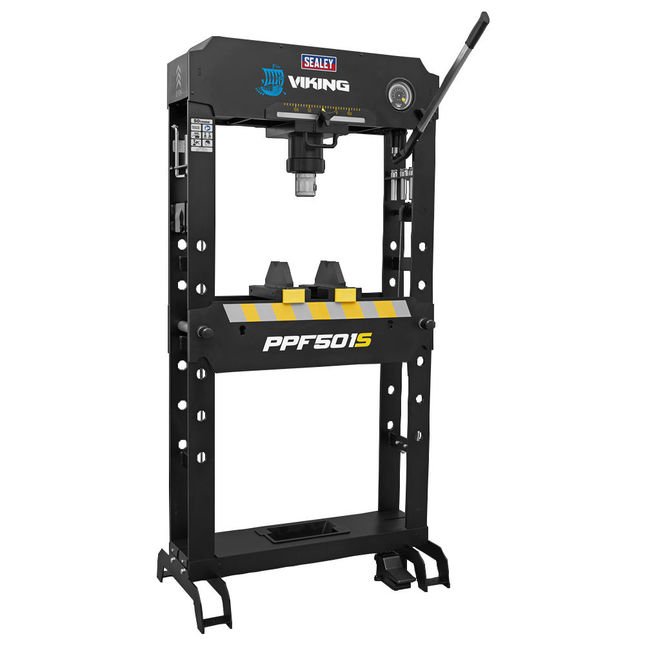
Sealey PPF501S Viking Pneumatic / Hydraulic 50 Tonne…
A 50‑tonne pneumatic/hydraulic floor press with reversible press plates, lateral ram travel and integrated pump and motor — built for demanding workshop use.
Overview
The Sealey PPF501S Viking is a substantial floor press intended for demanding workshop use. Combining pneumatic assistance with hydraulic power, it promises the speed of air operation with the fine control of hydraulics. The press sits in a heavy steel frame, includes an integral motor and pump assembly, and is rated at a combined 50 tonnes — a capacity aimed squarely at professional garages, engineering shops and other environments where large or stubborn jobs turn up regularly.
Where this model differs from smaller, simpler presses is in the detail. It has a winch‑assisted table for safer, easier height adjustments, reversible press plates with both flat and V‑block faces for gripping different workpieces, built‑in storage for press pins, a pressure gauge and, notably, lateral ram travel of ±140mm so you can position the ram off‑centre to line up awkward parts. These features make it more than a brute force tool: it’s intended to be a flexible piece of kit that speeds up repetitive work and reduces fiddly repositioning of heavy components.
Who is this best for?
If you run a professional workshop, fleet maintenance facility or serious home workshop with space and regular heavy pressing needs, the PPF501S is designed for you. It’s suitable where tasks include bearing and bush removal and installation, straightening components, pressing shafts and collars, and other jobs that require a long stroke of high force.
This isn’t a casual or mobile product. Because of its size, weight and the requirement for an appropriate workstation (and likely compressed air to get the most from the pneumatic functions), it’s best where the press can be installed as a permanent tool. Smaller garages or intermittent DIYers should consider whether they really need 50 tonnes of capacity or whether a smaller bench or workshop press would cover most jobs at much lower cost and footprint.
Key features
- 50‑tonne combined pneumatic/hydraulic capacity — engineered for heavy pressing tasks commonly found in professional settings.
- Integral motor and pump assembly with pressure gauge — built‑in hydraulics allow controlled pressing and easy monitoring of applied pressure.
- Pneumatic assistance — adds speed and reduces operator effort when positioning or initiating presses (compressed air supply required for full functionality).
- Winch‑assisted table — safer, smoother height adjustments of the work table; helpful when handling heavy or awkward parts.
- Reversible press plates — flat face for general pressing plus V‑block face for shafts and round stock, which increases versatility.
- Lateral ram travel ±140mm — allows off‑centre ram positioning so you can align bulky or asymmetrical components without constant repositioning of the workpiece.
- Built‑in storage — convenient housing for a set of press pins, keeping commonly used accessories to hand.
Practical evaluation
From the supplied details, the PPF501S presents as a thoroughly professional unit. The combination of pneumatic and hydraulic systems is a practical choice: air power speeds up non‑load movements and makes repetitive shifts less fatiguing, while hydraulic pressure provides the steady, precise force needed for most pressing operations. The integral motor and pump means there’s no need for external hydraulic sources, simplifying installation and day‑to‑day use.
The winch‑assisted table is a pragmatic safety and convenience feature. On a press of this size you’ll often be working with heavy components; manual lifting and laddering the table into position would be awkward and potentially unsafe. The winch helps you raise and lower the table in a controlled way, reducing strain and the risk of mishaps. Combined with the press’s robust construction, this points to a machine built for frequent use rather than occasional tinkering.
Lateral ram travel is a standout detail. A typical workshop task — say, pressing a bearing onto a long shaft or aligning a collar on an off‑centre part — can require repeatedly moving the workpiece. Being able to offset the ram by 140mm either side of centre means less fiddling, fewer repositionings and a quicker workflow. The reversible press plates add further utility: use the flat face for broad contact or switch to the V‑block to cradle round bars and shafts more securely.
There are practical installation and usage points to consider. The press is large and heavy; delivery will need planning and likely a lift or multiple people to manoeuvre it safely into position. You’ll want a permanent, level floor area and enough headroom to work comfortably. In smaller workshops the floor may need reinforcement, particularly if the press is sited on a mezzanine or a floor not designed for heavy concentrated loads. The pneumatic features will require a reliable compressed air supply — if you don’t have that already, you’ll need to budget for a suitable air compressor and plumbing.
Maintenance is straightforward in principle — keep hydraulic fluid at the correct level, check hoses and seals, and observe manufacturer recommendations for servicing — but because this is a professional, integrated unit, parts and service may be more specialist and therefore costlier than for off‑the‑shelf bench presses or simple bottle jacks. Factor in local serviceability when deciding if the model suits your workshop.
Strengths
- High capacity — 50 tonnes covers heavy press work that smaller presses cannot manage, reducing the need to send jobs out or improvise.
- Dual operation — pneumatic for speed and convenience, hydraulic for controlled pressing — a combination well suited to repetitive professional tasks.
- Lateral ram travel — significant practical advantage for aligning large or awkward workpieces and reducing repositioning time.
- Versatility of plates — reversible flat and V‑block faces expand the range of parts you can handle securely.
- Operator safety and convenience — winch‑assisted table and integrated storage for pins reduce lifting strain and keep accessories organised.
- Robust build — heavy steel construction intended for long life under professional use.
Limitations
- Size and weight — this is not a mobile or compact unit. You’ll need space for permanent installation and a plan for delivery and siting.
- Cost considerations — the guide price places it at the upper end of workshop presses, so budget impact should be considered against how often you’ll use the higher capacity.
- Compressed air requirement — the pneumatic features add convenience but rely on an air supply; if you don’t already have one, that’s an extra expense and installation task.
- Specialist servicing — integrated motor/pump assemblies and heavy hydraulic components may require specialist parts and service, which can be pricier and slower than for simpler tools.
- Not suitable for very small workshops — floor footprint and likely need for floor reinforcement make it inappropriate for cramped spaces or temporary setups.
Pricing and value
The Sealey PPF501S is positioned as a professional tool rather than a budget purchase. The published guide price should be used as a reference point when planning procurement, but bear in mind additional costs such as delivery and installation, possible floor reinforcement, and — if required — an adequate compressed air system. For businesses that regularly press heavy components, the investment can be justified by the time savings, improved safety and reduced need to outsource work. For less frequent users, the cost and footprint may not be worthwhile compared with smaller presses or external workshop services.
When assessing value, consider the lifecycle costs too: planned maintenance, replacement seals or hydraulic hoses, and any service contracts you may need. Equally, factor in the productivity gains from faster, safer adjustments and fewer part repositions because of the lateral ram travel and winch‑assisted table. If those features cut cycle times and reduce operator fatigue across many jobs, they contribute to the overall return on investment.
Note: product offers and prices can change — always check the retailer for up‑to‑date pricing and availability before buying.
Alternatives and what to consider instead
Not every workshop needs a 50‑tonne floor press. If your regular tasks are light to medium duty, a smaller bench or workshop press is cheaper, takes less space and is easier to move. Conversely, if you need mobility — for roadside rescue, on‑site repairs or work outside a permanent base — consider portable hydraulic presses or a selection of hydraulic jacks and pullers designed for mobile use.
For purely lifting tasks rather than pressing, a professional garage jack (often rated 2–4 tonnes for vehicle work) or a bottle jack may be more appropriate. These are more specialised for raising vehicles or frames rather than pressing components with precision. Likewise, a dedicated hydraulic pump used with various cylinders and rams can give flexibility if you already have modular tooling or need to power multiple hydraulic tools.
When choosing between these options, think about:
- Primary task — are you mostly pressing bearings and shafts, or lifting vehicles and bodies? Each task points to a different toolset.
- Frequency of use — professional, high‑volume shops will amortise the cost of heavier equipment faster than occasional users.
- Space and permanence — a floor press like the PPF501S needs a permanent space; mobile or occasional shops may prefer portable units.
- Service and local support — check availability of spare parts and authorised service locally to avoid long downtime.
- Ancillary equipment — do you have compressed air, a suitable electrical supply and enough floor strength? If not, factor those costs in.
Final verdict
The Sealey PPF501S Viking 50 Tonne floor press is a serious machine for serious work. Its 50‑tonne capacity, combined pneumatic/hydraulic operation, lateral ram travel and practical touches such as a winch‑assisted table and reversible plates make it well suited to professional workshops that handle heavy, repetitive pressing tasks. It’s built to speed up workflow and improve safety when compared with smaller, manual presses.
It’s not for everyone. The size, weight and likely requirement for compressed air mean you need to plan delivery, siting and possibly infrastructure upgrades before purchase. The guide price reflects its professional positioning, so weigh the purchase against how frequently you’ll use its full capability. For workshops that routinely need high‑force pressing, the PPF501S offers clear operational advantages; for lighter or occasional work, a smaller press or alternative hydraulic equipment may be a better fit.
As with any substantial workshop purchase, check the latest retailer information for current pricing and availability, confirm local service options, and make sure your workspace can safely accommodate the machine before committing.
Ready to check Sealey PPF501S Viking Pneumatic / Hydraulic 50 Tonne Floor Press?
Check the latest offer before buying, then return to the main comparison if you want to compare it against the other shortlisted options.
Compare this with the full shortlist
Return to the full comparison guide to see how this product compares against the other shortlisted choices.