
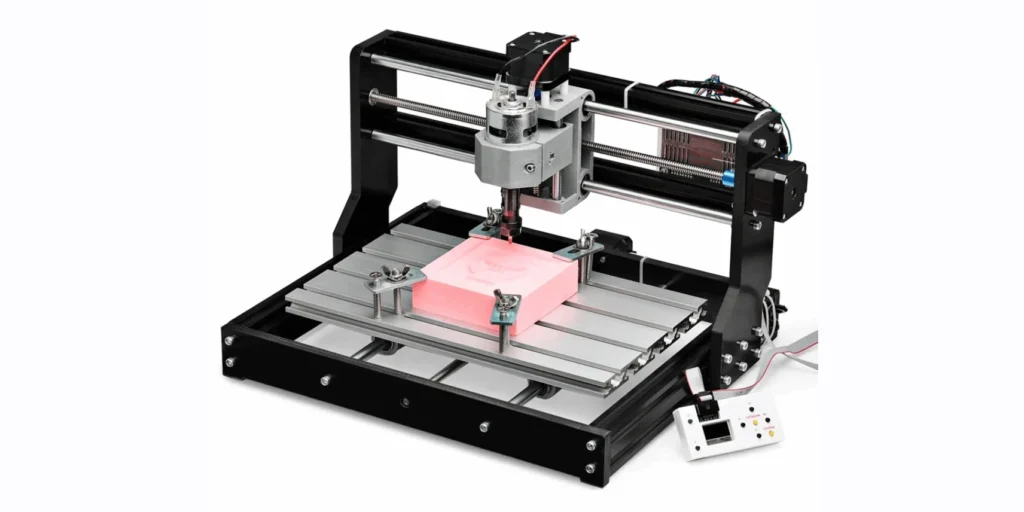
SainSmart Genmitsu (3018-style)
A compact, budget-friendly router that’s an entry point for hobby CNC work and learning G-code/CAM.
Overview
The SainSmart Genmitsu range — those 3018-style desktop CNC routers you see recommended across forums and beginner guides — is a straightforward entry point into CNC work. These machines are compact, affordable and arrive in a kit format that many newcomers find helpful for learning the basics of assembly, calibration and CAM/G‑code workflows. Out of the box they’re well-suited to engraving tasks, PCB milling and lightweight routing in wood, plastics and soft materials.
That convenience comes with trade-offs. Genmitsu units are not heavy‑duty routers: their frames and spindles prioritise price and portability over rigidity and high cutting power. If you plan to cut aluminium, thick hardwoods or demand millimetre‑perfect tolerances straight away, you should expect to upgrade components or choose a stiffer machine. Still, for the hobbyist who wants to learn how a CNC works, try engraving projects, and build confidence with CAM software, the Genmitsu 3018-style models are hard to beat on cost and community support.
Who is this best for?
The Genmitsu 3018-style machines target beginners and hobbyists. If you’re coming from hand tools or laser cutters and want to step into mechanical milling, they make a gentle and inexpensive introduction. Typical users include makers who want to engrave signs, produce simple PCBs, personalise items, or mill soft materials like basswood, plastics and acrylic.
They’re also a good choice for someone who enjoys tinkering. Because the machines often come as kits and have lots of aftermarket parts available, people who want to modify electronics, upgrade spindles or swap out motion components will find plenty of scope — and plenty of community help — for incremental improvements.
However, if you need a workhorse for production or you frequently cut metals and hard timbers, this isn’t the ideal final machine. Expect to treat a Genmitsu as a learning platform or a light‑duty workshop tool rather than a replacement for a mid‑range desktop router.
Key features
Below are the practical highlights you should expect from a Genmitsu 3018-style desktop CNC:
- Compact footprint that fits on small benches or hobby desks — useful where space is limited.
- Budget-friendly entry price when compared with larger, more rigid desktop CNC routers.
- Commonly supplied as a kit — assembly helps users learn machine mechanics and calibration.
- Strong online community and plentiful tutorials, spare parts and upgrade options.
- Suited to engraving, PCB milling and light routing in soft materials and plastics.
- Compatibility with standard G‑code and common CAM tools so you can use free or paid software.
Practical evaluation
When you’re assessing whether a Genmitsu 3018-style machine will do the job, think beyond the headline features and consider the entire workflow: unpacking and assembly, software and CAM, materials and cutting, and the upgrade path.
Assembly and setup – These machines usually arrive in kit form. That’s a benefit if you want to learn: you’ll install the linear rails, stepper motors, lead screws and the control board yourself, which forces you to understand the machine’s geometry and limits. The downside is that assembly quality can vary depending on the seller and your mechanical skill. Expect to spend time aligning rails, tightening bearings and doing initial calibration steps such as squaring the axes and setting end stops.
Software and workflow – One of the stronger points for Genmitsu users is software compatibility. The machines accept standard G‑code and work with common CAM packages, both free and paid. That means you can create toolpaths in familiar tools and export G‑code without learning an obscure proprietary format. The large user base also means you’ll find plenty of step‑by‑step guides for the typical software combinations hobbyists use.
Materials and cutting – Think lightweight and precise engraving rather than heavy stock removal. Softwoods, foam, plastics, acrylic and PCB FR‑4 are realistic targets straight away. For aluminium or harder materials, users commonly upgrade spindles, add more rigid frames or improve motion components before attempting anything serious. The stock spindle and frame will struggle for repeatable results when removing a lot of material or when pushing high feed rates.
Precision and rigidity – The 3018 form factor has inherent limits: compact machines trade frame stiffness for smaller footprint and lower cost. That affects how aggressive you can be with feeds and depths of cut. For fine engraving and detailed PCB milling the precision is generally acceptable, but for larger routing tasks or where part flatness and long‑reach accuracy matter you’re likely to encounter limits. If precision is critical for your projects, plan on upgrades and take time to dial in the machine carefully.
Maintenance and spares – One advantage of the Genmitsu ecosystem is the ease of finding replacement parts. Motors, belts, couplers, end mills and control boards are commonly stocked by retailers and third‑party sellers, and DIY communities have developed modification guides for popular upgrades. That makes long‑term repairs and incremental improvements straightforward for a user willing to tinker.
Strengths
- Low cost of entry: For those wanting to try CNC without a large upfront investment, the Genmitsu family is an affordable way in.
- Great learning platform: The kit format teaches the basics of machine assembly, alignment and calibration — useful knowledge if you plan to move to larger machines later.
- Large community and tutorial resources: You’ll rarely be stuck for help — there are many guides, videos and forum threads covering common issues.
- Easy to source parts and upgrades: Replacement parts and aftermarket upgrades are widely available so you can improve performance incrementally.
- Compact and portable: The small footprint suits workshops with limited space or makers who need a machine that can be moved around.
- Works with standard G‑code: Flexible software options mean you can choose CAM tools that match your skill level and budget.
Each of these strengths is practical rather than flashy. They make the Genmitsu appealing to hobbyists who want to learn the craft, create small projects at home and customise the machine as their skills grow.
Limitations
- Limited rigidity for heavy cuts: If you want to do serious machining of metals or thick hardwoods you’ll quickly reach the machine’s mechanical limits.
- Small work area compared with larger desktop units: The compact bed confines the size of parts you can work on.
- Stock spindle may be underpowered: For aggressive cutting or aluminium work the standard spindle often needs replacing with a higher‑torque unit.
- Assembly and calibration required: These aren’t plug‑and‑play workhorses — you’ll need patience and a willingness to learn setup procedures.
- Quality varies by kit and seller: Not all bundles include the same accessories, so you must check what’s included before purchase.
These are not minor caveats: they affect what the machine can do from the first day. Treat the Genmitsu like a starting point. If you accept those limits, you get an inexpensive, well‑supported gateway into CNC. If you need higher throughput, larger beds or dependable metal machining, look at more substantial desktop routers or industrial benchtop mills instead.
Pricing and value
The principal selling point of Genmitsu 3018-style machines is value for money. They offer a working CNC platform for a small fraction of the cost of larger, more robust desktop routers. That makes them attractive when budget is the primary constraint and your projects are small or experimental.
Value isn’t only about the initial price, though. Factor in what’s included in the kit and whether you’ll need to buy extra tools or upgrades. Some sellers offer bundles with bits, clamps, or additional accessories — others supply a bare minimum. If you’re planning to cut anything beyond thin plastics or PCBs, set aside budget for a better spindle, improved clamps, and perhaps stiffer motion components down the line.
Also consider the time cost: assembly, calibration and learning the CAM workflow add to the machine’s effective price. For many hobbyists, that’s not a sacrifice but part of the appeal — the learning curve is the point. For someone who needs a reliable out‑of‑the‑box production machine, a higher initial investment in a more capable device may make better long‑term sense.
Note: prices and offers change frequently. Check current listings and confirm exactly what’s included in the kit before buying to avoid surprises.
Alternatives
If you decide the Genmitsu is too limited, or you simply want something more capable without losing the convenience of a compact desktop unit, there are sensible alternative paths to consider.
Recommended choice: Twotrees TTC450 Ultra — For readers looking for a single alternative recommendation, the Twotrees TTC450 Ultra is our pick as the recommended choice. It’s often suggested as a step up from basic 3018-style kits, offering a more rigid build and a larger working area while still being suitable for hobbyists who want a machine that handles more demanding routing tasks. If you favour a machine with a stronger frame and fewer immediate upgrade requirements, it’s worth comparing the TTC450 Ultra to the Genmitsu before you buy.
Other directions to consider:
- Larger desktop routers: If your projects include larger signs, thicker stock or you want more rigidity, look at mid‑range desktop CNCs with aluminium frames and larger beds. These cost more but reduce the need for immediate upgrades.
- Specialist PCB‑focused machines: If PCB milling is your primary goal, there are machines purpose‑built for fine copper removal and part alignment that may be a better fit than a general‑purpose 3018‑style router.
- Other 3018 clones/upgrades: If you like the small footprint but want better performance, investigate 3018 variants with preinstalled upgrades such as metal leadscrews, better spindles or reinforced frames.
Comparing the Genmitsu directly with a recommended alternative such as the Twotrees TTC450 Ultra is a useful exercise: weigh what you need on day one against what you might want in a year. If you foresee quick progression to tougher materials, a slightly bigger initial outlay for a more capable machine can be money well spent.
Final verdict
The SainSmart Genmitsu 3018-style machines earn their place as pragmatic starter CNCs. They’re inexpensive, small enough for a hobby desk and supported by a large and helpful online community, which together make them an excellent learning platform. If you want to learn how CNC machines work, practice CAM workflows and make small engravings, PCBs and light routed parts, a Genmitsu is a very practical choice.
That said, be realistic about what you will and won’t do with one without upgrades. If your projects include metal milling, thick hardwood, or you need a larger working area and stronger rigidity, you’ll either need to upgrade components or choose a more robust machine from the outset. Factor in assembly time, calibration, and the likely cost of a few sensible upgrades when assessing overall value.
For most newcomers who enjoy tinkering and want a low‑cost way to get hands‑on with CNC, the Genmitsu delivers a capable, well‑documented platform. If you want a ready‑to‑work machine for tougher tasks, consider the Twotrees TTC450 Ultra as our recommended choice or look at larger, stiffer desktop routers. And remember to check current prices and the exact kit contents before you buy — offers change and what’s included can vary between sellers.
In short: buy a Genmitsu if you want a budget, compact learning tool with lots of community support; upgrade or step up to a different model if your projects demand more power and rigidity right away.
Ready to check SainSmart Genmitsu (3018-style)?
Check the latest offer before buying, then return to the main comparison if you want to compare it against the other shortlisted options.
Compare this with the full shortlist
Return to the full comparison guide to see how this product compares against the other shortlisted choices.