
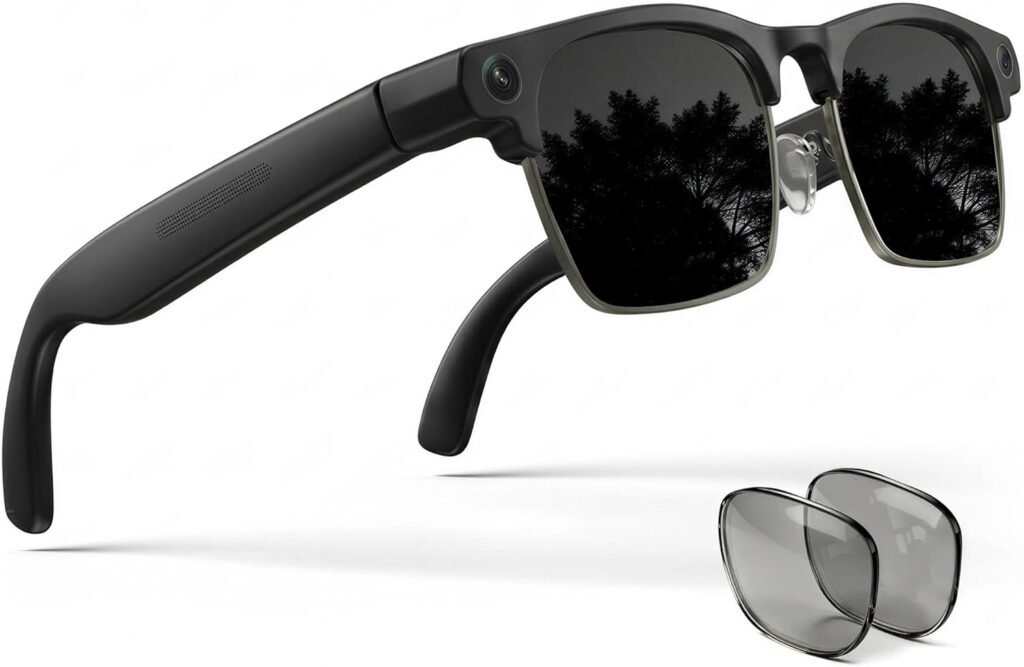
AI Smart Glasse for Men Women
Translation-focused smart glasses with an 8MP camera, open‑ear speakers, interchangeable lenses and voice assistant for meetings and travel.
Overview
These AI Smart Glasses aim to pack several convenience features into a single sunglass frame: an 8MP camera for quick photos and short video clips, open‑ear speakers that let you listen to audio while remaining aware of your surroundings, Bluetooth for calls and streaming, and voice‑controlled functions including real‑time translation. The set includes extra photochromic lenses that darken in bright light, which makes the glasses more usable outdoors without needing a separate pair.
The product is presented as an everyday wearable for people who want hands‑free capture and basic smart features rather than a specialist camera or a high‑end audio headset. The attraction is straightforward: carry one lightweight device that covers shade, capture and simple smart assistance. That convenience can be useful for travel, commuting, quick social posts, or hands‑busy tasks where reaching for a phone is awkward.
Who is this best for?
These glasses are aimed at users who prioritise convenience and situational awareness over the highest possible picture or audio fidelity. Typical buyers include:
- Travellers who want easy voice translation and the ability to record short clips without pulling out a phone.
- Cyclists, walkers and commuters who need to hear ambient sound for safety while listening to directions or taking calls.
- People who prefer discreet hands‑free photo capture during events or daily life.
- Anyone who wants sunglasses and a wearable camera in a single, compact item to reduce what they carry.
It’s not aimed at photography or audio enthusiasts. If you need long battery life for extended recording, studio‑quality sound, or advanced camera controls, a dedicated camera or wearable audio system would be more appropriate.
Key features
Based on the manufacturer’s details, the glasses combine a handful of useful features into a consumer friendly package:
- 8MP camera — for quick stills and short video clips. The camera is intended for convenience capture rather than professional imaging.
- Open‑ear speakers — deliver audio while keeping ears free, so you can remain aware of environmental sounds (traffic, announcements, conversations).
- Bluetooth connectivity — for phone calls and streaming audio from a paired device.
- Real‑time translation & voice assistant — on‑device voice features to assist with translation and give access to basic assistant tasks through voice control.
- Photochromic lenses included — the extra lenses change tint with light levels, making the glasses suitable for indoor and outdoor use without switching frames.
- Sunglass form factor — a compact, discreet design intended for everyday wear rather than specialist sports frames or eyewear with heavy sensors.
Practical evaluation
Without independent hands‑on testing here, the practical evaluation focuses on expected real‑world behaviour given the listed features and typical constraints of similar devices. The glasses sit in a pragmatic middle ground: they add convenience to daily routines, but they come with trade‑offs that buyers should weigh.
Camera: an 8MP sensor is perfectly adequate for quick social media snaps and short video clips viewed on phones or shared online. Expect limitations in low light, autofocus speed and image stabilisation compared with modern phones or action cameras. For spur‑of‑the‑moment capture — think a street scene, a quick group photo or a short travel clip — the camera offers a hands‑free alternative. However, if you plan to shoot long videos, film in challenging light or need high‑resolution stills for printing, a dedicated device will deliver better results.
Audio: the open‑ear speaker design is one of the glasses’ strongest practical selling points for safety and situational awareness. Unlike in‑ear or over‑ear headphones, open‑ear speakers let you hear ambient sound, which is helpful when walking in city traffic or cycling. The trade‑off is sound isolation and bass response: open‑ear audio tends to lack deep low frequencies and won’t block environmental noise. If you want to enjoy music fully or need noise isolation for concentration, these glasses won’t replace traditional headphones.
Voice features and translation: having on‑device voice control and translation built into the glasses is convenient for quick interactions — asking for directions, making a call, or getting a phrase translated while travelling. Bear in mind that translation accuracy and language coverage can vary; check the device’s supported languages and whether the translation requires a phone connection. Voice control is typically more basic than a full‑featured smart assistant on a phone, but it can complete common tasks hands‑free.
Comfort and form factor: the sunglass form is convenient for daily wear and the inclusion of photochromic lenses reduces the need to swap eyewear in changing light. Fit and comfort are subjective and depend on head shape; some users may find the additional electronics make the frame slightly heavier than standard sunglasses. Also consider whether you need prescription lenses — check with the manufacturer about prescription compatibility or third‑party lens fitting options.
Battery and usage patterns: battery life is commonly a constraint on multi‑function wearables. Expect the battery to be sized for short bursts of recording, voice tasks and audio streaming rather than for all‑day continuous recording. If you plan to use the camera and audio heavily, it’s sensible to confirm recording durations, standby time and how the device notifies you of low battery. Many buyers will find the glasses ideal for short outings and quick captures rather than for long streaming sessions.
Strengths
- Hands‑free capture: the built‑in camera makes it easy to take photos or short videos without reaching for your phone, which is useful when your hands are occupied.
- Ambient‑aware audio: open‑ear speakers let you listen to audio and take calls while still hearing traffic and other important sounds, improving safety during outdoor activities.
- On‑device translation and voice assistant: having translation and voice control available in the glasses reduces friction when travelling or when you need quick information without pulling out a phone.
- Photochromic lenses included: swapping between light conditions becomes simpler because the added lenses darken in bright light, effectively combining sunglasses and regular eyewear.
- Compact, everyday design: the sunglass style keeps the device discreet and wearable for daily use rather than looking like a tech gadget strapped to your face.
Limitations
- Not a specialist camera: an 8MP sensor is fine for casual shots but won’t match the low‑light performance, dynamic range or advanced controls of a phone camera or action camera.
- Audio trade‑offs: open‑ear speakers favour awareness over audio fidelity, so expect limited bass and a soundstage that won’t satisfy audiophiles.
- Battery life and recording limits: typical wearable batteries restrict continuous recording time; confirm the device’s limits if you need extended use.
- Basic controls and features: voice control and on‑device functionality will usually be simpler than what you get from a smartphone assistant or a smartwatch.
- Privacy and legal considerations: wearing a camera in public raises privacy issues and local laws can restrict recording in certain places. Be aware of signage, private property rules and consent expectations when recording others.
- Compatibility and accessibility: some features may require a paired phone, certain operating systems, or specific app access — verify compatibility with your devices and accessibility needs before purchasing.
Pricing and value
The manufacturer notes that price varies by retailer and configuration, so it’s sensible to check current pricing and any bundle options before you buy. Value depends on how you plan to use the glasses. If you expect to use the camera for occasional quick captures, rely on open‑ear audio for safety, and value the convenience of built‑in translation, the glasses can represent good value as an all‑in‑one wearable.
If, however, you already own a smartphone with a capable camera and a decent pair of headphones, consider whether the glasses will replace enough of those functions to justify the cost. For people who need specialist performance — such as extended video recording, professional sound, or optical corrections for vision — separate, purpose‑built devices are likely to be better investments.
When comparing price to value, check the manufacturer page for details such as warranty, included accessories (beyond the photochromic lenses), and what software support looks like. Also ask about repair or replacement policies for electronic eyewear, as fixing frames with integrated electronics can be more complicated than replacing regular sunglasses.
Note: offers and prices can change; check the manufacturer or retailer for the latest pricing and availability before buying.
Alternatives to consider
If the convenience of integrated camera and audio is attractive but you’re unsure whether these glasses are the right fit, consider the following alternatives depending on your priorities:
- Smartphones with clip‑on lenses or gimbals: If image quality is important, a recent smartphone plus accessories will outperform a built‑in 8MP sensor for photos and video, and you’ll also have better editing and sharing tools.
- Action cameras: For extended recording, waterproof use, or stable video, compact action cameras offer better battery life and image quality for active users.
- Bone‑conduction or open‑ear headphones: If ambient awareness and audio are the key requirement, specialist open‑ear audio devices often provide longer battery life and improved sound tuning compared with integrated glasses.
- Dedicated translation devices or apps: If translation is your main need, there are pocket translators and smartphone apps that can offer more accurate translations, higher language coverage, offline modes, and more features.
- Prescription‑compatible smart frames: If you require prescription lenses, look for vendors who explicitly support prescription inserts or separate models designed to accept optical lenses with electronics.
Final verdict
These AI Smart Glasses are a practical, feature‑packed option for anyone who values hands‑free convenience, situationally aware audio and the novelty of on‑device voice translation in a sunglass form factor. The combination of an 8MP camera, open‑ear speakers, Bluetooth connectivity and photochromic lenses makes them a sensible everyday wearable for travel, short capture moments and listening while staying aware of your environment.
However, they are a compromise product rather than a specialist tool. Expect basic camera performance, modest audio fidelity typical of open‑ear designs, and limited battery endurance compared with dedicated devices. Make sure the languages and functionality of the translation and voice assistant meet your needs, and check compatibility with your smartphone before buying. Also consider legal and privacy responsibilities when recording in public.
In short: choose these glasses if you want a compact, all‑round wearable that reduces what you carry and makes simple tasks easier. Look elsewhere if you need professional‑grade photos, studio sound or long‑duration recording. And remember to verify current pricing, any regional feature differences and warranty or repair options before making a purchase.
Ready to check AI Smart Glasse for Men Women —8 MP Camera, Open-Ear Speakers for Audio, Video Recording and Bluetooth, Real-Time Translation-Sunglasses (Extra Photochromic Lenses), Voice Control Smart Wearable?
Check the latest offer before buying, then return to the main comparison if you want to compare it against the other shortlisted options.
Compare this with the full shortlist
Return to the full comparison guide to see how this product compares against the other shortlisted choices.