
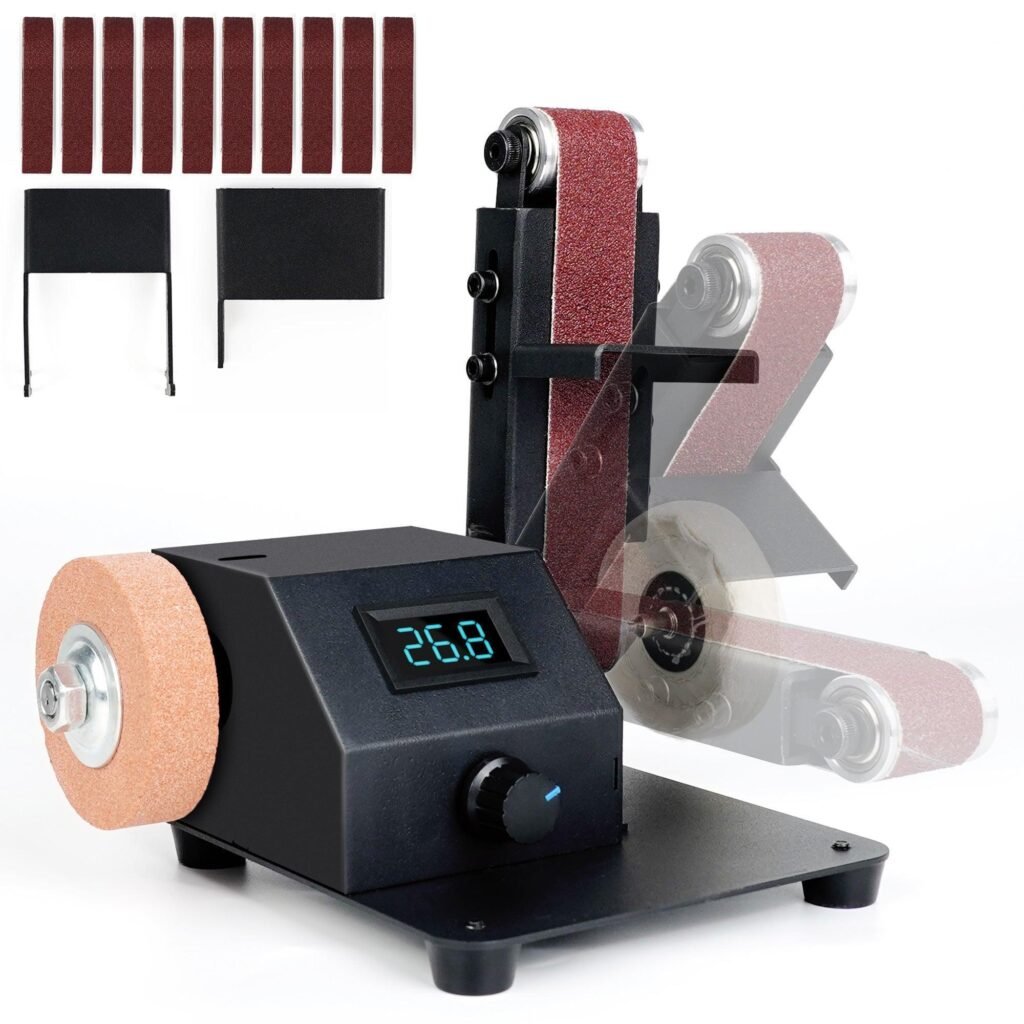
Twotrees Multi-function Belt Sander
Twotrees Belt Sander 【Dual Speed Adjustment】: Twotrees belt sander comes with variable speed adjustment and tachometer display The power configurator can also be adjusted in 7 spe…
Overview
The Twotrees Multi-function Belt Sander is a compact sanding machine that combines a belt-sanding head with a set of interchangeable attachments. Designed to be used either handheld or mounted to a bench, it promises to be a single, adaptable tool for shaping, smoothing and general surface preparation across common materials including wood and metal. A stepless speed adjustment helps you match the tool to different tasks, while the small footprint aims to suit tighter workspaces.
What makes the Twotrees appeal is the concept: instead of buying multiple specialist sanders, you get one base unit with attachments meant to cover a range of jobs. The model covered here is the EU mains version, supplied for continental electrical systems rather than UK mains without an adaptor. As with any multi-function machine, there are clear strengths and trade-offs to consider — most notably around power, accessory availability and dust management.
Who is this best for?
If you’re a hobbyist woodworker, a DIY enthusiast or a small-scale maker with limited bench space, the Twotrees Multi-function Belt Sander is aimed squarely at you. It’s useful when you want a single machine that can handle light shaping, edge work and surface prep without filling the workshop with several specialist sanders.
It’s also a sensible choice if you need a compact tool that can work both as a handheld sander and as a bench-mounted machine. That flexibility is handy for occasional use, repair jobs, small furniture projects, model-making and metalwork finishing where the workload and scale are modest.
However, this isn’t primarily for contractors, production shops or anyone planning heavy-duty, continuous sanding. The compact design and belt size mean it’s best used on projects of limited scale or where fine control and versatility are more important than throughput.
Key features
- Multi-function belt-sanding head with interchangeable attachments — intended to expand the range of shapes and tasks you can tackle with one base unit.
- Stepless speed adjustment — lets you vary belt speed smoothly to match material and finish requirements rather than fixed speed settings.
- Compact, small-footprint design — suitable for bench mounting in smaller workshops or for handheld use.
- Designed for common materials including wood and metal — marketed as a general-purpose preparation and shaping tool.
- EU mains model — supplied for continental electrical systems rather than a UK mains plug.
Practical evaluation
Because this review is based on the product description rather than independent hands-on testing, the practical evaluation focuses on how the design and features are likely to translate into real-world use, and the practical considerations to check before you buy.
Versatility and attachments
The headline selling point is the interchangeable attachments that convert the belt sander into different configurations. In practice, that adaptability can be really useful: it means you can swap from a flat belt for surface smoothing to shaped attachments for profiling and edge work without needing to invest in separate specialist machines.
Bear in mind that the quality and range of those attachments — and how easy they are to fit securely — will strongly affect how useful the system is day to day. Check what attachments are included with the unit and whether additional or replacement accessories are available from Twotrees or third-party suppliers.
Speed control and finish quality
Stepless speed adjustment is a solid feature for a compact machine. Slower belt speeds let you be gentler on thin veneers or soft woods and reduce the risk of burning or aggressive material removal, while higher speeds speed up stock removal when required. The ability to fine-tune speed is particularly beneficial when you switch between wood and metal.
How fine and stable the speed control is will depend on the motor electronics and build quality. For the best results, ensure the unit’s control feels smooth and that you can keep the tool steady at low speeds when sanding delicate pieces.
Bench or handheld use
Having the option to bench-mount or use the tool handheld increases its usefulness in a small workshop. For bench use, consider whether the product includes mounting hardware or whether you’ll need to fabricate or buy a stand or clamps. If you plan to mount it permanently, ensure there’s good access for dust collection and clearances for the belts and attachments you’ll use.
Handheld use is convenient for awkward shapes and on-site fixes, but for consistent results you’ll want a stable work-holding strategy. Small sanders can suffer from chatter or deflection under load, so consider how you’ll secure workpieces when accuracy matters.
Dust collection and workshop cleanliness
Dust collection is often the weak point on compact multi-function sanders. The Twotrees description notes the machine’s intended uses but does not promise advanced dust extraction. In many cases, basic dust ports are included that accept small bags or vacuum hoses, but they don’t replace a robust extraction system.
If you’re working with wood frequently or sanding metal (which produces fine particulates), plan for an aftermarket shop vacuum or extraction setup. Good dust management not only keeps your workspace cleaner but also improves the longevity of sanding belts and reduces health risks from inhaling dust.
Power and belt size — match to your projects
The listing emphasises compactness but doesn’t specify motor wattage or belt dimensions. Those details matter: a smaller motor and narrower belt are fine for shaping and finishing small pieces, but they won’t be efficient for heavy stock removal on large panels or prolonged industrial work.
Before buying, check the belt size, motor power (or amperage), and the maximum recommended duty cycle. If you plan to strip paint from large doors, sand lots of reclaimed timber, or run the sander for long periods, a larger dedicated belt sander or a specialised drum sander may be more appropriate.
Strengths
- Single adaptable machine: The multi-function approach reduces the need to buy several types of sanders, useful if workshop space is limited or you need a flexible tool for a variety of light tasks.
- Stepless speed control: Variable speed helps you match cutting speed to material and finish, reducing the risk of damage and improving finish control.
- Compact footprint: Suits hobbyists and makers working in small workshops or those who want a benchtop-friendly tool.
- Interchangeable attachments: Expands the range of tasks from general surface prep to shaping and edge work without multiple machines.
- Suitable for multiple materials: Marketed for both wood and metal, which broadens its usefulness for mixed-material projects.
- EU mains model: Convenient for buyers in continental Europe who want a machine supplied for their mains voltage without adapters.
Limitations
- Accessory availability: Compatible belts and additional attachments may be limited or require sourcing from third parties; ensure spares and consumables are easy to find before committing.
- Dust management may be basic: The built-in dust-collection options are likely modest; for regular use, you’ll want a proper extraction setup to protect health and the workshop.
- Not a heavy-duty replacement: The machine’s compact design and belt size mean it’s not a substitute for full-size belt sanders or specialist machines on intensive or large-scale jobs.
- Possible need for additional mounting hardware: Bench-mounting securely might require aftermarket brackets or home-made fixtures to achieve stable, repeatable workholding.
- Learning curve: Using multiple attachments and speeds effectively takes practice; expect an initial period of trial and error to find the best settings for different materials.
Pricing and value
The Twotrees Multi-function Belt Sander is sold through a range of retailers and accessory bundles, so price and value depend on what’s included in the package. Some listings bundle multiple attachments and spare belts, which can improve value for someone who wants to start using the sander straight away without hunting for parts.
Value should be judged on three things: the breadth and quality of included accessories, the availability and cost of replacement belts and attachments, and how well the machine’s capabilities match your regular projects. If the kit includes a useful range of attachments and you can buy spares locally or online, it can be a cost-effective way to cover several sanding tasks with one tool. If accessories are scarce or expensive, or the motor and belt size won’t handle your workload, the value proposition weakens.
Because pricing changes regularly, check current offers and shipping options to the UK before you buy. Also consider whether the EU mains version will need an adaptor or whether a UK-specific model is available if you’re buying from the UK.
Alternatives to consider
When deciding whether the Twotrees is right for you, it’s worth comparing it to a few alternative approaches:
- Dedicated belt sander: If you regularly remove large amounts of material or work with big panels, a full-size belt sander will be faster and more efficient than a compact multi-function machine.
- Orbital and random-orbit sanders: For finishing and smoothing between coats of paint or varnish, a random-orbit sander gives a finer finish and is less likely to leave belt marks.
- Specialist shaping tools: For heavy shaping or joinery tasks, spindle sanders or drum sanders can outperform a multi-function unit when volume or precision is required.
- Other multi-function systems: Some brands offer modular sanding systems with greater aftermarket support and accessory ranges; if spare parts and third-party accessories are important to you, check what’s easy to source.
Which alternative is best depends on your balance of space, budget and the kinds of jobs you do most often. The Twotrees sits in a niche for compact versatility; if that matches your needs, it’s worth serious consideration. If your work is larger scale or more specialised, one of the alternatives above will likely serve you better.
Final verdict
The Twotrees Multi-function Belt Sander is an appealing option for hobbyists and makers who need a small, adaptable sanding solution for a range of light to medium tasks. Its compact design and stepless speed control give it a flexibility that’s hard to match with a single-purpose sander, and the interchangeable attachments broaden the kinds of work you can tackle without expanding your toolset dramatically.
However, the usual caveats for modular tools apply: check what accessories are included, how easy it is to buy compatible belts and attachments, and whether the motor and belt size are suited to the projects you plan to do. Dust extraction is likely basic, so plan for a shop vacuum or extraction setup if you’ll be sanding frequently. For heavy, continuous or large-scale jobs, a dedicated belt sander or specialist machine remains the better option.
In short, if you want a compact, multi-purpose sanding machine for a small workshop and you value flexibility over raw power, the Twotrees is worthy of consideration. If your priorities are high throughput, industrial durability or guaranteed local parts support, compare dedicated sanders or larger modular systems before committing.
Note: Offers, pricing and availability can change — check the official product page and current retailer listings for the latest details before you buy.
Ready to check Twotrees Multi-function Belt Sander | Stepless Speed Adjustment – EU?
Check the latest offer before buying, then return to the main comparison if you want to compare it against the other shortlisted options.
Compare this with the full shortlist
Return to the full comparison guide to see how this product compares against the other shortlisted choices.