
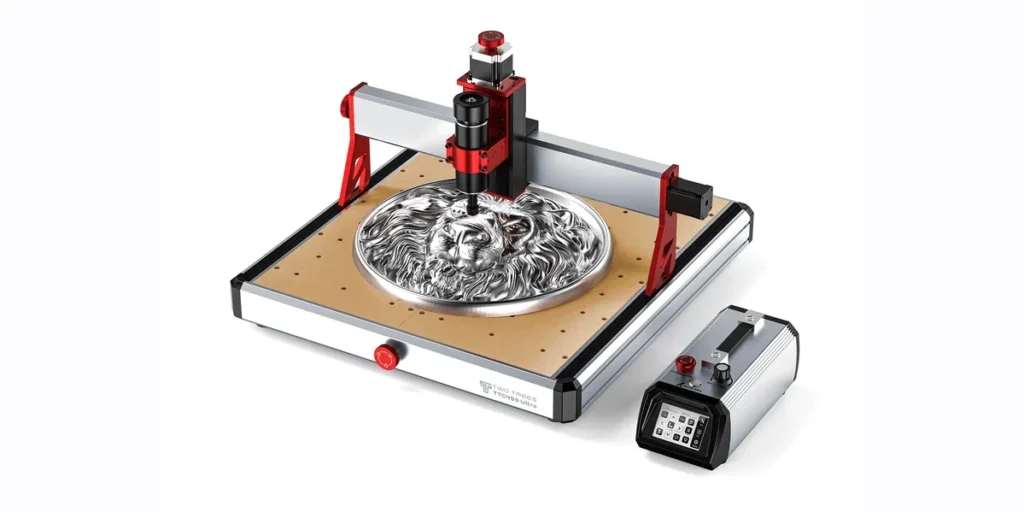
Twotrees TTC450 Ultra
Compact desktop CNC with a modern control package and a focus on upgradeability and ease of integration.
Overview
The Twotrees TTC450 Ultra is pitched at makers and small workshops that want a capable desktop CNC without committing to a large, industrial machine. It offers a compact, benchtop-friendly footprint and a modular design that makes it straightforward to upgrade spindles, controllers and fixtures over time. Community documentation and parts availability are strong selling points, making it a sensible choice if you like to tinker or plan to adapt the machine to different jobs.
Out of the box the TTC450 Ultra is aimed at routing wood, plastics and light aluminium when paired with the right tooling and feeds. It’s not a heavy industrial mill, but for prototype parts, sign-making, routing and general maker projects it gives a flexible platform that can be improved as your needs change. As with any kit-style CNC, check the current price and exactly which accessories and mounting bits are included before buying.
Who is this best for?
The TTC450 Ultra is best suited to hobbyists, makers and small-scale fabricators who want a desktop CNC that’s easy to fit on a bench but still offers a useful work area. If you value the ability to tinker — fitting a different spindle, changing the controller or adding custom fixtures — the modular approach here makes those upgrades much easier than with sealed, proprietary machines.
It’s a good fit for people who plan to work mainly with wood and plastics and who may occasionally cut light aluminium. It will also appeal to those who prefer to rely on a broad community for setup tips, upgrade parts and problem-solving rather than calling a manufacturer’s support hotline. However, it isn’t the right choice for users who need heavy, continuous machining of thick aluminium parts or production-level throughput.
Key features
- Compact, benchtop-friendly footprint — Designed to sit on a workbench without dominating a workshop, the TTC450 Ultra aims to balance usable work area with space efficiency.
- Modular design — Components and mounting points are structured so you can swap spindles, change controllers or add accessories with fewer hurdles than a more closed system.
- Common G-code compatibility — The controller works with standard G-code workflows, making it compatible with most CAM software and familiar to users who already run CNC tooling.
- Suitable for a range of materials — With the right tooling and feeds it can handle wood, plastics and light aluminium work, offering flexibility for many hobby and prototyping tasks.
- Good community and parts availability — Extensive community documentation and commonly available replacement parts make troubleshooting and upgrades straightforward.
- Multiple mounting and fixture options — Often supplied with or compatible with various clamps, fixtures and mounting plates to help secure workpieces of different sizes.
Practical evaluation
When considering the TTC450 Ultra, think of it as a platform rather than a finished production tool. The modularity is its strongest practical feature — you can start with a basic configuration and selectively upgrade spindles, toolholding, drive electronics and even add enclosures or dust collection as your projects demand. That flexibility means the machine can evolve alongside your skills and needs rather than becoming obsolete after a short time.
Assembly and setup: The TTC450 Ultra typically requires assembly and some initial tuning. Builders who are comfortable with basic mechanical assembly, wiring and controller configuration will find the process straightforward, but beginners should factor in time to read community guides and follow calibration steps carefully. Expect to spend time setting end stops, squaring axes, and tuning feed and spindle speeds before attempting precision work — this is normal for modular, kit-style CNCs.
Controller and software: The controller supports common G-code, which keeps software options wide open. You can generate G-code in most mainstream CAM packages and run it on the machine without needing proprietary conversion tools. That compatibility is important if you already use a specific CAD/CAM workflow, or if you want to experiment with a variety of CAM packages as you learn.
Working with materials: For wood and plastics the TTC450 Ultra will meet most hobbyist and small-shop needs. It’s capable of cutting clean contours, pocketing, engraving and sign work with appropriate bits and tuned feeds. When moving to aluminium, quality of results depends on a few variables: the chosen spindle and collet setup, cutter quality, feeds and speeds, and the rigidity of the overall build. With correct tooling and conservative feeds, light aluminium work is achievable — but expect to fine-tune and, in some cases, upgrade components to achieve consistent results.
Tooling and spindles: One of the advantages of the TTC450 Ultra is that you can retrofit different spindles or toolholding systems. Before you buy, check the spindle specifications and collet sizes supplied (if any), and decide whether you will need an alternate spindle for the kinds of jobs you plan to run. Frequently, hobbyists install higher-quality spindles or different collet sizes to broaden capability, especially when working with metals.
Noise, dust and safety: As with any open-frame router, noise levels and dust output can be significant. The machine does not come with a sealed enclosure by default, so plan for a dust extraction system or shop vac, and consider building an enclosure if you’re working indoors. Appropriate hearing protection and eye protection should be used during operation. When cutting metals, coolant or air blast and suitable chips management become important considerations.
Fixturing and accuracy: The TTC450 Ultra usually ships with a range of mounting and fixture options or is compatible with standard fixtures. Workholding is a vital part of achieving good results: clamps, vacuum tables (if compatible), sacrificial spoil boards and T-slot fixtures all play a role in accuracy and surface finish. Don’t underestimate time spent on workholding; robust fixture setup often improves part quality more than marginal gains in feed rates.
Strengths
- Balanced size for workshops — The machine uses bench space efficiently while still offering a useful work area for a wide range of hobby and light professional tasks.
- Modularity and upgrade paths — Swappable spindles and controller compatibility make it easy to improve the machine incrementally rather than replacing the whole unit.
- Common CAM workflows — Standard G-code support keeps the software side flexible and familiar to most users.
- Versatile materials range — Capable of wood, plastics and light aluminium with appropriate cutting tools and feeds.
- Community resources — Well-documented by builders and supported by an active user base for tips, upgrades and troubleshooting.
- Fixture flexibility — Often compatible with multiple mounting and fixture options, making it easier to secure different part shapes and sizes.
Limitations
- Not an industrial machine — It isn’t designed for heavy, continuous machining or thick aluminium production work. For industrial volumes or heavy cuts you’ll need a larger, stiffer machine.
- May require tuning for aluminium — To reliably machine aluminium you’ll likely need to tune feeds and speeds carefully and possibly upgrade the spindle, collets or even add stiffening components.
- Accessories often sold separately — Dust extraction, premium spindles, advanced controllers and some fixtures can be extra costs; check the package contents carefully before buying.
- Assembly and learning curve — It typically requires assembly and calibration, which takes time for newcomers. Expect to invest in learning and setup to get the best results.
- Noise and dust management — Without an enclosure you will need to manage dust and noise yourself, particularly when cutting woods or composites.
Pricing and value
Rather than being the cheapest possible hobby router, the TTC450 Ultra positions itself as a value-packed platform you can expand over time. The real value comes from the combination of a reasonably compact footprint, modular upgradeability and a strong community — all of which extend the machine’s useful life far beyond a sealed, proprietary unit that cannot be upgraded.
When judging price and value, two practical checks matter more than the headline number: first, what accessories and fixtures are included in the bundle; and second, what you will need to buy immediately to meet your intended use cases. Some sellers include only the bare machine, while others bundle spindles, collets, clamps and even starter tooling. If you plan to cut aluminium, budget for suitable end mills, possibly a better spindle and some way to clamp parts securely. If dust and noise are concerns, factor in a dust extraction system and personal protective equipment.
Because the TTC450 Ultra is modular, buyers can spread upgrades over time — buy the base machine, learn the workflow, then add a better spindle or controller as requirements grow. This staged investment can offer better long-term value than buying a higher-spec machine up front that you outgrow.
Note: prices and special offers change frequently. Always check the latest price and the exact list of included accessories before purchasing so you know what additional costs to expect.
Alternatives to consider
If the TTC450 Ultra sounds appealing but you’re weighing options, think in terms of categories rather than single models, unless you have a specific competitor in mind.
- Entry-level benchtop CNCs — These are generally simpler and sometimes cheaper, but they often have fewer upgrade paths and smaller work areas. Choose one if you want a low-cost, low-maintenance machine for basic engraving and light routing.
- Sturdy hobby mills — If your work will mainly be small metal parts, a dedicated hobby milling machine with a rigid Z-axis and heavier build may be a better fit than a gantry-style router.
- Larger benchtop routers — For users who need to cut thicker aluminium or larger panels, stepping up to a bigger, stiffer benchtop machine reduces the need for immediate upgrades but requires more space.
- Laser cutters or desktop routers with enclosures — If your focus is on engraving and cutting thin materials rather than profile milling of metals, a laser cutter or an enclosed router might be more efficient and offer better dust/noise containment.
Choosing between these alternatives comes down to the materials you plan to cut, the tolerances you need, your workspace, and whether you prefer a machine that’s ready to run out of the box or one you can upgrade and tinker with.
Final verdict
The Twotrees TTC450 Ultra is a solid recommendation for makers and small workshops that want a compact, flexible CNC platform. Its modular nature and good community support make it especially attractive to anyone who enjoys upgrading and customising their tools. For routine wood and plastic work it will meet most needs out of the box; for light aluminium projects it can be made to work well, though you should plan time and possibly extra expense to tune or upgrade components.
If you want a machine that grows with your skills, supports common CAM workflows and won’t dominate your bench space, the TTC450 Ultra is worth considering. It’s not a substitute for a heavy-duty industrial mill, but it provides a sensible balance between capability, upgradeability and footprint for hobbyists and small shops.
Before you buy, double-check the current price, delivery details and what is included in the package — spindle, collets, clamps and tooling can vary by seller, and these extras change the immediate cost and utility of the machine. With the right expectations and a small amount of setup and tuning, the TTC450 Ultra can be a dependable and adaptable addition to a maker’s workshop.
Ready to check Twotrees TTC450 Ultra?
Check the latest offer before buying, then return to the main comparison if you want to compare it against the other shortlisted options.
Compare this with the full shortlist
Return to the full comparison guide to see how this product compares against the other shortlisted choices.