
Twotrees TTC6050 CNC Router Machine – US /…
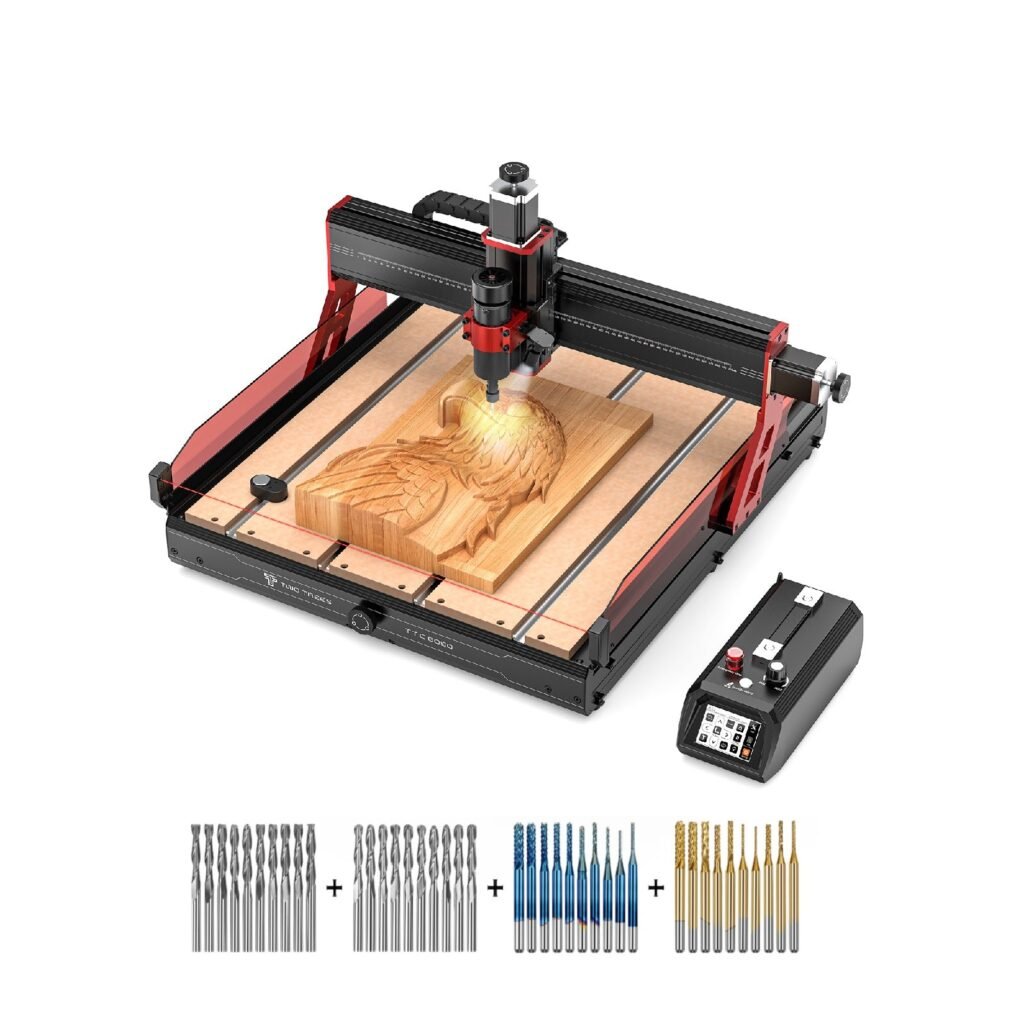
TTC6050 with end mills included — same large-capacity router with starter cutters to help you begin projects sooner.
Overview
The Twotrees TTC6050 CNC Router Machine positions itself between hobby desktop kits and heavier industrial routers. With a 600×500×100mm work area, ball-screw drive, linear rails and a 500W spindle, it aims to give makers and small workshops enough capacity for larger signs, cabinetry parts and short production runs. This particular bundle comes with a set of end mills so you can start cutting right away — helpful if you want to get set up without hunting for tooling.
The machine supports useful upgrades — including a rotary axis, an 800W spindle and a vacuum table — so it can grow with more ambitious projects. It also offers safety features such as infrared protection and an emergency-stop. That combination makes the TTC6050 a flexible mid-range option for people who need a solid bed size and better-than-basic accuracy but don’t yet require a full industrial machine.
Who is this best for?
If you’re a serious hobbyist, a small business doing signage or furniture components, or a maker who needs a larger work area than the usual desktop machines, the TTC6050 is worth considering. The 600×500×100mm bed is big enough to run multiple parts in one cycle or to handle single larger panels without the awkward set-and-reposition workflow that smaller routers force on you.
It also suits workshops that expect to iterate on tooling and accessories. The machine’s expandability — rotary axis, stronger spindle and vacuum table — lets you tailor it as your needs change. That said, it isn’t a heavy metal mill: it’s designed primarily for wood, plastics and light, intermittent aluminium work rather than continuous hard-metal cutting. If you plan continuous high-load machining you’ll likely need a more industrial platform.
Key features
- Working area: 600×500×100mm — roomy for a mid-range router and convenient for sign-making and cabinetry parts.
- Spindle: 500W as standard, with support for an optional 800W upgrade for tougher materials or faster feeds.
- Drive and guidance: Ball screws and linear rails designed to reduce backlash and keep accuracy over time.
- Feed rate: Up to 5,000mm/min top speed for efficient material processing.
- Tooling bundle: Ships with a set of end mills so you can begin routing immediately.
- Safety: Infrared sensors and an emergency-stop to help protect operators in shared workshop environments.
- Expandability: Supports a rotary axis, an 800W spindle and vacuum table to broaden capabilities.
Practical evaluation
From the spec sheet, the TTC6050 looks like a thoughtfully configured machine for makers who want more space and more accuracy than compact kits provide. Ball screws and linear rails are the two features that most noticeably lift its long-term capability: compared with belt-driven hobby routers, ball-screw drives give less backlash and more consistent positioning, which matters when you’re cutting fine details or running multiple identical parts.
The 500W spindle is a sensible middle ground. It’s powerful enough for deeper profiles in wood and for working with common plastics, and with sensible feeds you can do light aluminium work. If you need to push harder — for example thicker aluminium panels or tougher composites — the advertised option to upgrade to an 800W spindle is useful. The ability to add a vacuum table and a rotary axis also helps the machine remain relevant as your workshop’s needs evolve.
Having a tooling bundle in the box lowers the barrier to first cuts. New owners often spend frustrating days sourcing compatible collets and cutters — having a starter set of end mills means you can focus on software, fixturing and dust extraction first. Bear in mind, however, that the supplied cutters are typically basic general-purpose bits; experienced users usually replace or supplement them with job-specific cutters for better finish, longer life or faster feed rates.
Workspace demands should not be underestimated. A 600×500×100mm bed gives you a decent machining envelope, but the machine itself needs a sturdy bench or floor footprint, room for dust extraction hoses and space for the controller and wiring. Expect to set aside a permanent corner of the workshop rather than tucking this in on a temporary bench. Also plan an extraction strategy: routers generate a lot of fine dust and chips, and effective extraction will keep the workplace clean and protect both electrical components and your lungs.
Operationally, a 5,000mm/min maximum feed rate is adequate for quickly clearing material when you’re using the right tools and setting sensible passes. Actual feed and speed choices depend on material and cutter geometry; manufacturers’ guidance and community-sourced profiles are useful starting points but plan for some trial runs to dial in feeds for your specific workpieces.
Strengths
- Generous work area: 600×500×100mm opens up larger projects and simple batch runs without constant repositioning.
- Solid motion hardware: Ball screws and linear rails promote long-term accuracy and reduced backlash compared with cheaper belt systems.
- Immediate tooling: Comes with a set of end mills so you can get cutting soon after assembly.
- Expandable: Options for a rotary axis, stronger spindle and vacuum table help the machine stay useful as your needs grow.
- Workshop-friendly safety: Infrared protection and an emergency-stop are practical for shared spaces and classes.
Limitations
- Basic bundled cutters: The end mills in the bundle are convenient but generic; expect to upgrade to specialist cutters for fine finishes or efficient aluminium work.
- Higher entry cost: Compared with entry-level kits the TTC6050 sits at a higher starting point — the additional capability justifies that for some buyers but not all.
- Space and extraction needs: It requires a significant bench or floor area and a proper dust-extraction setup; this adds to the total cost and complexity of getting started.
- Not an industrial metal mill: While capable of light aluminium work, it’s not designed for continuous heavy metal machining.
- Spare parts and service depend on supplier: Availability of replacement components and support can vary; factor this into long-term ownership plans.
Pricing and value
The guide price listed for this bundle is USD 1,698, which positions the TTC6050 in the mid-range for hobby-to-light-production routers. That price reflects the larger work area, ball-screw drive and the included set of end mills. If your needs align with the machine’s strengths — larger parts, the need for better-than-basic positional accuracy, and the desire to expand later — the unit represents good value compared with outfitting a smaller desktop router to try to do the same work.
Value is about more than the sticker price, though. Factor in several additional costs when budgeting: a rigid bench or stand, a good dust-extraction system, tooling beyond the supplied cutters (particularly if you plan aluminium or fine finishing), any upgraded spindle or rotary axis you anticipate, and possibly a vacuum table if you plan sheet work. Depending on where you buy, shipping and import duties may also affect the final cost, plus the time and labour required for assembly and initial setup.
For workshops that will grow into the machine — adding a vacuum table, a stronger spindle or a rotary axis as needed — the TTC6050 can be a cost-effective platform. If you only have occasional small parts to make, however, a smaller, cheaper router or a benchtop CNC may be the better short-term value.
Note: offers and prices can change — check the retailer page for the latest price and availability before buying.
Alternatives to consider
When weighing the TTC6050, compare it with two broad alternative approaches depending on your priorities:
- Smaller desktop routers: If your work is mostly small-scale decorative pieces, models with 300–400mm beds are cheaper, lighter and easier to fit into a home workshop. They won’t handle wide panels or run the kind of small-batch production the TTC6050 can, but they’re less intimidating to set up and maintain.
- Heavier production machines: If you expect continuous, heavy-duty cutting — particularly of metals — a larger industrial router or dedicated milling machine with higher-torque spindles, more rigid frames and professional service agreements is a better match. These cost more but are built for sustained high-load work.
Within the middle ground, look for machines that share the TTC6050’s ambitions: an emphasis on ball-screw drives or other low-backlash systems, large work envelopes and upgrade paths. Compare vendor support, the quality of supplied controllers and software compatibility, as these practical differences often matter more than small spec-sheet variations.
Final verdict
The Twotrees TTC6050 CNC Router Machine is a solid choice if you need a larger working area than desktop kits offer and you value the repeatability that ball screws and linear rails bring. The included set of end mills is a welcome convenience, and the machine’s expandability means it can adapt as your workshop’s needs develop. Safety features such as infrared detectors and an emergency-stop also make it practical for small commercial environments or class settings.
On the flip side, the starter tooling is basic and you should expect to invest in better cutters for specialist work or an improved finish. The unit also requires a meaningful workshop footprint and a proper dust-extraction system. It’s versatile, but it’s not a replacement for heavier industrial equipment if you plan continuous metal milling or production-level loads.
Overall, if you are a serious maker or a small business operator planning to produce larger wooden components, signage or occasional light aluminium parts, the TTC6050 gives you a balanced mix of work area, accuracy and upgradeability. If you only need to cut small items occasionally or you need industrial-scale metal machining, look elsewhere. As always, check the current price, delivery options and the supplier’s support for spare parts before you buy.
Ready to check Twotrees TTC6050 CNC Router Machine – US / End Mills / None?
Check the latest offer before buying, then return to the main comparison if you want to compare it against the other shortlisted options.
Compare this with the full shortlist
Return to the full comparison guide to see how this product compares against the other shortlisted choices.