
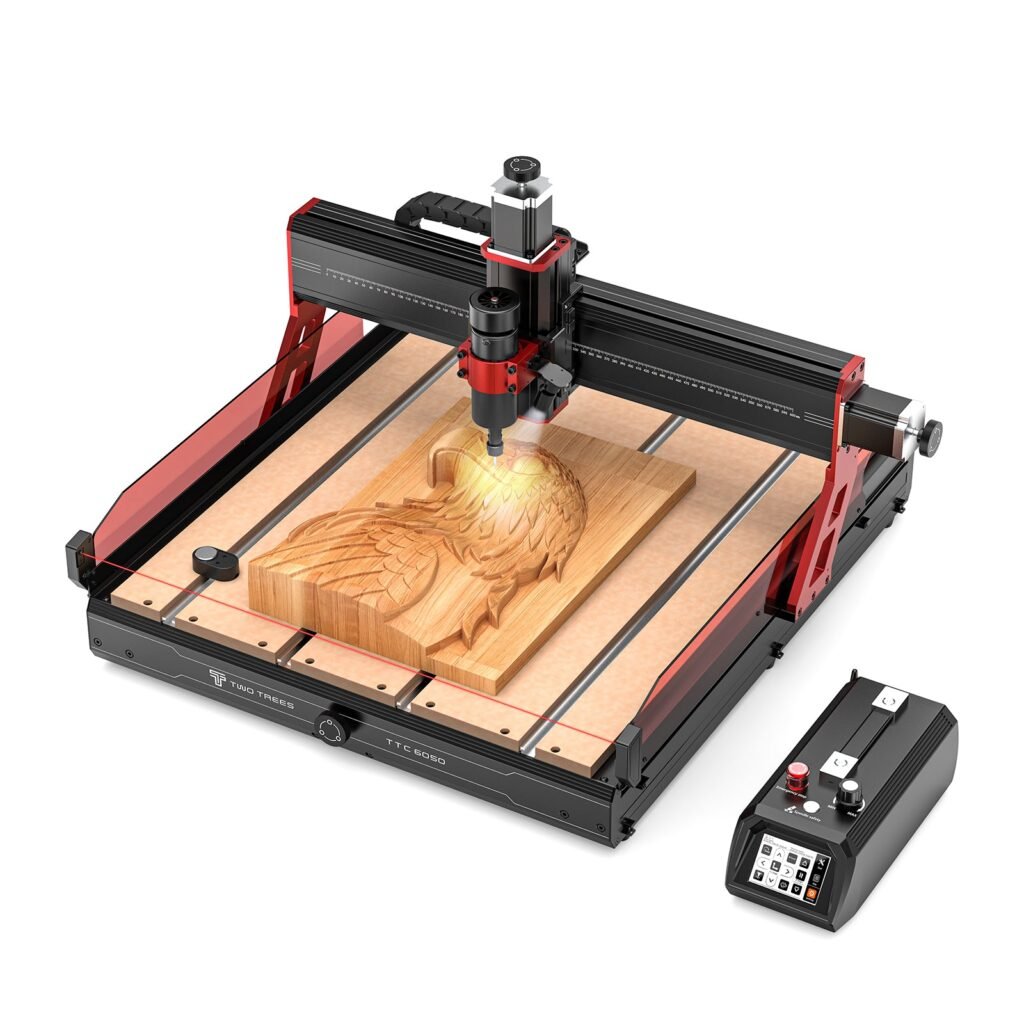
Twotrees TTC6050 CNC Router Machine – US /…
An industrial-style desktop router with a 600×500×100mm bed, ball screws, linear rails and safety features — aimed at higher throughput and larger projects.
Overview
The Twotrees TTC6050 is a step up from the compact hobbyist routers and into a more industrial‑style desktop machine. It combines a fairly large 600 × 500 × 100mm working area with ball screws and linear rails, a 500W spindle (around 12,000rpm nominal) and a claimed maximum feed speed of up to 5,000mm/min. On paper this places the TTC6050 where users want more accuracy, a stiffer frame and higher throughput, while still keeping the machine footprint and purchase price below full‑size industrial CNC routers.
TwoTrees positions the TTC6050 for tasks such as producing wooden furniture components, sign making and light metal engraving — essentially applications that benefit from the combination of a larger bed, better repeatability and the option to add expansions like a rotary axis or a stronger spindle. It also includes practical safety and control features for workshop use, including an infrared safety sensor, emergency‑stop support and an offline 3.5‑inch touchscreen controller.
Who is this best for?
The TTC6050 makes the most sense for hobbyists and small businesses who have outgrown lightweight desktop kits but do not want the cost, size or complexity of a full industrial router. Typical prospective owners include:
- Woodworkers and furniture makers creating medium‑sized components — drawer fronts, panels, trim and small casework.
- Sign makers who need a generous bed to cut and carve larger panels without repeated repositioning.
- Small shops doing light aluminium engraving or profiling where increased stiffness and repeatability matter.
- Makers looking to expand later with a rotary axis, vacuum table or upgraded spindle to increase capability and throughput.
If you primarily cut tiny projects or need extreme portability, a smaller desktop kit may be a better fit. Conversely, if you require heavy steel cutting, thick aluminium milling or industrial cycle‑times, a full‑size industrial machine will be more appropriate.
Key features
The TTC6050 is defined by a handful of practical hardware choices that push it towards a light production role rather than purely hobby use:
- Generous working area: 600 × 500 × 100mm — large enough for panel work and multi‑part jigs without constant re‑fixturing.
- 500W spindle: A stronger motor (around 12,000rpm nominal) compared with many desktop routers, offering more torque for tougher cuts and denser materials.
- Ball‑screw drive and linear rails: Higher precision and reduced backlash compared with belt drives; aimed at better repeatability for batch work.
- High max feed speed: Up to 5,000mm/min — useful for improving throughput on light cuts and faster machining strategies.
- Safety and control: Infrared safety sensor and emergency‑stop support, plus an offline 3.5‑inch touchscreen for standalone operation.
- Expandable platform: Options to add a rotary axis, stronger spindle or vacuum table for greater flexibility as needs evolve.
Practical evaluation
Without hands‑on testing from this review, it’s worth walking through how those features translate into everyday use and what you should expect during ownership. The TTC6050 is aimed at being a more reliable and accurate machine for longer or repeatable jobs, but it brings trade‑offs that are important to weigh.
First, the working envelope: the 600 × 500 × 100mm bed is a useful sweet spot. It’s big enough to handle many common panel sizes, multiple smaller workpieces in a single setup and parts used for small furniture and signage. That reduces the need for time‑consuming repositioning and improves efficiency for batch runs. The 100mm Z travel gives decent clearance for fixturing and thicker stock, although deep heavy milling remains beyond a machine of this class.
Mechanically, the use of ball screws and linear rails changes the behaviour you can expect compared with belt‑driven hobby kits. Ball screws reduce backlash, which helps for repeatable pocketing, dovetails or parts where multiple passes need to line up perfectly. Linear rails add stiffness under cut loads, which is why the TTC6050 is suggested as a candidate for light metal engraving — though “light” is the operative word. These components also typically increase the machine’s weight and footprint, so plan for a solid bench or mounting plate and less portability.
The 500W spindle improves cutting capability, especially when paired with the machine’s higher feed rates. In wood, this means you can use larger cutters and move faster without bogging the spindle. For aluminium or brass engraving you’ll still need conservative depths of cut, sharp tooling and likely multiple passes, but the stiffer frame and ball‑screw drive mean cleaner results than many smaller kits. Keep in mind that heavy metal milling, slotting or cutting thick sections still demands more power and a machine designed for that duty.
Control and safety features match the production leaning. The offline 3.5‑inch touchscreen lets the TTC6050 operate without a continuously connected PC, which is handy in busy workshops where the machine is left running. The infrared safety sensor and emergency‑stop help address shared workspace concerns, offering an extra layer beyond a basic on/off switch. For any CNC environment, pair those features with proper guards, extraction and safe programming practices.
Dust extraction and workshop setup are practical considerations. Routing wood produces significant chips and fine dust; even light metal work creates swarf that must be contained. The TTC6050’s larger bed and stronger spindle mean more material removal, so a dedicated extractor or good dust‑collection strategy is important for part quality, tool life and health. Noise and vibration will be higher than compact kits simply because of the heavier construction and stronger spindle, so plan for isolation and PPE.
One advantage of a more modular machine is the option to expand. Adding a rotary axis opens woodworking and sign‑making possibilities like engraving cylinders or tapered items. Upgrading to a stronger spindle or integrating a vacuum table can push the machine further towards small‑scale production. However, these expansions add cost and complexity; they may require electrical changes, controller configuration and space for ancillary equipment.
Finally, consider maintenance and parts. Ball screws and linear rails generally need regular inspection and lubrication to maintain accuracy. Replacement parts for brand‑name components are usually available, but sourcing specific TwoTrees replacement items or local service might be more difficult than for mainstream industrial brands, depending on your region. Factor in that some owners will choose to stock spare bits or have a local technician familiar with CNC mechanics.
Strengths
- Roomy work area: 600 × 500 × 100mm gives real capability for panel work and batch machining without constant re‑setup.
- Improved accuracy: Ball screws and linear rails reduce backlash and increase repeatability compared with belt‑driven hobby units.
- Stronger spindle: 500W motor provides more torque for denser woods and light metal engraving than many entry‑level spindles.
- Faster feed rates: Up to 5,000mm/min can shorten cycle times on many jobs when paired with appropriate tooling and feeds.
- Safety and standalone control: Infrared sensor, E‑stop support and an offline touchscreen make the TTC6050 more workshop‑ready.
- Expandable: Designed to accept rotary axes, vacuum tables or stronger spindles to grow with your needs.
Limitations
There are a few trade‑offs that come with moving into this class of CNC router. These aren’t dealbreakers for many buyers but are worth understanding before you commit.
- Not an industrial heavy‑duty machine: While stiffer than small kits, the TTC6050 is still intended for light metal engraving and woodworking rather than heavy steel milling or production‑grade metal cutting.
- Higher cost and footprint: Expect a larger machine and higher upfront cost than compact desktop routers. You also need a stable bench and space for extraction and any expansions.
- Configuration complexity: Adding expansions such as a rotary axis or upgraded spindle increases electrical, control and mechanical complexity, which may require additional parts or expertise.
- Dust and extraction needs: A larger spindle and more material removal demand an effective dust‑collection system to protect parts, tools and operator health.
- Parts and service: Depending on your location, sourcing replacement parts or local support may be less straightforward than for long‑established industrial brands.
Pricing and value
The TTC6050 is positioned as a mid‑range, more industrial desktop router. TwoTrees lists a guide price of around USD 1,599 but prices and availability change frequently, so check the retailer before buying. At that price point the machine competes with a number of options: smaller desktop kits, other mid‑sized hobby‑industrial hybrids and entry‑level industrial routers. Value depends on what you need from the machine.
If your work involves cut‑to‑size panels, repeated parts or occasional light‑metal engraving, the TTC6050’s larger bed, ball‑screw drive and stronger spindle represent sensible value compared with buying multiple smaller machines or upgrading a hobby kit. The ability to expand the platform later can make the purchase a better long‑term investment if you expect your business or projects to grow.
However, remember the total cost of ownership. Additions like a vacuum table, stronger spindle, rotary axis or a decent dust‑extraction system increase the overall spend. Also consider tooling — good end mills, cutters and fixturing contribute directly to finished part quality. If you plan heavy metal work or high hour production, factor in the cost of a true industrial machine rather than pushing a desktop platform beyond its intended use.
All told, the TTC6050 aims to strike a middle ground: more capability than a hobby kit without the price or footprint of industrial equipment. Whether it represents value for you depends on your material mix, batch sizes and plans for expansion.
Alternatives
When considering the TTC6050, weigh it against three broad alternatives:
- Compact desktop routers: Smaller, lower‑cost machines are easier to move and set up, and they suit light hobby work or prototyping. They can be a better choice if your parts are small or transportation is critical.
- Other mid‑sized machines: Competitors in this segment may offer different trade‑offs — for example, belt drives with very fast rapids or other configurations with larger spindles fitted from the factory. Compare frame rigidity, drives, control systems and expansion options when choosing between manufacturers.
- Entry‑level industrial routers: If your work increasingly involves aluminium, steel or long production runs, consider stepping up to a machine built for sustained metal cutting. These are more expensive but save time and tooling wear over the long run.
Evaluate alternatives by prioritising what matters most: bed size and usable work area, drive system (ball‑screw vs belt), spindle power, supported controller and available expansions. Also check local service and parts availability — that can matter more than a small price difference when the machine is in daily use.
Final verdict
The Twotrees TTC6050 is a credible option for makers and small shops who need a step up from hobby kits and want a machine capable of larger panels, more repeatable parts and occasional light metal work. Its large 600 × 500 × 100mm bed, ball‑screw drive, linear rails and 500W spindle give it the mechanical foundations to do real production work for woodworking, sign making and light engraving, while safety and offline control features make it practical for a shared workshop environment.
It’s important to be realistic about limits. This is not a full‑size industrial CNC meant for heavy metal milling, and expansions such as stronger spindles or rotary axes will increase cost and setup complexity. You should also budget for dust extraction, fixturing and quality tooling to get the best results from the machine.
If you want a capable, expandable mid‑sized router that sits between entry‑level hobby rigs and expensive industrial machines, the TTC6050 warrants serious consideration. Check the retailer for current pricing and availability, and factor in the extras you’ll need for your intended work — extraction, tooling and any planned upgrades — before committing. Offers and prices can change, so confirm the latest details on the retailer page before buying.
Prospective buyers who prioritise a larger bed, improved repeatability and a platform they can upgrade will find the TTC6050 attractive. If your work is primarily small‑scale hobby projects or requires heavy metal cutting, look at smaller or larger specialised machines instead.
Ready to check Twotrees TTC6050 CNC Router Machine – US / None / None?
Check the latest offer before buying, then return to the main comparison if you want to compare it against the other shortlisted options.
Compare this with the full shortlist
Return to the full comparison guide to see how this product compares against the other shortlisted choices.