
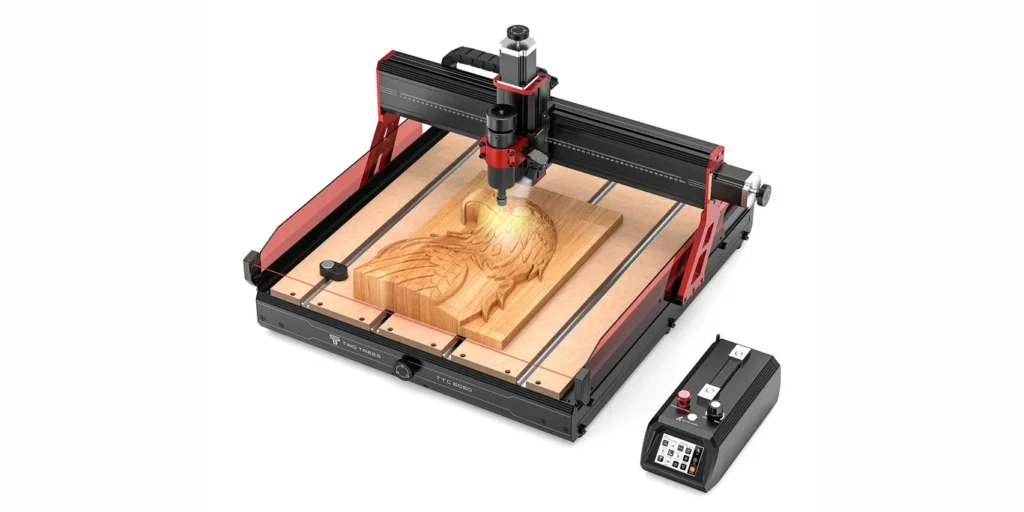
Twotrees TTC6050
Mid‑sized desktop CNC offering an expanded work envelope and a modular design aimed at upgradeability and workshop use.
Overview
The Twotrees TTC6050 sits in the sweet spot between compact benchtop CNC routers and full‑sized shop machines. With roughly a 600 × 500mm work area for longer parts, an aluminium frame and modular rails designed for upgrades, it gives hobbyists and small workshop users more usable table space without needing a dedicated industrial floor footprint.
It’s built around a modular philosophy: the frame and motion components are intended to be easy to modify, and there’s an active community producing brackets, dust shoes, spindle mounts and other add‑ons. That makes the TTC6050 a good starting point if you expect your needs to change — you can swap spindles, strengthen the frame, add dust collection or upgrade electronics as your budget and skills allow.
Do note that many sellers deliver the TTC6050 as a kit or semi‑assembled machine. What’s included varies, so check whether limit switches, a spindle motor, collets and clamping hardware are bundled with the package you’re looking at. Prices and accessory bundles change frequently — always check current listings and offers before you buy.
Who is this best for?
The TTC6050 is aimed at makers, small‑scale fabricators and hobbyists who want more working area than tiny benchtop units but still need something that fits on a standard workbench. If you cut timber, plastics and occasional light aluminium, and you’re comfortable with assembly, calibration and some mechanical tweaks, this machine is a practical option.
It’s particularly well suited to people who expect to tinker: the modular design makes upgrades straightforward, and the community around Twotrees offers plenty of aftermarket parts and advice. If you want a ready‑to‑run, plug‑and‑play production router that will happily mill thick billet aluminium at high feed rates straight out of the box, this probably isn’t the right model without substantial upgrades.
Key features
- Generous desktop work area: The table is sized to accommodate longer parts than compact desktop routers, useful for larger panels, signs and multi‑part assemblies.
- Aluminium frame and modular rails: The frame and rail system are designed for adaptability — you can reinforce sections or swap components as needed.
- G‑code and CAM compatibility: The TTC6050 works with standard G‑code workflows and common CAM packages, so it integrates readily into existing hobbyist toolchains.
- Intended materials: The machine is marketed for wood, plastics and light aluminium when paired with appropriate tooling and conservative feeds and depths of cut.
- Community and third‑party ecosystem: An active user base produces upgrade parts, jigs and troubleshooting advice that make tackling tweaks and repairs easier.
- Often kit or semi‑assembled: Expect some assembly and calibration; the exact level of completion and included accessories varies by seller.
Practical evaluation
Because the TTC6050 tends to ship as a kit or semi‑assembled machine, plan on dedicating a few hours to assembly and setup. For someone comfortable with mechanical assembly and basic electronics, this is straightforward: follow the manufacturer’s instructions, align the rails, fit limit switches if not pre‑installed and test motion. For newcomers, it’s worth budgeting extra time to learn alignment, belt tensioning and homing routines.
One of the practical strengths of the TTC6050 is the range of aftermarket upgrades and community guidance. If you find rigidity lacking for certain cuts, there are common reinforcement kits and stiffer spindle mounts available. Likewise, if dust control or noise is a concern, third‑party dust shoe designs and small‑shop extraction solutions are widely shared among users. That ecosystem reduces the friction of tailoring the machine to your workshop.
Workflows are familiar: generate toolpaths in your preferred CAM package, export standard G‑code and drive the machine with a controller that accepts that code. Because it uses common tooling standards, you can choose spindles, collets and endmills from many suppliers. However, many sellers do not include a spindle, controller or clamping kit as standard, so factor those into your setup plan.
On materials: expect reliable results with timber and plastics. Light aluminium is feasible, but the outcome depends heavily on tooling, feeds, depths of cut and machine rigidity. If you plan regular aluminium work, consider upfront investment in a stiffer spindle mount, a better spoilboard or paralleled support and lower RPM, higher quality cutters designed for metal. Otherwise, limit aluminium use to light jobs to avoid chatter or poor surface finish.
Strengths
- Roomier table for larger projects: The roughly 600 × 500mm working area lets you tackle longer or multiple parts without resorting to awkward staging.
- Modular and upgrade‑friendly: The design makes it straightforward to change spindles, reinforce the frame or add accessories like dust management or larger controllers.
- Good for hobby and light production: It strikes a practical balance between capability and a bench‑friendly footprint — useful for small businesses, prototype work and serious hobbyists.
- Community support: Strong third‑party ecosystem for fixtures, upgrades and troubleshooting reduces the learning curve and improves long‑term value.
- Standard G‑code/CAM compatibility: Works with common workflows, so you won’t be locked into niche software if you already use mainstream CAM tools.
Limitations
- Footprint and bench space: It’s larger than compact desktop machines and needs a sturdy bench — measure your workspace before buying.
- Rigidity for heavier cuts: For sustained aluminium removal or heavy‑duty machining, the stock frame and rail stiffening may be insufficient without upgrades.
- Accessories often sold separately: Spindles, collets, clamps and homing switches are frequently not included. Double‑check the vendor listing so you don’t underestimate the total cost.
- Assembly and calibration time: New users should expect to spend time assembling, aligning and learning the machine rather than plugging it in and getting straight to production.
- Dust and noise: Like most routers, it produces dust and sound — a dust‑collection plan and hearing protection are sensible additions for workshop safety and cleanliness.
Pricing and value
It’s not possible to quote exact prices here because listings and bundle options change frequently. The TTC6050’s value comes from the balance of a larger work area, modular construction and community support. However, the headline price of the base machine doesn’t tell the whole story: many buyers need to add a spindle, collets, a reliable clamping system, dust collection and possibly frame reinforcements or a better controller.
When you evaluate value, consider the total package you’ll need to be productive. Ask these questions before you buy:
- Does the seller include a spindle or is the machine drive‑only?
- Are limit switches, homing hardware and a controller provided, or will you need to source them separately?
- What clamping and fixturing options are included? Will you need a T‑slot table, vacuum hold‑downs or bespoke jigs for your work?
- Do you need dust extraction or a sound‑damping solution for your workspace?
- If you plan to cut aluminium, what upgrades to rigidity and spindle quality will be necessary?
Factor in these extras when comparing the TTC6050 to other machines. For many hobbyists the flexibility of a modular, upgradable platform represents excellent value — you can start with the core machine and add only the parts you need. For users who want a turn‑key, high‑throughput production router, a purpose‑built higher‑end machine may deliver better value despite a higher initial outlay.
Also remember to check the seller’s shipping terms, warranty and support channels. An active community can be a huge help, but reliable vendor support and clear parts lists reduce downtime and confusion if something arrives missing or damaged.
Alternatives
The TTC6050 sits between smaller benchtop machines and larger desktop routers. If your priority is space efficiency and you don’t need the larger table, compact benchtop models may be a better fit — they are easier to store and often require less assembly. Conversely, if you need a machine that will repeatedly cut thicker aluminium or run heavy production, larger, stiffer routers with dedicated industrial frames will be more appropriate.
Within the same brand family, the Twotrees TTC450 Ultra is our recommended choice for many users who want a well‑balanced, bench‑friendly router. It offers a slightly smaller footprint but can be better suited for workshops where bench space is limited while still providing a robust platform and the same community ecosystem for upgrades. If you’re weighing up the TTC6050 vs a compact alternative, ask whether the extra table area is a must‑have for your projects or an occasional convenience.
If you favour a different upgrade path, consider machines with heavier factory rigs if you plan to take large amounts off aluminium, or a router with a bundled, high‑quality spindle to reduce initial setup work. Ultimately, the best alternative depends on whether you prefer a modular platform you can tweak over time or a more finished out‑of‑the‑box experience.
Final verdict
The Twotrees TTC6050 is an attractive option if you want a roomy, upgrade‑friendly desktop CNC that still fits on a standard workbench. Its modular design and active community mean you can start with a solid core machine and evolve it as your needs change — add a better spindle, reinforce the frame, fit dust collection or improve the controller without undoing the whole system.
It’s not a magic bullet though. Expect to spend time assembling and tuning the machine, and budget for accessories that are often excluded from base packages. If you’ll be cutting a lot of aluminium, plan on reinforcing the chassis and choosing appropriate tooling and feeds. For wood and plastics, and occasional light metalwork, this is an effective, flexible platform.
For many readers, especially those short on bench space, the Twotrees TTC450 Ultra is our recommended choice across the brand’s lineup — but if you specifically need the larger working area and the upgrade path the TTC6050 offers, it’s a practical pick. Whatever you choose, check current listings carefully to confirm what’s included and whether any accessory bundles or upgrades are part of the deal. Prices and offers change often, so verify the latest details before you buy.
In short: choose the TTC6050 if you need a larger desktop work area and value the ability to upgrade and customise. If you prefer a more compact, bench‑friendly machine while still keeping upgrade options open, look closely at the TTC450 Ultra recommendation as an alternative.
Ready to check Twotrees TTC6050?
Check the latest offer before buying, then return to the main comparison if you want to compare it against the other shortlisted options.
Compare this with the full shortlist
Return to the full comparison guide to see how this product compares against the other shortlisted choices.