
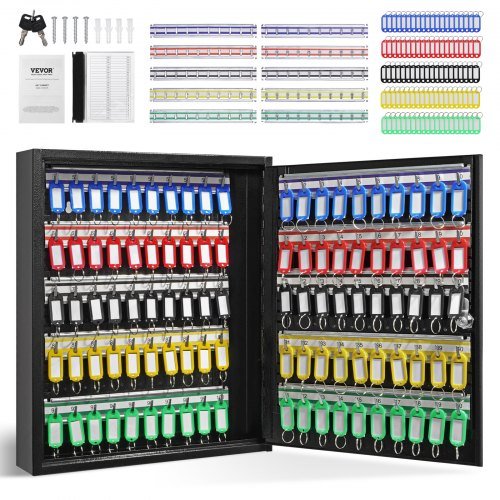
VEVOR 100-Key Cabinet
Mid-size 100-key steel cabinet with adjustable racks and 100 coloured tags — a practical middle ground for growing key collections.
Overview
The VEVOR 100-Key Cabinet is a straightforward, no-frills solution for physical key management. Built from cold-rolled steel with galvanized racks, it holds up to 100 keys on organised, numbered hooks and comes with 100 colour-coded tags and two record cards to help log key movements. Access is controlled by a keyed zinc alloy lock, and the unit is compact enough to fit in reception areas, maintenance rooms or small stores.
This review looks at the cabinet’s design, practicality and likely uses so you can decide whether it is the right fit for your workshop, office or facility. The focus is on real-world considerations — capacity, installation, security and day-to-day usability — rather than technical marketing claims.
Who is this best for?
The 100-key model sits in the middle of VEVOR’s range and is intended for organisations that need more capacity than a small, domestic box but don’t require a very large cabinet. Typical users include small-to-medium businesses, department-level managers in larger facilities, schools, hotels with modest room numbers, and maintenance or facilities teams that manage a modest fleet of vehicles, plant or locked spaces.
If you run a garage, a small property management company, or a business with multiple departments that each need controlled key access, this model will usually provide a good balance between storage capacity and wall space. It’s also a sensible option where budget and practicality matter — it’s less bulky and easier to site than larger 200-key units but offers more organised capacity than small 48-key boxes.
Key features
- 100-key capacity — Numbered hooks provide clear organisation so keys can be located quickly.
- Cold-rolled steel construction — The body is built for everyday commercial use and should resist knocks and dings better than lightweight alternatives.
- 0.7mm galvanized racks — The internal racks are treated to resist corrosion and are adjustable to suit different key groupings.
- Zinc alloy keyed lock — A traditional key lock keeps the cabinet secured; access control is simple and familiar.
- 100 colour-coded key tags — Included tags allow fast visual identification and grouping of key sets.
- Two record cards — Basic paper logs are supplied to track who took which key and when.
- Compact footprint — Approximate dimensions of 450 × 380 × 84 mm make it easy to mount on a variety of walls without taking up too much space.
- Wall-mountable — Designed to be fixed to a wall to keep keys secure and visible.
Practical evaluation
Organisation and day-to-day use are where simple key cabinets either make life easier or become a nuisance. The VEVOR 100-Key Cabinet scores well for straightforward organisation: numbered hooks combined with colour-coded tags reduce time spent searching for the right key. The included record cards are a basic but useful tool for logging sign-outs in low-tech environments.
Installation is generally straightforward because the unit is relatively light and compact compared with much larger cabinets. That makes it possible to site the cabinet in reception areas, plant rooms or corridors where authorised staff can reach it without climbing a ladder. Do check whether mounting screws and wall anchors are included by your retailer — some sellers don’t supply these, so you may need to source appropriate fixings for your wall type.
Security with a keyed zinc alloy lock is familiar and effective for many day-to-day needs. However, it’s worth noting that keyed systems rely on good key control practices: lost or duplicated access keys are the main security risk with this type of cabinet. If your operation demands audit trails, remote management or multi-user access controls, you won’t find that here — this is intentionally a low-tech solution.
The adjustable racks add practical flexibility. You might prefer grouping keys by department, vehicle or area rather than strictly sequentially; being able to reconfigure the racks helps keep that organisation tidy. The galvanised finish on the racks is also thoughtful for durability — keys and tags will be rubbed on these surfaces frequently, so corrosion resistance matters over the long term.
Strengths
- Good mid-range capacity — 100 hooks suit many small businesses, departments and schools without overwhelming wall space.
- Durable, simple construction — Cold-rolled steel and galvanized racks provide everyday resilience in commercial environments.
- Practical organisation aids included — 100 colour tags and two record cards make it easier to implement a basic sign-out process immediately.
- Compact and easier to site — Smaller and lighter than large 200-key cabinets, making installation simpler in tighter locations.
- Cost-to-capacity balance — For organisations that need around this many hooks, it is a sensible, value-focused option.
Limitations
As with any physical, keyed cabinet, there are limitations to be aware of. The zinc alloy keyed lock is practical but represents a single point of failure: misplaced access keys can disrupt operations until a replacement or lock change is made. If you need remote access control, audit trails or different user permissions, this cabinet won’t deliver those features because it has no electronic or networked access control.
The cabinet still requires manual record keeping if you want an audit trail. The included record cards are useful in smaller setups, but they’re not a replacement for centralised property management software or electronic logging if you have strict compliance or accountability requirements. Finally, while the build is robust for its class, finish quality and included accessories (mounting hardware, for example) may vary by retailer, so check what’s included before purchase.
Where this model fits compared with smaller and larger options
It helps to think of the 100-key cabinet as a practical compromise. A 48-key cabinet can be a better fit for very small teams, home-based workshops or when you only need to manage a few vehicles or properties. Those smaller units are lighter, cheaper and easier to hide away, but they quickly run out of space once you need to manage more than a few dozen keys.
At the other end, a 200-key cabinet suits larger facilities, multi-site managers or businesses with extensive vehicle fleets and equipment. Those larger cabinets provide greater consolidation but require more wall space, a sturdier mounting solution and often a two-person lift to install. If you expect growth or plan to centralise keys for several departments, stepping up to 200 hooks can make sense — but if you only need to manage keys for a single small office or workshop, the 100-key model is often the better, more economical choice.
Practical buying considerations
Before buying, consider how you will operate the cabinet day to day. Ask yourself:
- How many keys do I need now, and how many might I need in 12–24 months? (Leave room for growth.)
- Who will have access, and can you manage duplicate or misplaced access keys responsibly?
- Do you require audit trails, multi-user permissions or electronic logs? If so, consider an electronic cabinet or a key management system.
- Where will you mount it? Verify wall type and select appropriate fixings — the retailer may not provide anchors or screws.
- Will the cabinet be in a public area (reception) or a secured back-office? The location impacts who can see the key tags and logs and how strictly you need to control access.
Also check whether the colour-coded tags are plain or pre-numbered, and whether the record cards match your preferred logging format. You may want to invest in a small clipboard, laminated sign-out sheet or a simple digital log to complement the supplied cards if you expect frequent key movement.
Pricing and value
The VEVOR 100-Key Cabinet is positioned as a value-conscious, mid-capacity solution. It generally costs more than very small domestic boxes but offers clear advantages in terms of capacity, organised hooks and included tags. For organisations that need to manage dozens of keys without paying for a high-end electronic system, this cabinet offers a sensible return on investment: durable construction, practical accessories and a compact footprint.
Bear in mind that prices and offers can change. Always check current availability and the retailer’s full description — including what fixings and accessories are included — before buying. If you need additional security, factor in the cost of a spare key, lock-change service or even a move to an electronic option should your requirements evolve.
Alternatives to consider
If you’re weighing options, consider the following general alternatives (without referring to specific models):
- Smaller keyed cabinets — A 48-key model is worth considering if your needs are modest or you want the lightest, most compact option for a reception desk or home office.
- Larger keyed cabinets — A 200-key (or larger) cabinet may be a better long-term choice if you plan to centralise keys for multiple departments or expect rapid growth.
- Electronic key management units — For facilities that require audit trails, timed access or multi-user permissions, an electronic system offers those features but at a higher cost and with more complex installation.
- Hybrid approaches — Some organisations use a mix: a small electronic unit for the most critical keys and a keyed cabinet like this one for routine items. That balances cost with control.
Final verdict
The VEVOR 100-Key Cabinet is a practical, value-focused solution for small-to-medium workplaces that need organised physical key storage without the complexity or cost of electronic systems. Its steel construction, galvanized racks and included tags make it well suited to everyday commercial use, and the 100-hook capacity is large enough for many offices, schools and maintenance departments while remaining compact enough to install in tight locations.
It is not, however, a fit for every situation. If you need electronic access control, remote logging, or strict audit trails, you should consider higher-end key management systems. Likewise, if your operation is very small or entirely digital, a 48-key cabinet or a different storage approach may be preferable. But for many organisations that manage dozens of keys and want a straightforward, durable cabinet with practical organisation aids, this VEVOR model represents a sensible balance of cost, capacity and usability.
Note: Prices and offers can change — check current price and availability before buying and confirm exactly what is included with your order (mounting hardware, spare keys, and accessories can vary by retailer).
Ready to check VEVOR 100-Key Cabinet, Key Lock Box with Adjustable Racks, Security Key Storage Box Steel, Key Organizer with 100 Colorful Key Tags and 2 Record Cards for School, Office, Hotel?
Check the latest offer before buying, then return to the main comparison if you want to compare it against the other shortlisted options.
Compare this with the full shortlist
Return to the full comparison guide to see how this product compares against the other shortlisted choices.