
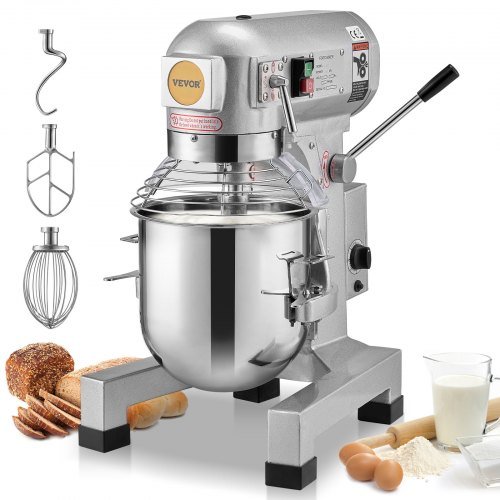
VEVOR Commercial Food Mixer
18.7L capacity and 1100W motor provide a clear step up for larger batches and heavier mixing tasks in professional kitchens.
Overview
The VEVOR Commercial Food Mixer in the 18.7L size sits in the middle of VEVOR’s commercial lineup. It pairs an 1,100W motor with a relatively compact footprint (533 × 462 × 780 mm) and a heavier build (around 63 kg), and is supplied with the usual stainless steel bowl, basic mixing attachments and a protective cover. The speed profile is simple — three selectable speeds with a higher top end (approximately 458 r/min, mid 193 r/min and low 130 r/min) — reflecting a design geared toward denser doughs and sustained, heavier use than smaller 550–750W machines.
This review pulls the product details together and explains how the 18.7L model fits into a professional or semi‑professional kitchen. It highlights the practical considerations — capacity, motor torque, footprint, installation and maintenance — so you can decide whether this is the right mixer for your workflow.
Who is this best for?
The VEVOR 18.7L is aimed at small bakeries, busy cafés, restaurants and catering operations that need to produce medium to large batches more frequently than a domestic or light‑commercial machine can handle. It’s a sensible choice if you need extra torque for bread doughs, longer run times and a larger bowl to reduce the number of production cycles each day.
It’s also appropriate for serious home bakers who regularly make sizeable quantities and have the bench space and electrical capacity for a heavier unit — but bear in mind the weight and dimensions mean it’s less suited to occasional domestic use where a lighter 10–14L mixer would be more practical and cost‑effective.
Key features
- Motor power: 1,100W motor designed for heavier doughs and longer runs.
- Three adjustable speeds: top speed ~458 r/min, mid ~193 r/min, low ~130 r/min — a profile tuned for torque rather than fine‑grained speed control.
- Bowl and attachments: stainless steel bowl and standard mixing attachments supplied; protective cover included for cleaner operation.
- Construction: cast iron and stainless construction for durability in daily commercial use.
- Footprint and weight: dimensions of 533 × 462 × 780 mm and a weight in the region of 63 kg — larger and heavier than small benchtop machines.
These elements combine to make a machine that focuses on reliable torque, easy cleaning and a workmanlike design rather than a long list of precision speed settings or cosmetic features.
Practical evaluation
With the supplied specifications in mind, the practical question is how the VEVOR 18.7L performs in everyday kitchen scenarios. While this review does not claim hands‑on testing, the machine’s listed features point to several clear practical outcomes and trade‑offs that buyers should anticipate.
Capacity and workflow
The 18.7L listing positions this model as a mid‑capacity mixer. In commercial terms, that typically means you can mix larger batches of dough, batter or cream in one cycle compared with 10–14L units. Fewer cycles reduces handling time and lets small teams keep up with steady demand — useful in a café during rush hour or a bakery producing multiple loaves and trays per shift.
However, larger capacity also raises operational considerations: loading and unloading a heavier bowl takes more space and may need two people for certain tasks, and you’ll want a stable, sturdy bench or stand to support the mixer’s weight and the torque generated in use.
Motor and speed profile
The 1,100W motor is the central selling point. Compared with lighter 500–750W motors, it should deliver noticeably more torque for thick, heavy doughs and longer mixing cycles. The speed figures given (high 458 r/min, mid 193 r/min, low 130 r/min) show a design that favours outright power and a limited yet practical speed range rather than exact, multi‑step control.
For many commercial tasks — mixing bread dough, kneading pastry and combining large batters — three well‑spaced speeds are adequate. If you need very fine control for delicate whisking or certain confectionery tasks, machines with more incremental speed settings or specialised attachments may feel more flexible.
Build quality and cleaning
The mix of cast iron and stainless construction is positive for anyone using the machine daily. Cast iron components lend rigidity and longevity to the body and lifting mechanisms; stainless contact parts (bowl, attachments) help with hygiene and cleaning. The included protective cover reduces splatter and keeps the work area neater.
Routine cleaning should be straightforward: stainless bowls and attachments can be rinsed and washed; cast components typically need wiping down. As with any commercial kit, establish a daily cleaning routine and check for wear on moving parts — bearings and lift mechanisms are the common maintenance points on mixers.
Installation and power
The mixer’s weight (around 63 kg) and footprint mean you’ll need a strong, level work surface. Consider securing the bench or using a dedicated stand. Also verify the electrical supply in your kitchen: an 1,100W motor draws more current than smaller mixers, and depending on local wiring and usage, you may need to confirm the circuit can handle sustained loads, especially if other heavy equipment shares the same supply.
If you plan continuous multi‑hour operation, check the manufacturer’s duty cycle guidelines and any warranty/support terms for commercial use. The product listing emphasises heavier duty design, but it’s sensible to confirm whether there are limits on continuous run times or recommended cool‑down periods.
Strengths
- More torque for denser doughs: The 1,100W motor is the key advantage, giving the machine better capability to handle bread and heavy mixes than smaller models.
- Greater batch capacity: The larger bowl reduces the number of batches you must run, saving time during busy periods.
- Durable construction: Cast iron and stainless components suit daily commercial use and frequent cleaning.
- Practical speed profile: Three speeds with a higher top speed are a simple, robust approach for common commercial tasks.
- Attachments and protective cover: Supplied accessories and a cover help keep the unit functional and hygienic out of the box.
Limitations
- Size and weight: At roughly 63 kg and with a larger footprint, the mixer demands bench space and a strong support surface — not ideal for cramped or makeshift kitchens.
- Electrical requirements: The higher‑power motor may need a more robust supply. Verify your kitchen circuits and consult an electrician if you’re unsure.
- Price compared with smaller models: It’s more expensive than the lighter 550–750W options, so budget‑minded buyers should weigh whether the extra capacity and torque are necessary.
- Limited speed granularity: Only three speeds are available. For operations that need very fine control for delicate aeration or specific confectionery techniques, a mixer with more speeds or variable control might be preferable.
- Unknown continuous duty details: The listing highlights commercial intent, but check the duty cycle and support/warranty if you expect near‑continuous, heavy daily usage.
Pricing and value
The published guide price for this VEVOR 18.7L mixer is USD 819.90. That places it above lighter benchtop commercial machines and below full‑scale floor mixers, making it a mid‑market choice. Whether it represents good value depends on your output and how often you’ll rely on the machine.
If your operation regularly produces medium to large batches, the time savings from fewer mixes and the reduced strain on smaller motors can justify the extra spend. The build materials (cast iron and stainless) and the stronger motor suggest a design intended to keep running day after day, which supports longer‑term value for busy premises.
For occasional commercial work or infrequent large‑batch baking, a smaller, cheaper mixer might be more economical. Always factor in installation (bench reinforcement or stand), possible electrical upgrades and any warranty or spares support when calculating total cost of ownership.
Note: prices and offers can change — check the retailer page for the latest availability and current pricing before you buy.
Alternatives
When choosing the right commercial mixer, it helps to compare the 18.7L VEVOR with smaller and larger options so you can match capacity and power to your needs.
- Smaller 10–14L mixers: These are lighter, less expensive and easier to install. They suit bakeries or cafés that make smaller batch sizes, or businesses that primarily prepare pastry and light batters rather than heavy bread doughs. If bench space is tight or budget is a priority, a smaller model will be easier to live with day to day.
- Larger 28.5L / floor mixers: If you’re running a high‑volume bakery or catering business that routinely mixes very large quantities, a larger floor‑standing mixer will reduce batch counts further and generally offer even more torque. These units are pricier and need more space, but they pay off in very high throughput environments.
- Machines with variable speed controls: If precision aeration and delicate whisking are common tasks in your kitchen, look for mixers with finer speed control. These give more flexibility for tasks that sit outside heavy dough mixing.
Think about the kinds of recipes you use most and the daily batch volumes. If bread and dense doughs are your main work, the additional motor power of the VEVOR 18.7L is attractive. If your operation skews toward pastries, whipped creams or small artisan cakes, a machine with more nuanced speed control or a smaller capacity may be better value.
Final verdict
The VEVOR 18.7L Commercial Food Mixer is a pragmatic mid‑capacity choice for kitchens that need more muscle than a small benchtop mixer but aren’t ready to move to a full industrial floor machine. Its 1,100W motor, three‑speed profile and sturdy cast iron/stainless build make it well suited to regular, heavier use — in small bakeries, busy cafés and restaurants that produce medium to large batches day after day.
It isn’t without compromises: the weight and footprint require a sturdy work surface and likely a dedicated spot in the kitchen, the three speeds lack fine‑tuned control for some delicate tasks, and you should check electrical supply and any continuous‑use limits before committing. For buyers who need reliable torque and a larger bowl to cut batch counts, the 18.7L offers a useful middle ground and can represent good value compared with stepping up to a floor mixer.
Before you buy, double‑check the retailer listing for the most current specifications and availability, verify any warranty or support terms for commercial use, and make sure you’re prepared for the installation and electrical needs of a heavier unit.
Offers and prices change; check the retailer page for the latest availability and up‑to‑date pricing information.
Compare this with the full shortlist
Return to the full comparison guide to see how this product compares against the other shortlisted choices.