
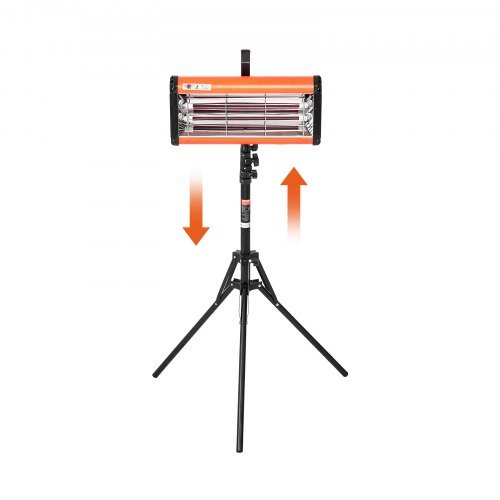
VEVOR Infrared Curing Lamp
2000W infrared curing lamp with handheld or stand operation and timer for faster paint cures.
Overview
The VEVOR Infrared Curing Lamp is a compact, high-power paint dryer designed for small workshops, mobile repairers and anyone looking to speed up drying times for panels and small parts. With a 2,000W rating, adjustable height stand and the option to use it handheld, it’s built to be flexible: you can tack it onto a tripod for repeatable cycles or move it around for targeted spot repairs. The unit claims an emitter life of around 5,000 hours and covers roughly 0.33 m² (about 3.55 sq.ft) per pass — enough for single panels, bumpers or small bodywork areas but not for curing an entire vehicle.
This review pulls together the confirmed product details and practical considerations that matter when adding an infrared lamp to a small paint-shop workflow. It doesn’t rely on hands-on testing; instead it explains how the lamp is specified, where it will help, and the realistic limits you need to plan for.
Who is this best for?
The VEVOR infrared lamp suits a handful of specific use cases rather than full-scale bodyshop production. Typical users who will get most value include:
- Independent repairers and mobile technicians who do spot repairs and one-off paint jobs and need faster turnaround than air-drying allows.
- Small workshop owners who don’t have the space, budget or electrical infrastructure for a fixed bake booth, but still want quicker curing for panels and parts.
- Hobbyists and restorers working on small components, trim items or single panels where precise, localised heat is more useful than oven-style baking.
It’s less appropriate for large-volume bodyshops, full-vehicle baking or any situation where you routinely need to cure large areas simultaneously — those environments are better served by dedicated bake booths or controlled ovens.
Key features
- Dual handheld or stand use: The lamp can be used in your hand for close work or mounted on its adjustable stand, which ranges from 740mm to 1,970mm. That flexibility helps when you need repeatable positioning or want to angle the emitter for tricky shapes.
- 2,000W power rating: A high power level for a portable unit, intended to significantly accelerate drying and curing for small areas.
- 0–90 minute timer: Integrated timing control allows for repeatable cure cycles rather than relying on guesswork. This supports better process control for spot repairs.
- Baking footprint: The emitter covers around 0.33 m² (3.55 sq.ft) per pass — good for panels and parts but not designed for whole-vehicle baking.
- Emitter lifespan: A quoted lifespan of roughly 5,000 hours, which gives some indication of eventual replacement needs.
- Build and portability: Constructed from stainless steel, aluminium and carbon steel, the unit is relatively lightweight at approximately 3.55 kg and has a foldable base for easier storage and transport.
Practical evaluation
When you consider introducing an infrared curing lamp into a small paint-shop workflow, the practical questions are where it will sit in your process, how you’ll manage safety, and whether your electrical setup can handle its demands. The VEVOR lamp is clearly aimed at improving single-panel throughput and reducing drying waits; here’s how it stacks up against those needs.
Speed and workflow fit: Infrared heat significantly reduces the time for solvent evaporation and cross-linking in many paint systems compared with ambient air cure. For spot repairs — think a wing, door skin or bumper — the ability to target heat directly speeds mixing/colour-matching, buffing and reassembly. In practical terms, this lamp is best used after preparation and application but before final assembly, so you can shorten the time the vehicle is off the road without needing a full bake booth.
Portability and positioning: The stand’s height range covers most practical working positions, and the lightweight, foldable design makes it easy to move between jobs or store between uses. Handheld use is helpful for awkward angles or smaller parts, though that requires operator care to maintain correct distance and avoid hot spots.
Electrical and heat considerations: A 2,000W device draws a substantial current when in use. Before relying on it regularly, check your workshop’s circuits — extension leads and multi-socket strips are poor solutions for sustained 2kW loads. Also plan for clearances: infrared is effective but will also heat surrounding trim, plastics and panels. Maintaining the recommended distance from vulnerable materials, using heat shields if required, and monitoring temperatures are essential precautions.
Repeatability and control: The 0–90 minute timer is a helpful inclusion that supports repeatable cycles, particularly when you need to standardise a repair process. However, different paint types and thicknesses cure differently; the timer should be used alongside manufacturer guidance for the coatings you’re using rather than as a one-size-fits-all setting.
Strengths
- Significant time savings: For small panels and spot repairs the lamp meaningfully cuts air-dry times and helps reduce vehicle downtime.
- Flexible deployment: Dual handheld or stand use means you can adapt to small parts, awkward angles and repeatable set-ups.
- Repeatable cycles: Built-in timer helps you standardise workflows and avoids overexposure or guesswork.
- Compact footprint: It takes up far less space than a bake booth and is easier to store when not in use — a practical advantage in small workshops.
- Portable for on-site work: Lightweight and foldable base make it a practical tool for mobile repairers who need to bring curing to the job.
Limitations
- Not designed for whole vehicles: With a baking area of around 0.33 m² the lamp is intended for panels or parts — it’s not a substitute for a bake booth when you need to cure large areas or entire bodies.
- High power draw: At 2,000W the unit demands a robust electrical supply. Poor cabling or overloaded circuits are potential hazards and will limit performance.
- Risk of heat damage: Trim, plastics and certain coatings can be damaged by excessive or uneven heat. Operator attention and, where appropriate, heat shields are essential to avoid problems.
- Emitter life: The quoted 5,000-hour emitter life means the lamp will eventually need a replacement element — factor this into long-term running costs.
- Not a substitute for controlled ovens: For critical industrial work where regulated temperature and airflow are required, infrared spot curing is not equivalent to a controlled bake booth.
Pricing and value
The guide price provided for this unit is USD 80.99, but prices and availability can change — always check the retailer for current offers and shipping costs. On paper, a portable infrared lamp in this price bracket represents good value for hobbyists and small shops that need occasional faster curing but can’t justify a more expensive fixed booth.
Value depends on how you’ll use the lamp. If your workflow includes many spot repairs or short panel jobs, the time savings alone (reduced drying/wait times, quicker turnaround) can justify the purchase quickly. Conversely, if you rarely need rapid curing or you already have access to a bake booth, the lamp becomes a niche convenience rather than a core tool.
Remember to budget for practical extras: safe, heavy-duty cabling or a dedicated circuit, heat shields or masking materials for nearby trim, and eventual emitter replacement. Those items add to the lifetime cost but are essential for safe and effective operation.
Alternatives and complementary kit
If you’re deciding whether to buy this lamp, it helps to think about alternatives and what else you might need to complete a small paint-shop setup.
- Full bake booth: A fixed or inflatable bake booth is the right choice when you need to cure full panels or whole vehicles regularly. Bake booths provide controlled temperature and airflow, and they’re safer for broad-area curing, but they demand space, ventilation and higher capital outlay.
- Other infrared lamps: There are alternative handheld and stand-mounted infrared solutions with different power ratings and emitter sizes. Higher-power lamps may cure faster but increase the risk of heat damage and require heavier electrical supply.
- Conventional drying methods: If you don’t need speed, ambient air drying with good ventilation and controlled humidity can be effective and cost-free to run, though it’s slower and weather-dependent.
- HVLP spray guns and prep tools: An infrared lamp complements good spraying and preparation kit. If you haven’t already invested in a quality HVLP gun and dust control, those are the tools that determine the finish quality before the lamp comes into play.
Used together, a modest spray setup, an inflatable or small booth for dust control, and a targeted infrared lamp create an efficient small-shop workflow: prep and spray in a clean environment, then use the lamp to accelerate cure and move on to final finishing sooner.
Practical buying guidance
Before you buy, consider these practical questions to make sure the lamp will fit your needs:
- How often will you use it? Regular daily use changes expectations for build quality, emitter lifespan and running costs. For heavier use, check the warranty and availability of replacement emitters.
- What’s your electrical capacity? Confirm that your workshop circuit can safely supply a 2,000W load. Where necessary, factor in installation of a dedicated circuit or heavier-duty leads to avoid trips and hazards.
- What materials and paints do you use? Some materials and coatings are more sensitive to heat. Check manufacturer curing recommendations and run small tests on sacrificial panels to dial in safe distances and times.
- Do you need portability? The lamp’s lightweight, foldable base makes it suitable for mobile work. If you expect to move between sites frequently, check how easy it is to pack and secure the unit for transport.
- How will you manage safety? Plan for heat shields, protective gloves and clear signage. Heat can accumulate quickly in enclosed areas; make sure you have ventilation and temperature monitoring where necessary.
Final verdict
The VEVOR 2000W infrared curing lamp is a clear-minded tool for small paint shops, mobile repairers and DIY restorers who need faster drying for panels and spot repairs without the footprint and cost of a bake booth. Its combination of portability, stand-mounted repeatability and a useful timer makes it a practical addition to workflows that aim to reduce vehicle downtime and improve throughput for single-panel jobs.
That said, it’s important to be realistic about the limits. This is a targeted curing solution rather than a replacement for controlled ovens or full vehicle baking. It draws significant power, carries a risk of heat damage to adjacent materials when used incorrectly, and will require eventual emitter replacement. If you understand those trade-offs and plan for proper electrical supply and safety measures, the lamp offers good value for the right user.
In short: if your work centres on spot repairs, touch-ups and small panels — and you need to speed up drying without investing in a full booth — the VEVOR lamp is worth strong consideration. If you routinely cure whole vehicles, or need strict, uniform temperature control for industrial processes, look at larger, dedicated bake solutions instead.
Note: offers and prices can change. Check the retailer page for the latest price and availability before you buy.
Ready to check VEVOR Infrared Curing Lamp, Handheld/Stand Dual Use, 2000W 0-90 min Timing, Auto Heating Car Curing Light with Bracket, 3.55 sq.ft Spray Baking Booth Heaters, Paint Dryer for On-Site Repair?
Check the latest offer before buying, then return to the main comparison if you want to compare it against the other shortlisted options.
Compare this with the full shortlist
Return to the full comparison guide to see how this product compares against the other shortlisted choices.