
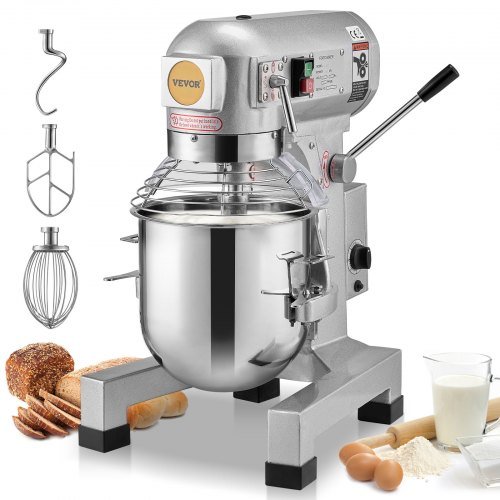
VEVOR Commercial Food Mixer
Largest capacity in the range — 28.5L bowl with an 1100W motor ideal for high‑volume production and dense dough mixing.
Overview
The VEVOR 28.5L commercial stand mixer is the largest model in VEVOR’s commercial mixer line-up covered in this guide. It combines a single-batch capacity aimed at high-volume production with an 1100W motor, three mechanical speed settings and a selection of standard mixing attachments — whisk, dough hook and beater. The machine is built from heavy cast iron and comes with a stainless steel bowl. At 548 x 462 x 855 mm it occupies a substantial footprint and is intended for work environments where large quantities are mixed frequently, such as busy bakeries, pastry shops, cafés with significant food production or small commercial kitchens.
This review explains how the 28.5L model compares to smaller commercial mixers, who it suits, how you should think about motor power and capacity, and the practical trade-offs involved when choosing a mixer of this size.
Who is this best for?
The VEVOR 28.5L is purpose-built for operations where one large batch is better than multiple small batches. It suits:
- Bakeries producing large volumes of dough, batter or fillings that benefit from a single mixed batch.
- Commercial kitchens and caterers that prepare bulk mixes for soups, sauces, desserts or dough and need consistent throughput.
- Food service businesses that can justify the bench space and electrical supply a large mixer requires and want to reduce labour from repeated smaller mixes.
It is not aimed at casual home bakers, low‑volume cafés or kitchens where counter space is tight. If you normally mix a few loaves at a time, domestic stand mixers or VEVOR’s smaller commercial models are likely a better fit.
Key features
Here are the principal features to know, followed by why each matters in commercial use:
- 28.5-litre bowl capacity — the largest single-batch capacity in this product range, letting you process significantly larger quantities than smaller mixers.
- 1100W motor — designed for sustained heavy mixing; provides the torque needed for dense doughs and extended runs.
- Three-speed mechanical control — basic but robust speed selection for whisking, mixing and heavy kneading functions.
- Standard attachments — stainless whisk, dough hook and beater are included for common bakery and food-prep tasks.
- Heavy cast-iron construction — durable build that helps the machine withstand the demands of frequent commercial use.
- Stainless steel bowl and removable attachments — eases cleaning and helps meet hygiene expectations in a professional setting.
- Physical footprint — at 548 x 462 x 855 mm this mixer requires a dedicated bench or sturdy stand and adequate clearance above the bowl.
These features align with the mixer’s role as a high-capacity, durable workhorse. The inclusion of basic but robust controls and fittings keeps operation straightforward for trained staff, while removable utensils and the stainless bowl keep cleaning and turnaround manageable.
Practical evaluation
Buying a 28.5L mixer is as much about logistics as it is about mixing performance. The VEVOR unit’s strengths and limitations are clearer when you put the machine into the context of a working kitchen.
Capacity and workflow: If your business benefits from mixing large single batches — for example, where dough is bulk-processed and portioned after proofing — the 28.5L bowl reduces the number of mixing cycles and staff interventions. This can save time during peak shifts and reduce wear from constant start/stop cycles on smaller machines. Consider how you will handle the mixed product: large bowls mean larger, heavier bowls to manoeuvre. You will need adequate space for cooling, proofing and portioning after mixing.
Motor and performance: The 1100W motor is specified for sustained heavy mixing. That makes a meaningful difference when dealing with high-hydration breads, enriched doughs or thick custards. However, the mixer relies on three fixed speeds rather than a variable speed controller, so there is less scope for very fine speed adjustments during delicate tasks. For many commercial uses, fixed speeds are a reasonable compromise between simplicity and durability; but if you require slow, controlled starts for sensitive batters or very slow kneads, you should factor this limitation into your decision.
Durability and maintenance: The heavy cast-iron frame indicates a focus on longevity and resistance to the knocks of a busy kitchen. Removable attachments and a stainless bowl help with cleaning, but routine maintenance and occasional inspection of moving parts are still advisable. A machine this size and weight may need two people to place or reposition safely, and it may benefit from professional installation and periodic servicing, particularly in very high-use environments.
Power and installation: An 1100W motor draws significantly more power than a domestic mixer. Check your kitchen’s electrical capacity and, if necessary, consult an electrician to verify that circuits and sockets can safely supply the machine, especially if other equipment is running at the same time. The mixer’s footprint and height also demand ample bench strength and clearance; ensure ventilation is adequate and that staff can load and remove large quantities safely.
Strengths
Summarised below are the areas where this VEVOR model stands out:
- Largest single-batch capacity — If your priority is reducing the number of mixes per shift, a 28.5L bowl lets you move more product through in one run.
- Heavy-duty motor for sustained use — The 1100W motor is specified for continuous mixing tasks and should cope with dense doughs and regular commercial workloads better than lower-powered models.
- Built to last — Cast-iron construction and commercial-grade attachments are designed for the wear and tear of a busy kitchen.
- Cleaner workflow — Removable stainless steel bowl and detachable attachments make cleaning between shifts or recipes more straightforward, helping maintain hygiene standards.
- Reduced downtime — Bigger batches mean fewer interruptions for loading and unloading, which is valuable during busy service periods.
These strengths align with the needs of high-throughput operations where reliability and bulk capacity are the priority considerations.
Limitations
No product is perfect for every situation. The main trade-offs with the VEVOR 28.5L are practical and operational:
- Size and weight — The machine’s footprint and mass require a strong bench or stand and two-person handling for safe placement. It isn’t suitable for cramped or home kitchens.
- Electrical demands — Higher power consumption and the need for a suitably rated circuit mean you may need an electrician or an upgrade to your kitchen’s electrical layout.
- Three fixed speeds — While robust, the limited speed range provides less granular control compared with variable-speed mixers. For delicate emulsions or very slow dough development, this could be a disadvantage.
- Cost and outlay — Larger commercial mixers are inherently more expensive than smaller models. Beyond the purchase price, factor in installation, any required electrical work and the operational cost of running a larger motor.
- Not for low-volume kitchens — If you rarely need large batches, the machine will be underused, and a smaller mixer will be more economical and space-efficient.
These are practical considerations rather than faults; they simply reflect the realities of installing and operating a large-capacity commercial mixer.
Pricing and value
The guide price supplied for this model is USD 887.90. Prices and availability for commercial equipment can vary over time and between suppliers, so check current figures before committing. When assessing value, consider the total cost of ownership rather than just the headline purchase price. That includes:
- Any installation or electrical work required to accommodate the machine.
- Staff training and handling procedures for safe loading/unloading and maintenance.
- Operating costs — a larger motor will draw more electricity, especially during extended runs.
- Spare parts and servicing — commercial machines in constant use require periodic servicing; confirm availability of parts and local service options.
For kitchens that will run large batches daily, the upfront cost will often be justified by the time saved and the reduced labour of repeated smaller mixes. If your operation is more sporadic or a smaller throughput, a mid-size mixer will usually offer better value.
Alternatives
If you’re considering the VEVOR 28.5L, you should also review smaller-capacity commercial mixers and heavy-duty domestic machines to match capacity with need. A few typical alternatives to weigh up:
- Smaller commercial VEVOR mixers (10L–20L): These reduce footprint, power draw and cost while still offering better durability and capacity than domestic machines. They are a good middle ground for cafés, small bakeries and kitchens that need regular but not massive batches.
- Capital equipment from established commercial brands: If budget and local service availability are priorities, consider machines from long-established commercial kitchen suppliers. These often come with robust local after-sales support and established service networks.
- High-end domestic stand mixers: For low volumes or specialist bakeries doing staged batches rather than bulk mixing, a professional-grade domestic mixer can offer more precise speed control and a smaller footprint.
How to choose between these: start with your average and peak batch sizes. If you frequently reach or exceed what a 10–15L bowl can hold, you are likely to benefit from stepping up to 20–28.5L. Next, check the physical and electrical constraints of your kitchen. If you can’t accommodate the bench strength or circuit capacity of the 28.5L, a smaller model will be a wiser long-term purchase.
Final verdict
The VEVOR 28.5L commercial stand mixer is a clear choice for busy kitchens and bakeries that genuinely need large single-batch capacity. With its 28.5-litre bowl and 1100W motor it is specified to handle sustained heavy mixing and to reduce the number of mixing cycles required across a busy shift. The heavy cast-iron build and removable stainless bowl and attachments align with the durability and hygiene standards expected in commercial settings.
That said, it comes with real practical trade-offs. The size, weight and electrical demands mean you must plan your workspace and power supply before purchase. Its three fixed speeds deliver durability and simplicity but limit fine control for more delicate mixing tasks. Cost, handling and servicing considerations also mean the 28.5L model is best for businesses that will use its capacity regularly.
In short, choose this VEVOR model if large single-batch throughput is central to your operation, you have the bench space and electrical capacity to support it, and you want a durable, commercial-grade mixer that reduces downtime from repeated mixes. If you only occasionally need large volumes, or if space and power are constraints, a smaller commercial model or a high-end domestic mixer will probably be a better fit.
Please note: product availability and prices can change. Always check current offers and supplier details before purchasing, and confirm any electrical or installation requirements with a qualified electrician.
Ready to check VEVOR Commercial Food Mixer, 28.5L Commercial Stand Mixer with 3 Adjustable Speeds, 1100W Dough Mixer with Stainless Steel Bowl and 3 Mixing Attachments, Ideal for Restaurant, Bakery, Pastry shop, Caf?
Check the latest offer before buying, then return to the main comparison if you want to compare it against the other shortlisted options.
Compare this with the full shortlist
Return to the full comparison guide to see how this product compares against the other shortlisted choices.