
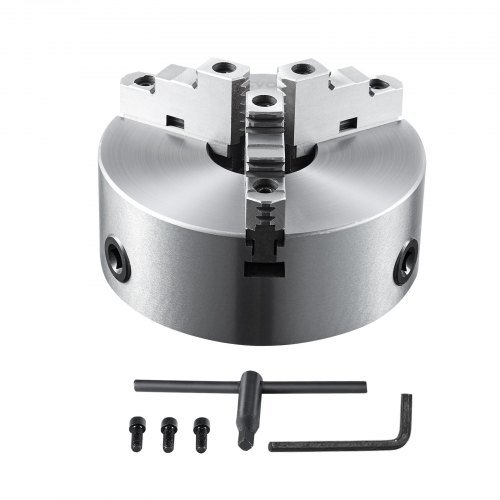
VEVOR 3-Jaw Lathe Chuck
VEVOR 3-Jaw Lathe Chuck, 10'', Self-Centering Lathe Chuck, 0.24-9.84 in/6-250 mm Clamping Range with T-key Fixing Screws Hexagon Wrench, for Lathe 3D Printer Machining Center Mill…
Overview
The VEVOR 3‑Jaw Lathe Chuck (K11‑250) is a 10‑inch, self‑centring chuck aimed at hobbyists and small shops that need a versatile, reasonably heavy‑duty holding solution. It’s a conventional three‑jaw design with hardened jaws and a large external and internal clamping range, and it comes with the usual T‑key and hex wrench for jaw/fastener adjustment. The manufacturer supplies a handful of technical details that tell you what the chuck is made from and the mounting dimensions — useful information when deciding if it will fit your machine.
This review pools those specs into practical guidance: what the chuck is best for, where it might fall short, how to check compatibility, and sensible maintenance and safety notes for anyone considering buying one for a lathe, machining centre or other rotating tool set‑up.
Who is this best for?
The VEVOR 10″ 3‑jaw chuck suits users who need an affordable, general‑purpose chuck for turning round stock. Typical buyers include hobby machinists, small engineering workshops, and people fitting a chuck to a home lathe or multi‑purpose machining centre where ease of use and a broad clamping range matter more than the absolute last degree of concentricity.
It’s particularly appropriate if you often work with cylindrical bar stock and want a quick, repeatable self‑centring grip rather than the time‑consuming adjustments of an independent four‑jaw chuck. The combination of internal and external clamping ranges also makes it convenient if you switch between gripping inside a bore and outside on a round bar.
However, it is not primarily targeted at precision toolroom applications where micrometre‑level runout control, certification, or ultra‑high repeatability are essential. For jobs that demand deliberate off‑centre setups, irregular workpieces or very small diameters, you’ll want to consider alternative chuck types or accessories (see the Alternatives section).
Key features
- 10‑inch (≈250 mm) chuck outside diameter, nominal product size φ252 × 190 mm; net weight approximately 22.3 kg.
- Self‑centring 3‑jaw design: jaws move together to centre the workpiece.
- Clamping ranges: internal (approx. 6–110 mm / 0.236–4.331 in) and external jaw clamping (approx. 80–250 mm / 3.15–9.84 in).
- Jaw material and hardness: jaws listed as 20Cr with hardness ≥53 HRC.
- Scroll material: 40Cr work with hardness ≥45 HRC.
- Body material: HT300 (cast iron), surface treatment Ra <0.8, oil coated.
- Bore: φ80 mm; fixed thread: 3‑M10 mounting points (check your spindle/faceplate pattern).
- Supplied accessories: T‑key fixing screws and a hexagon wrench for jaw and fastener adjustments.
Practical evaluation
Based on the published specifications, the VEVOR K11‑250 is built around the standard trade‑offs of a three‑jaw self‑centring chuck: quick set‑up and reliable holding for round work, but less flexibility for irregular shapes. The hardened 20Cr jaws (≥53 HRC) indicate reasonable wear resistance — that’s an advantage if you’re repeatedly clamping similar workpieces and don’t want the jaws to deform quickly. The scroll made from a harder 40Cr (≥45 HRC) is typical and should provide dependable engagement with the jaws.
The cast iron HT300 body will help dampen vibration compared with some lighter aluminium chucks, which is a bonus when cutting finishes are important. That said, because the chuck is fairly heavy (around 22 kg), you should be sure your machine can accept the load — both in terms of mounting and in the maximum recommended spindle speed for a chuck of this diameter. A 250 mm‑class chuck is physically substantial and may not be suitable for small bench lathes designed for light hobby use.
Installation considerations: the chuck has an 80 mm bore and uses three M10 mounting threads. That means mounting it will be straightforward on machines with a compatible backplate or adaptor, but you must verify the thread spacing and the depth of the bore. If the bolt pattern on your lathe’s spindle nose or backplate differs, you’ll need an appropriate adaptor plate or a different chuck mounting method.
On the subject of clamping range, the product lists two useful ranges: the internal clamping range (approx. 6–110 mm) is what you’d use to grip inside a bore or between internal shoulders; the external jaw range (approx. 80–250 mm) covers outside gripping on bars and larger workpieces. This dual‑range flexibility is handy so you don’t have to change jaws or use separate chucks for basic internal and external work.
Keep in mind the inherent trade‑offs of three‑jaw chucks. They centre work quickly but are not as adaptable to odd‑shaped pieces. If you regularly need to true up an asymmetrical item, or require exact off‑centre positioning, an independent four‑jaw chuck or a collet system will give more control.
Strengths
- Wide clamping range for both internal and external work, meaning fewer jaw changes for common tasks.
- Hardened jaws and scroll material suggest reasonable wear resistance for repeated use.
- Cast iron body gives mass and damping, which can help surface finish during cutting.
- Self‑centring action speeds up setup of round stock compared with independent chucks.
- Comes with the basic tools (T‑key and hex wrench) needed to get going.
- Relatively straightforward mounting using three M10 fixings — common on many lathes.
Limitations
- Precision details such as guaranteed runout or dynamic balance are not listed; if you need toolroom‑grade accuracy you should verify runout with your own test equipment or consider a product with measured tolerances and certification.
- At roughly 22 kg the chuck is heavy; ensure your machine and tooling can handle the mass and the inertia at speed.
- Three‑jaw chucks are inherently less flexible for irregular shapes and for deliberate eccentric set‑ups compared with independent chucks.
- Surface finish and long‑term wear depend on installation, maintenance and the specifics of your workload. Regular cleaning and lubrication are required to keep the scroll and jaws operating smoothly.
- Compatibility depends on your spindle nose, backplate and bolt pattern; an adaptor may be required if measurements don’t match exactly.
Buying and safety considerations
Before you buy, check the following carefully to avoid surprises:
- Spindle mounting: verify that the chuck’s bore and the three‑bolt M10 thread pattern match your lathe’s backplate or that you can obtain a suitable adaptor.
- Weight and rotational limits: confirm your machine can safely accommodate a 22 kg chuck and that you stay within safe chuck speed for the workpiece and chuck diameter.
- Workpiece size: ensure the internal and external clamping ranges meet the majority of the diameters you intend to work on; remember jaw travel and the closed‑position minimum are important for small diameters.
- Accessories and spare parts: consider buying spare jaws or a dedicated backplate if you expect to switch between many different setups.
- Safety: always use a chuck guard, check jaw tightness before spinning, and never exceed the recommended RPMs for a given diameter and mass. Avoid over‑torquing the T‑key; use manufacturer torque guidance if supplied.
Maintenance tips: keep the scroll and jaw slides clean from chips and swarf, apply light machine oil periodically to the scroll and moving surfaces, and inspect mounting bolts for security before every session. Well‑maintained slides and a clean scroll extend jaw life and reduce the risk of jamming or uneven clamping.
Pricing and value
The listed guide price for this chuck is USD 169.90. That places it in the budget‑to‑mid range for a 250 mm self‑centring chuck with hardened jaws. Whether it represents good value depends on your priorities: for hobbyists and small shops requiring a large‑format, general‑purpose chuck, the combination of a wide clamping range, hardened jaws and a cast‑iron body makes it an attractive option.
If you need certified runout or guaranteed balancing for precision work, you may have to pay more for a premium brand or a factory‑balanced, test‑certified model. Also factor in any adaptor plates, shipping, VAT or import duties if you’re buying from abroad, as these can increase the total cost substantially compared with the guide price. Always check the retailer’s page for the latest price and availability before purchasing.
Alternatives
Choosing the right chuck depends on the work you do. If the VEVOR 3‑jaw chuck nearly fits your needs but not quite, consider these alternatives in type (rather than brand):
- Four‑jaw independent chuck: ideal if you need to centre square or irregular stock or set up deliberate off‑centre work. It takes longer to set up but offers greater versatility and fine adjustment.
- Collet chuck: choose this if you need superb concentricity and are mostly turning smaller, uniform bar stock. Collets give excellent repeatability for specific diameter ranges but are less flexible for larger or varied sizes.
- Keyless chucks or quick‑change jaw systems: useful if you frequently need to swap jaws or fixtures quickly for short production runs.
- Hydraulic or pneumatic chucks: these provide uniform, high clamping force and excellent concentricity for industrial or production settings, but they cost more and require additional equipment.
When weighing alternatives, think about what you clamp most often, how much setup time you can tolerate, and whether runout tolerance or sheer clamping force is the priority. For many users a quality three‑jaw chuck is the most practical all‑round solution — but for specific precision or irregular work, the alternatives above will outperform a standard self‑centring chuck.
Final verdict
The VEVOR 3‑Jaw 10″ Self‑Centring Lathe Chuck is a sensible choice if you want a large, general‑purpose chuck at an affordable price. The specs — hardened 20Cr jaws, a 40Cr scroll, cast‑iron body and a wide internal/external clamping range — point to a capable unit for routine turning tasks. Its self‑centring action saves setup time on round bar stock and the included tools make initial fitting straightforward.
That said, it’s important to be realistic about limits. The three‑jaw design is not the right tool for every job; precision‑centric work or non‑round pieces demand other chucks or workholding methods. Also, the product literature does not quote measured runout or balance figures, so if you require certified tolerances you should seek a chuck with test documentation or consider a higher‑end model.
Overall, for hobbyists and small workshops that need a rugged, flexible chuck for everyday turning, the VEVOR K11‑250 looks like a good-value option — provided you double‑check the mounting compatibility with your lathe and are happy with the typical trade‑offs of a three‑jaw self‑centring design.
Note: Offers and prices can change, and availability varies by retailer. Check the seller’s page for the latest price, delivery and compatibility information before buying.
Ready to check VEVOR 3-Jaw Lathe Chuck, 10'', Self-Centering Lathe Chuck, 0.24-9.84 in/6-250 mm Clamping Range with T-key Fixing Screws Hexagon Wrench, for Lathe 3D Printer Machining Center Milling Drilling Machine?
Check the latest offer before buying, then return to the main comparison if you want to compare it against the other shortlisted options.
Also featured in
This product also appears on these price comparison pages:
Compare this with the full shortlist
Return to the full comparison guide to see how this product compares against the other shortlisted choices.