
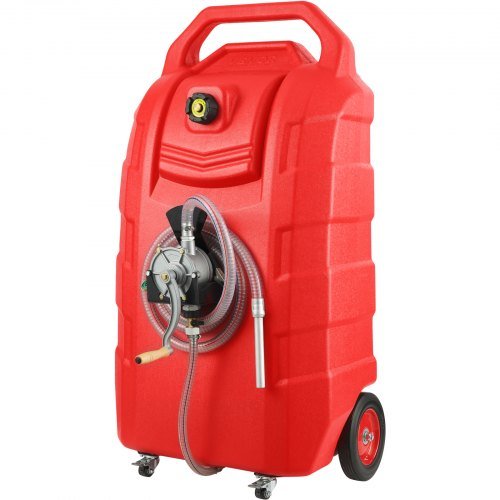
VEVOR Fuel Caddy
Same 32‑gallon tank on wheels but with a rotary manual pump — simple, reliable and independent of power.
Overview
The VEVOR 32‑gallon fuel caddy is a straightforward, portable fuel storage solution that pairs a high‑capacity polyethylene tank with a fixed steel mount and 8‑inch rubber wheels. Where many portable caddies come with a 12V transfer pump, this version deliberately keeps things simple: it uses a rotary manual transfer pump and a sizeable internal hose (φ19 mm, 250 cm long) to move fuel without the need for batteries or vehicle power.
On paper this feels like a pragmatic alternative for people who don’t want to rely on electrical power, or who need a robust, lower‑complexity unit for occasional top‑ups and on‑site refuelling. It’s not a compact can for everyday carry; filled it’s heavy, and the unit is built for movement around a yard, garage or job site rather than frequent long‑distance transport.
Who is this best for?
This VEVOR caddy is aimed at buyers who prioritise simplicity and reliability over automated convenience. Typical users include:
- Homeowners and smallholders who need to top up lawn mowers, ATVs or garden machinery but don’t want to fuss with electrical pumps.
- Boat owners and anglers who may be working from a launch site with limited shore power or car battery access.
- Tradespeople and site workers who want a robust tank that can be manoeuvred on site, where access to 12V is not guaranteed or desirable.
- Anyone who prefers fewer electronic parts to maintain — rotary manual pumps are often easier to keep running in the field.
If your priority is rapid, hands‑free transfers for frequent refuelling of vehicles or machinery, an electrically driven 12V transfer pump might be a better fit. But if you want a lower‑cost, lower‑complexity option that will work anywhere, this manual variant is worth considering.
Key features
- 32 US gallon capacity (about 121 litres) — enough to carry a meaningful quantity of fuel without being a bulk tanker.
- Rotary manual transfer pump included — no batteries or vehicle power needed.
- Listed maximum flow ~7.8 L/min under the manufacturer’s stated conditions — the pump is reasonably capable for a manual unit.
- Wired hose: 19 mm internal diameter, 250 cm length — a generous internal bore helps reduce pumping effort and improve flow.
- PE (polyethylene) tank with fixed carbon steel mounting — durable materials that resist corrosion and general wear.
- 8‑inch rubber wheels for mobility — easier to move on tarmac, concrete or compacted ground than smaller hard wheels.
Practical evaluation
Because this is a manual rotary pump model, the real‑world experience depends largely on how often and how much you intend to dispense. The manufacturer lists a maximum flow of about 7.8 litres per minute under stated conditions; with the 19 mm internal hose and a 2.5‑metre length, the system is designed to be reasonably efficient for hand pumping. That larger internal diameter helps the pump move fuel more smoothly and reduces the number of strokes required compared with narrower manual hoses.
In everyday uses — topping a lawn mower or refilling an ATV — the caddy is likely to feel convenient. You’ll avoid the need to connect to a vehicle battery or an auxiliary power source, which simplifies operation and reduces the number of potential failure points. The simplicity also means fewer things to maintain: rotary pumps have relatively straightforward internals, and replacement parts are generally easier to source or improvise in the field.
On the other hand, manual pumping becomes a physical task when you’re transferring large volumes. While the listed flow is competitive for a manual unit, pumping for several minutes straight can be tiring. If you regularly move fuel between multiple vehicles or service lots of machines every day, you might miss the hands‑free convenience of a 12V pump.
Mobility is a clear plus. The 8‑inch rubber wheels and fixed steel mount make it straightforward to reposition the caddy around a yard or garage. However, do not underestimate the weight when full: a 121‑litre tank of fuel is heavy even with wheels, and while the caddy is designed to be moved on site, it’s not intended for strenuous lifting or long‑distance transport without suitable equipment or vehicle support.
Strengths
- No power required: The main selling point is obvious — this unit works anywhere without a battery or 12V connection. That matters if you work away from mains or rely on simple, durable kit.
- Simpler mechanics and easier maintenance: Manual rotary pumps are mechanically less complicated than electric pumps, which generally makes field repairs or part swaps easier.
- Good hose diameter for manual transfer: The 19 mm internal hose reduces resistance, so each stroke delivers more volume than narrower options.
- Durable construction: A PE tank paired with carbon steel mounting reduces corrosion concerns and stands up to the knocks common in outdoor use.
- Lower purchase complexity and cost: Manual models are typically cheaper than powered versions and avoid the need to maintain electrical connectors and wiring.
Limitations
- Physical effort needed: For larger transfers the rotary pump will require repeated manual strokes, which can be tiring or impractical for some users.
- Slower throughput for high‑use scenarios: If you’re refuelling many machines each day, a 12V pump’s continuous flow could save time and effort.
- Still heavy when full: The wheels help, but manoeuvring the filled caddy requires care; it’s not a lightweight portable can by any means.
- May need adapters: The hose and nozzle may not fit every filler neck cleanly; you might want to keep common adapters to hand.
- Regulatory and safety considerations: Always check local transport and storage rules when moving fuel — the caddy’s design doesn’t remove the need to comply with safety regulations.
Pricing and value
The guide price supplied with the product data is USD 235.90. Manual variants generally cost less than their 12V‑equipped counterparts because they omit the transfer motor and associated wiring. That makes sense if you’re on a budget or want to avoid the extra complexity of an electrical system.
Value here comes down to matching the product to your needs. If you only need occasional top‑ups — filling garden machinery, small boats or the odd ATV — the savings in purchase price and ongoing maintenance can make the manual caddy a sensible buy. Equally, if you operate where electrical access is unreliable, the lower long‑term ownership risk (fewer electrical failure modes) is a tangible benefit.
Before buying, check current prices and availability on the retailer page — offers and stock levels change. Also consider a modest budget for any additional nozzles, adapters or grounding straps you might need to integrate the caddy with your existing equipment safely.
Alternatives to consider
When comparing options it helps to think about the two main trade‑offs: convenience (12V transfer pump) versus simplicity and independence from electrical power (manual pump).
- 12V transfer pump versions: These models let you run transfers from your vehicle battery or an auxiliary power source. They’re faster for repeated refuelling and reduce physical effort, but they add wiring, circuitry and another failure mode. If you regularly refuel many machines or need much faster throughput, the electric variant may be worth paying extra for.
- Smaller portable jerry cans: For infrequent, light jobs a handful of certified jerry cans may be cheaper and easier to store, though they lack the capacity and wheeled mobility of a 32‑gallon caddy.
- Stationary tanks and fixed dispensers: If you have a workshop with a high turnover of fuel, a fixed tank with a pump and metering system offers the most efficiency and safety controls, though it requires more installation and compliance work.
Which alternative is right comes down to how often you’ll use the caddy, where you’ll use it (site vs home vs launch), and whether you prefer speed over simplicity.
Final verdict
The VEVOR 32‑gallon fuel caddy with manual rotary transfer pump is a practical, no‑frills solution designed for people who need a reliable way to move a substantial quantity of fuel without relying on batteries or vehicle power. Its strengths are its simplicity, durable construction and the convenience of having a sizeable, wheeled tank on site.
It’s not the right tool for everyone. If you routinely need fast, hands‑free transfers — for example, if you refuel multiple vehicles daily — you’ll likely prefer the convenience of a 12V transfer pump. Likewise, anyone who intends to move the caddy long distances while full should pay attention to vehicle rules and safe securing methods; despite the wheels, this remains a heavy item when filled.
For buyers who value a lower‑complexity system that’s easier to maintain and that will work in remote locations without power, the manual VEVOR caddy delivers sensible value. The larger hose diameter and reasonable listed flow rate make it one of the more user‑friendly manual options, and the robust PE tank and steel mounting contribute to long service life in rugged environments.
Note: offers, prices and availability can change — check the retailer page before buying.
Ready to check VEVOR Fuel Caddy, 32 Gallon, Portable Fuel Storage Tank On-Wheels, with Manual Transfer Pump, Gasoline Diesel Fuel Container for Cars, Lawn Mowers, ATVs, Boats, More, Red?
Check the latest offer before buying, then return to the main comparison if you want to compare it against the other shortlisted options.
Compare this with the full shortlist
Return to the full comparison guide to see how this product compares against the other shortlisted choices.