
VEVOR 48-Key Cabinet
Steel 48-key cabinet with combination and key lock options, adjustable racks and 48 colourful key tags — compact and budget-friendly.
Overview
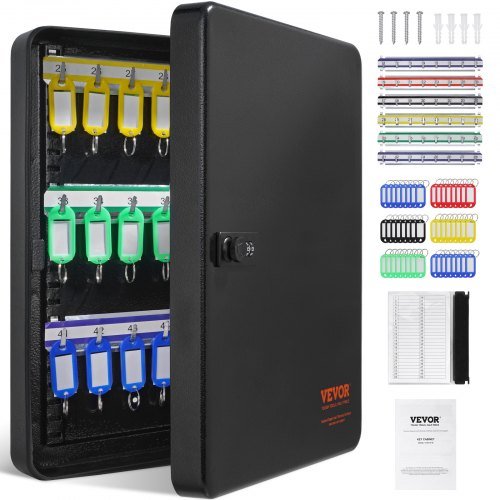
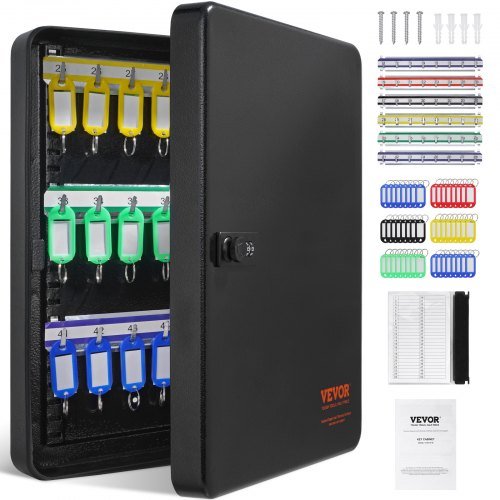
The VEVOR 48‑Key Cabinet is the smallest model in VEVOR’s range of steel key organisers. It’s designed for locations where wall or counter space is limited but a tidy, lockable home for keys is still needed. The cabinet combines a mechanical combination dial with a keyed lock for two‑layer access control, includes adjustable internal racks and is supplied with 48 colour‑coded tags plus a record card for manual logging.
This review explains how the unit will perform in everyday use, who it suits best, what practical compromises it forces you to accept, and how to decide whether this compact option or a larger or more feature‑rich system is the better investment for your site.
Who is this best for?
The VEVOR 48‑Key Cabinet is aimed at small‑scale users who want straightforward, physical key management without electronics or complicated user permissions. Typical use cases include:
- Reception desks and small offices where available wall space is limited and a compact unit will fit without dominating the area.
- Property managers and landlords who need a portable, secondary cabinet for overflow keys, seasonal lets or a small portfolio of properties.
- Small businesses that require a simple check‑in/check‑out routine and physical security for a modest number of keys rather than audit trails and remote control.
- Facilities where portability and low cost matter more than high mechanical security or digital logging — for example, temporary sites or shared spaces.
If your site routinely handles dozens into the hundreds of keys, needs detailed audit logs, or relies on electronic fobs and remotes that are large or irregularly shaped, this 48‑key unit will probably be too limited. In that case, consider larger VEVOR models with 100 or 200 key capacity or an electronic key management system that records who accessed what and when.
Key features
The VEVOR 48‑Key Cabinet sticks to the essentials. It doesn’t try to be clever — which is precisely the point for buyers who want a simple, reliable cabinet without a subscription or software to manage. Key features are:
- 48‑key capacity: Numbered hooks let you assign and quickly find up to 48 keys or fobs. The numbering helps when combined with the supplied tags and record card.
- Steel construction: A metal body gives a basic level of physical protection that is sturdier than plastic alternatives and suitable for everyday use.
- Dual access control: A mechanical combination dial plus a keyed lock provide two ways of securing the cabinet. You can use the combination for routine access and keep the key as an emergency override.
- Adjustable internal racks: Racks can be repositioned to accommodate different key sizes and to make the most of the internal space.
- Accessories included: 48 colour‑coded key tags and a record card are supplied so you can start assigning and tracking keys straight away.
- Compact footprint: The unit is intentionally small to suit narrow walls, counters or reception backdrops.
- Mechanical design: No electronics, batteries or network connections — this is a purely mechanical solution.
Practical evaluation
Looking beyond the spec list, the VEVOR 48‑Key Cabinet is about practicality and clarity. It delivers exactly what the specification promises: a small, lockable cabinet that organises up to 48 keys with a simple record‑keeping method. That predictability is useful for many buyers, but it also defines the product’s limits.
Size and placement: The cabinet’s compact dimensions make it a good fit where space is at a premium. Because it’s lightweight relative to larger steel units, it’s reasonably easy to move between rooms or sites if necessary. That portability is an advantage for landlords or mobile technicians who don’t want to commit to a heavy, permanently fixed safe.
Security and access control: The dual locking arrangement is sensible for small teams. Using the combination as the primary access method removes dependency on a key for everyday retrieval, while the keyed lock functions as an override or manager’s access. This addresses common operational needs — for example, receptionists needing frequent access while a manager retains the key for emergency situations.
However, this is not a high‑security safe. The steel construction and mechanical locks provide a deterrent against casual tampering and opportunistic theft, but they will not match dedicated high‑security safes or electronic systems with anti‑tamper features. If your keys safeguard high‑value assets or you expect determined attempts at forced entry, consider a heavier duty cabinet or a professional safe instead.
Organisation and day‑to‑day use: The numbered hooks, colour tags and included record card make it easy to set up a check‑in/check‑out routine. Colour coding helps rapid visual identification — handy in busy receptions or when multiple staff share responsibility for keys. The record card is sufficient for low‑volume environments, but if you need a permanent audit trail you’ll want to supplement it with a staff log or digital spreadsheet. Manual logging introduces the usual human error risks, so clear procedures and periodic checks are recommended.
Compatibility with fobs and remotes: The adjustable racks add flexibility if you have some larger items to store, but very bulky car remotes or oversized FOBs may still crowd neighbouring hooks. Before committing, consider measuring the largest items you need to store to ensure a comfortable fit or plan for alternative storage for those few items.
Installation: Mounting is straightforward on solid masonry or timber stud walls, but like any light steel cabinet you should check the supplied fixings and the wall construction. Plasterboard or hollow walls will need appropriate anchors or reinforcement to prevent the unit being levered from the wall. If portability is crucial and you plan to move the cabinet often, consider whether you prefer freestanding placement on a secure counter or a bolted wall fit.
Strengths
- Space efficient: The compact form factor suits tight areas — reception counters, narrow corridors and small offices — where a full‑size key room cabinet would be impractical.
- Flexible access management: Combination dial plus keyed lock gives practical options for everyday use and emergency override without needing a sophisticated access control system.
- Ready to use out of the box: Supplied colour tags and a record card mean you can implement a basic system immediately.
- Steel construction: A solid metal body offers durable everyday protection and is less likely to warp or crack than cheaper plastic alternatives.
- Portable for small operations: Because it’s lighter than larger safes, it’s easier to relocate when your needs change.
Limitations
- Capacity limit: 48 keys will be insufficient for medium or large facilities. If you expect growth, plan whether to buy a larger VEVOR model (100 or 200 keys) or an additional cabinet.
- No electronic audit trail: There’s no event logging or user authentication beyond the combination and key. All allocation records must be kept manually, which increases administrative overhead and the risk of gaps in accountability.
- Combination management: The benefits of a combination lock come with administrative work — codes must be recorded or remembered and changed when staff leave or security incidents occur.
- Key duplication risk: The keyed override presents the typical risk that copies could be made or the key misplaced. Secure storage and strict key control procedures are still required.
- Wall fixing dependency: Proper anchors or bolts are needed for secure wall mounting. Unsuitable fixings or weak walls reduce the cabinet’s effectiveness as a theft deterrent.
- Not for high‑security needs: This is a basic mechanical product. For sites that need anti‑tamper features, certified security ratings, or electronic user management, this cabinet is not a substitute.
Pricing and value
The VEVOR 48‑Key Cabinet is positioned as an economical, no‑frills key organiser. Its value proposition is straightforward: low upfront cost, minimal running expenses (no batteries or subscriptions), and immediate usability thanks to the included tags and record card. That makes it attractive for small businesses, landlords and reception areas that need a tidy, lockable place for a modest number of keys.
When weighing value, consider the total cost of making the cabinet work in your environment. Items to factor into your decision include the cost of suitable wall fixings or reinforcement if mounting on non‑solid walls, potential additional tags or log sheets if you prefer digital records, and any labour involved in updating security procedures (for example, rotating the combination or maintaining an audit spreadsheet). If you expect requirements to grow, you should compare the price of upgrading to a 100‑ or 200‑key VEVOR cabinet against using multiple 48‑key units — a single larger unit can be cleaner operationally in many cases.
Note: prices and offers vary between retailers and over time. Check current availability and pricing before you buy to ensure you get the best deal and confirm what’s included in the box.
Alternatives and when to choose them
The VEVOR 48‑Key Cabinet suits a clearly defined niche. If your needs fall outside that niche, here are reasonable alternative directions and the types of solution to consider:
- Higher‑capacity metal cabinets: If you expect to manage more than 48 keys, look at the VEVOR 100‑ or 200‑key models. A single larger cabinet reduces the operational overhead of running multiple small units and is simpler to audit and secure.
- Electronic key management cabinets: For facilities needing audit trails, per‑user access control, timestamped logs and remote administration, an electronic cabinet is a better fit. These solutions cost more up front and may carry software or subscription costs, but they remove the need for manual logging and give a robust paperless audit trail.
- High‑security safes: If the keys grant access to particularly valuable assets or if theft risk is high, consider a certified safe or a heavy‑duty cabinet designed to resist forced entry. These options are more expensive and heavier but offer peace of mind where risk is significant.
- Custom organisers for odd shapes: If your key set includes many large vehicle remotes or proprietary fobs, search for cabinets with larger spacing, bespoke hook layouts, or shelving that accommodates non‑standard items. Some suppliers offer modular interiors or purpose‑built trays for mixed inventories.
Choosing between these alternatives comes down to three questions: how many keys you need to manage, how important an audit trail is, and how much you’re prepared to spend on security and convenience.
Final verdict
The VEVOR 48‑Key Cabinet is a sensible, practical choice for anyone who needs a compact, low‑cost key organiser and doesn’t require electronic logging or enterprise‑grade security features. It does what it’s designed to do: provide a tidy, locked home for up to 48 keys, with both a combination dial for routine access and a keyed lock for override situations. The inclusion of colour tags and a record card helps you implement a simple check‑in/check‑out routine straight away.
Where this cabinet excels is its simplicity and portability. It makes sense for small offices, reception areas, landlords with a limited portfolio and temporary or seasonal sites. It’s also a good secondary unit for larger organisations that prefer to keep a small, separate set of keys at a reception or satellite office.
Where it doesn’t fit is anything that requires auditability, remote control, or very high physical security. If you need to track precisely who accessed the keys and when, or if you manage a large or growing key inventory, you’ll be better served by an electronic key system or a higher‑capacity cabinet. Also bear in mind the practicalities of mounting and the risk that bulky remotes may not sit comfortably on the hooks.
Overall, if your brief is a compact, durable and uncomplicated mechanical key cabinet, the VEVOR 48‑Key Cabinet is a worthwhile option that balances convenience with value. It’s not a replacement for more advanced or certified security products, but as a straightforward organisational tool it performs the role well. Before you purchase, check current prices and offers, confirm that the included hooks fit your keys and ensure you choose suitable fixings for the wall type where it will be installed.
Note: prices and offers can change — check current availability and pricing before buying.
Ready to check VEVOR 48-Key Cabinet, Key Safe with Combination & Key Lock, Digital Security Storage Box Steel Key Organizer with Adjustable Racks, 48 pcs Colorful Key Tags and A Record Card for School, Office, Hotel?
Check the latest offer before buying, then return to the main comparison if you want to compare it against the other shortlisted options.
Compare this with the full shortlist
Return to the full comparison guide to see how this product compares against the other shortlisted choices.