
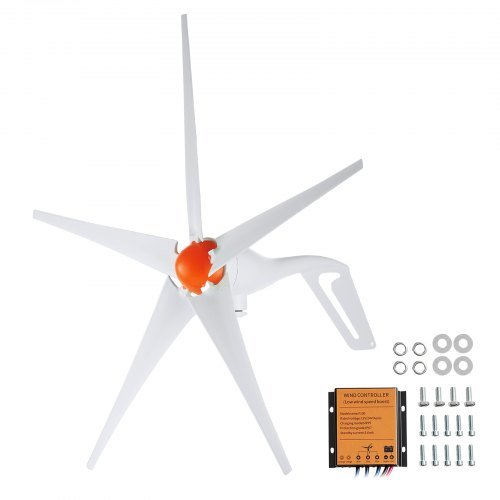
VEVOR 500W Wind Turbine Generator
500W 12V model with a 5-blade rotor — trades a bit of top-end RPM for improved low-wind torque and earlier start.
Overview
The VEVOR 500W Wind Turbine Kit is a compact, 12V small-scale wind generator that ships as a kit for DIY installation. It uses a five-blade rotor with a 1.2m (47in) diameter and includes an MPPT controller to improve battery charging efficiency. The design is targeted at leisure and small off-grid applications—think caravans, boats, remote sheds or experimental home systems—rather than whole-house backup or grid-tie installations. The specification lists a peak power of 500W and a claimed start-up wind speed of around 2.5 m/s, with a manufacturer noise figure of roughly 55dB.
This review pulls together the product’s notable design choices and practical implications so you can judge whether this particular kit fits your site and system goals. I haven’t personally tested it; the points below are assessed from the supplied product details and standard off-grid considerations.
Who is this best for?
The VEVOR 500W kit is primarily aimed at DIYers who need a compact wind generator to charge a 12V battery bank. Typical users include owners of boats and RVs who want a renewable charging option while stationary or at anchor, off-grid hobbyists running small lighting and USB-power setups, and anyone experimenting with wind generation on a limited budget.
It’s not suitable for replacing mains power or for powering a typical home on its own. The 500W rating is a peak figure; realistic average output will be much lower and heavily dependent on local wind climate and mounting height. If you need a system that delivers continuous higher power or AC output, you’ll also need separate inverter and battery capacity planning.
Key features
- Rated peak power: 500W (12V system) — intended for direct battery charging rather than AC supply.
- Rotor: five blades, 1.2m diameter — higher blade count for stronger low-speed torque and earlier start-up.
- Included MPPT controller — improves charging efficiency compared with a basic dump or PWM regulator.
- Start-up wind speed: approximately 2.5 m/s — a design focus on starting in light winds.
- Adjustable yaw/windward direction — helps align the rotor with prevailing winds.
- Manufacturer noise figure listed at ~55 dB — a useful reference for domestic siting.
Practical evaluation
Blade count and rotor size are two places where this VEVOR kit differs from many small turbines. The five-blade rotor gives stronger torque at low RPMs, which is why the manufacturer highlights a relatively low start speed. For sites with gentle breezes, that means the turbine may begin charging earlier than three-blade alternatives. That can be valuable for small leisure batteries where every trickle helps.
However, the same blade-count advantage can have downsides. Five blades typically increase aerodynamic drag and reduce top-end efficiency compared with a three-blade design. That isn’t automatically a problem—if your site rarely sees high wind speeds you’ll benefit from low-wind performance—but it’s worth understanding that peak figures (the 500W rating) are rarely sustained and depend on wind speed and rotor aerodynamics.
The kit includes an MPPT controller, which is a meaningful inclusion at this price level. MPPT (maximum power point tracking) regulators adjust the electrical load presented to the turbine so the rotor can operate closer to its optimal power point as wind and battery state change. For practical off-grid systems this usually delivers measurably better battery charging and reduced wasted energy compared with basic controllers. On a 12V system with low battery voltage swings and limited turbine output, the MPPT’s benefit is still important because it improves how often the turbine produces useful current into the batteries.
Mechanically, the unit is described as slightly heavier than some three-blade equivalents. That may feel reassuring in build quality, but it raises two installation implications: the tower or mast needs to be robust and well-anchored, and rotor balance and secure mounting become even more important. Uneven blade balance or a flimsy mount can increase vibration and shorten component life. The kit’s adjustable yaw direction is useful for letting the rotor align with prevailing winds, but check the included instructions and hardware; you may need additional bracing or a higher-quality tower depending on your location and exposure.
Noise quoted at around 55 dB gives a rough idea of what to expect; in many domestic settings that is noticeable but not intrusive, especially if the turbine is mounted away from living areas. Still, neighbours and planning rules should be factored into siting decisions.
Strengths
- Good low-wind starting: the five-blade rotor and 2.5 m/s start-up claim make this a sensible choice where wind speeds are modest.
- MPPT controller included: reduces the need to buy a separate regulator and improves battery charging efficiency.
- 12V compatibility: integrates directly with common leisure and deep-cycle 12V batteries, simplifying DIY systems for boats, caravans and small sheds.
- Complete kit approach: supplied as a packaged unit so hobbyists have fewer separate purchases to make.
- Robust feel: the slightly heavier build can be reassuring for longevity if mounted correctly.
Limitations
- 500W is a peak figure: average output will depend on wind resource and will usually be much lower than the peak rating.
- Five blades reduce high-wind aerodynamic efficiency: you may see diminishing returns in strong winds compared with three-blade designs.
- No inverter or AC output: the kit charges batteries but won’t power mains appliances directly without a separate inverter and correctly sized battery bank.
- Mounting and balance requirements: heavier rotor mass and extra blades demand a sturdy tower and careful installation to avoid vibration and stress.
- Additional hardware responsibility: safety cut-outs, fuses, diversion loads and weather protection are not always comprehensive in kit form—buyers must confirm what’s included and what they still need to buy.
- Warranty and aftercare: check retailer or manufacturer terms before purchase—service and spares can be important for long-term reliability.
Installation and system planning considerations
Plan your installation like any small renewable project: start by assessing the wind resource. Average wind speed at the turbine hub height is the single biggest factor in expected energy yield. The 2.5 m/s start-up suggests this turbine is tuned for lighter winds, but if your site rarely reaches 4–5 m/s you should temper expectations about usable energy.
Next, think about mounting. A taller mast increases wind exposure and typically improves energy capture, but it also increases structural loads. The kit’s slightly heavier rotor and additional blades mean you should choose a tower rated for the expected wind loading and ensure secure guying or a solid fixed base. Consider professional help for any installation that exceeds basic mast heights or that involves rooftop mounting.
Batteries and inverter are critical. Because the kit is 12V and includes an MPPT, pair it with a battery bank sized to accept intermittent charge (deep-cycle lead-acid or lithium options). If you expect to run AC appliances, size an inverter and batteries to handle peak draws; small 12V chargers and USB loads are straightforward, but household items create much larger energy requirements. Include appropriate charge diversion or dump load protection if the controller or batteries could be overcharged in prolonged windy conditions.
Finally, safety and compliance: check local planning rules and any marina or caravan park restrictions. Use proper fuses, lightning protection and earthing arrangements. Small turbines can attract lightning, and electrical protection is worth the investment.
Pricing and value
The listed guide price is USD 125.90—check the retailer for current offers and local currency pricing. At that price point the VEVOR kit presents a strong value proposition for hobbyists because it bundles the rotor, generator and MPPT controller together. For those building a basic 12V leisure charging system or experimenting with off-grid renewables, the single-package approach minimises the number of separate purchases and reduces compatibility guesswork.
Value depends heavily on your expectations. If you want a dependable trickle-charger to top up batteries on a boat or power LED lighting in a shed, this kit could be an economical way to add renewable charging. If your goal is continuous household energy or reliable off-grid living, the 500W peak rating and 12V system will require a larger supporting battery bank and likely additional turbines or PV (solar) to be viable—so total system cost rises quickly beyond the item price.
Alternatives and when to consider them
There are a few reasons you might choose a different small turbine. If you have a windier site and want better high-wind efficiency and smoother performance at higher RPMs, a three-blade design with a similar rotor diameter can offer better aerodynamic efficiency at speed. Those designs typically have higher cut-in speeds but can sustain higher power at stronger winds.
If you need higher peak power for more demanding off-grid setups, consider larger-wattage units (for example 800W and above). Remember that greater rated power increases demands on the tower, braking system and batteries—system design complexity rises with capacity.
Finally, if you want grid-tie capability or to run AC appliances without significant battery capacity, look for turbine packages that either include a suitable inverter or are specifically designed for hybrid systems with solar. Otherwise, you’ll be buying an inverter separately and factoring in conversion losses and inverter sizing.
Final verdict
The VEVOR 500W Wind Turbine Kit is a well-priced, practical entry point into small-scale wind generation for DIYers, boaters and caravan owners. Its five-blade rotor and low start-up wind speed make it a sensible choice in light-wind locations where early starting and torque matter. The included MPPT controller is a welcome inclusion that improves real-world battery charging compared with basic regulators.
That said, the 500W figure is a peak rating—don’t expect continuous 500W output. The five-blade design favours low-speed torque over high-wind aerodynamic efficiency, and the heavier build increases the need for a robust tower and careful installation. You’ll also need to budget for an inverter, batteries sized for your loads, and any safety hardware (fuses, lightning protection, protective enclosures) the kit doesn’t include.
For hobbyists and small leisure applications who want a self-contained kit to charge 12V batteries and try wind power out, this VEVOR kit offers strong value. For readers planning larger off-grid systems or who prioritise peak aerodynamic efficiency in windy sites, consider a three-blade or higher-rated alternative and ensure a proper system design that includes adequate battery storage and safety measures.
Note: product offers and prices can change—check the retailer listing for current availability and any shipping or warranty terms before buying.
Ready to check VEVOR 500W Wind Turbine Generator, 12V Wind Turbine Kit, 5-Blade Wind Power Generator with MPPT Controller, Adjustable Windward Direction & 2.5m/s Start Wind Speed, Suitable for Home, Farm, RVs, Boats?
Check the latest offer before buying, then return to the main comparison if you want to compare it against the other shortlisted options.
Compare this with the full shortlist
Return to the full comparison guide to see how this product compares against the other shortlisted choices.