
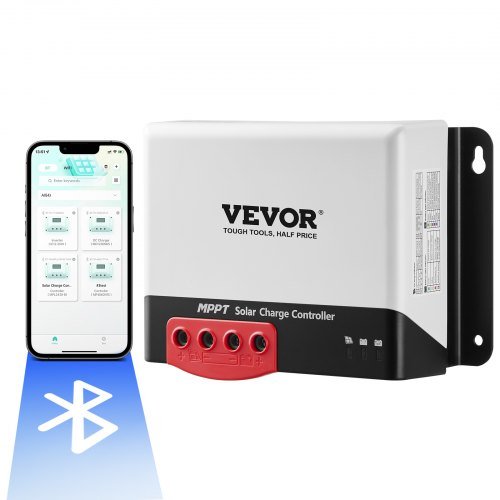
VEVOR 50A MPPT Solar Charge Controller
50A MPPT controller with built‑in Bluetooth, high efficiency and higher rated input power — suited to larger 12V/24V installations.
Overview
The VEVOR 50A MPPT solar charge controller is positioned as a step-up regulator for installations that need more charging current and better monitoring than smaller regulators offer. It supports 12V and 24V battery systems with auto-detection, delivers up to 50A of continuous charging current and claims MPPT efficiency of at least 98%. Built-in Bluetooth gives app-based monitoring and control via the Neutral app, and the unit accepts common battery chemistries including sealed (AGM), gel, flooded and lithium batteries. With a stated maximum open-circuit voltage of 100V and rated input power limits of 660W (12V) and 1320W (24V), the controller aims to sit in the middle ground between small cottage or camper controllers and larger industrial units.
Who is this best for?
This controller is aimed at buyers who are sizing or upgrading a solar charging system where charging current matters. Typical scenarios include:
- Domestic off-grid battery banks or larger leisure systems that use 12V or 24V batteries and need higher continuous charging current than basic controllers provide.
- People who want remote monitoring and configuration without running extra cables—built-in Bluetooth and an app allow smartphone control and data viewing.
- Installations where higher MPPT efficiency can meaningfully increase energy harvest from the same array, for example in locations with variable irradiance.
- Anyone planning to connect multiple panels or a moderate-sized array within the controller’s Voc and rated input power limits.
It is less appropriate for very small single-panel setups, tiny camper rigs or situations where the solar array design exceeds the 100V open-circuit voltage limit. If you have a small leisure battery or a single-panel trickle system, a lower current controller is likely a better value and easier to integrate.
Key features
- 50A maximum charging current — provides significant charging capacity for larger 12V/24V battery banks.
- 12V/24V auto-detection — the controller detects the battery system voltage automatically, simplifying installation setup.
- MPPT efficiency ≥98% — a high conversion efficiency figure that helps extract more usable energy from PV panels compared with basic PWM controllers.
- Built-in Bluetooth — hands-free monitoring and control via the Neutral app on compatible smartphones.
- Max Voc 100V DC — this limits how you configure panels in series but is adequate for many small to medium arrays.
- Rated input power — 660W for 12V systems and 1320W for 24V systems, which helps with system design and array sizing.
- Battery chemistry support — settings for sealed (AGM), gel, flooded and lithium battery types.
- External temperature sensor support — allows temperature-compensated charging when precise battery care is needed.
- ABS+PC enclosure — a compact, durable housing suitable for a range of operating environments.
Practical evaluation
When choosing a charge controller, the two most important practical considerations are whether its voltage and current ratings match your battery and array, and whether its features suit how you intend to use and monitor the system. The VEVOR 50A model is conservative in design where it matters: 50A charging capacity for mid-range battery banks, MPPT that prioritises capturing more energy from the array, and a built-in Bluetooth module for local wireless monitoring.
Start with system sizing. The controller’s rated input powers (660W at 12V, 1320W at 24V) tell you roughly how much PV you can connect without exceeding the controller’s capacity. For example, if you have a 12V battery bank, aim the array so the total panel peak power is at or below 660W unless you deliberately choose to limit array output. At 24V, the higher 1320W rating suits larger arrays or faster charge rates on bigger banks.
The 100V maximum open-circuit voltage (Voc) must be considered when wiring panels in series. Many modern panels have Voc in the 35–45V range, so two in series may be acceptable for 24V systems, but long series strings will quickly exceed the 100V limit. This restricts high-voltage array configurations, so you may need to wire panels in parallel or use a different controller for very large roof-mounted arrays that benefit from higher string voltages.
On the battery side, the auto-detection of 12V/24V simplifies setup. The controller supports several common chemistries — sealed (AGM), gel, flooded and lithium — which is useful because different battery types require different charge profiles. The optional external temperature sensor is a good feature if your batteries sit in an environment with pronounced temperature swings; it allows the controller to adjust charging behaviour to protect battery life.
Monitoring and control via Bluetooth and the Neutral app are valuable for everyday users. If you want to glimpse charging status, historical data or tweak charge modes without crawling under the panel array or opening the installed enclosure, wireless monitoring is a real convenience. Bear in mind that Bluetooth range is limited compared with Wi‑Fi-based systems, so the controller suits setups where a smartphone can be used nearby or within line of sight of the unit.
Installation is fairly straightforward for someone with electrical knowledge, but like any DC system you’ll need the right accessories: appropriately sized cables, fuses or circuit protection and a safe earthing arrangement. The controller’s enclosure and mounting points make wall-mounting simple, but always follow electrical safety best practice and local regulations, or get a qualified installer if you’re unsure.
Strengths
- High continuous charging current: 50A capacity lets this controller service reasonably large battery banks and supports faster recharge times than smaller controllers.
- Strong MPPT efficiency: A quoted ≥98% efficiency means the controller should convert most of the available panel power into battery power, which is especially useful under variable light conditions.
- Bluetooth and app control: Built-in wireless monitoring and configuration are much more convenient than models requiring wired displays or third-party monitors.
- Flexible battery support: Compatibility with sealed, gel, flooded and lithium batteries covers most residential and leisure installations.
- Temperature compensation: External temperature sensor support improves battery charging accuracy and longevity in varying climates.
- Compact, durable casing: The ABS+PC enclosure is practical for domestic installation and should withstand normal environmental conditions when mounted indoors or in a sheltered location.
Limitations
- Max Voc 100V: This restricts high-voltage panel string designs. If you plan to connect many panels in series, you may hit the Voc limit and need a different controller or to rewire the array.
- Not the best fit for tiny systems: For single-panel setups or very small batteries, the 50A capacity is overkill and a smaller, cheaper controller will do the job more economically.
- Bluetooth only: The controller relies on Bluetooth for wireless monitoring; there’s no built-in Wi‑Fi or ethernet option, which limits remote access unless you use a phone within range or a Bluetooth gateway.
- Additional accessories required: Cables, fuses, breakers and possibly an external temperature sensor are not guaranteed to be included, so budget for installation materials and any professional labour.
- Check warranty and parts: The product description highlights features but specific warranty details and what’s included in the box should be confirmed with the seller before purchase.
Pricing and value
The VEVOR 50A MPPT is positioned higher than basic controllers due to its 50A output, MPPT performance and Bluetooth functionality. For people who need the extra capacity and value app monitoring, the controller represents a practical investment compared with buying a smaller controller and later upgrading. The approximate guide price from the source listing is shown as a reference, but offers and prices change frequently — check current pricing and availability before you buy.
When assessing value, think in terms of system lifetime rather than upfront cost alone. A correctly sized MPPT controller that harvests more energy and charges your batteries more efficiently can reduce generator runtime, shorten grid recharge cycles and extend battery life by applying the right charge profile. For medium-sized off-grid systems or larger leisure installations, those gains can make a larger-capacity MPPT controller a cost-effective choice over several years.
Alternatives and when to choose them
There are a few scenarios where a different controller might be a better match:
- Small or single-panel systems: If you only have a single panel or a very small battery (e.g. a single 12V leisure battery), a 20A or smaller MPPT controller will usually be cheaper and sufficient for the task.
- High-voltage arrays: If your PV array design relies on long strings with Voc above 100V, look for a controller rated for higher open-circuit voltages. Higher-Voc controllers allow longer series strings and can reduce DC cable losses on bigger roof-top arrays.
- Remote monitoring at a distance: If you need internet-based remote monitoring without being near the controller, models with built-in Wi‑Fi or options for remote gateways may be preferable to Bluetooth-only units.
- Commercial or very large systems: For larger off-grid homes or commercial installations that exceed the 50A limit, a bigger controller or an MPPT charge controller designed for battery banks of higher voltage (48V and above) may be the right choice.
If you’re deciding between this VEVOR 50A unit and smaller VEVOR models (for example 20A variants), base the choice on the battery bank size, the expected charging current and headroom for future expansion. A 50A controller gives you more growth margin but will cost more and may be oversized for small installations.
Final verdict
The VEVOR 50A MPPT solar charge controller is a sensible step-up option for homeowners, caravan owners and small off-grid systems that need stronger charging capability and convenient app-based monitoring. Its core strengths are a solid 50A continuous charge rating, high MPPT efficiency and Bluetooth connectivity that simplifies daily interaction with the system. Support for multiple battery chemistries and an external temperature sensor are practical additions that help protect batteries and keep charging accurate.
It is not perfect for every situation: the 100V Voc limit constrains some array designs, and Bluetooth-only monitoring is less flexible than networked options for remote sites. For very small setups the controller is over-specified, and buyers should factor in the cost of appropriate wiring, fusing and any professional installation. Confirming warranty details and the full contents of the package with the seller before purchase is also sensible.
Overall, the VEVOR 50A MPPT makes a compelling option if you need a reliable mid-capacity controller that balances efficient MPPT charging with practical monitoring features. It’s worth choosing when your battery bank and array size justify the 50A capacity and you value Bluetooth control for easy daily oversight.
Note: product offers and prices can change — check current availability and specifications with the seller before buying.
Ready to check VEVOR 50A MPPT Solar Charge Controller, 12V / 24V Auto DC Input, Solar Panel Regulator Charger with Bluetooth Module, 98% Charging Efficiency for Sealed(AGM), Gel, Flooded and Lithium Battery Charging?
Check the latest offer before buying, then return to the main comparison if you want to compare it against the other shortlisted options.
Compare this with the full shortlist
Return to the full comparison guide to see how this product compares against the other shortlisted choices.