
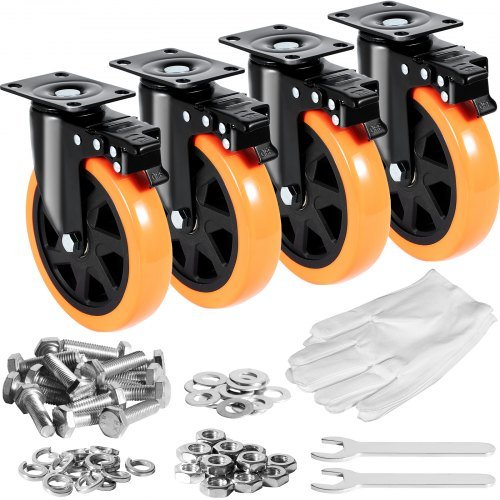
VEVOR Caster Wheels
Set of four 6" swivel plate casters with non‑marking PVC wheels, dual ball bearings and A/B locking. Designed for heavy loads and quiet indoor use.
Overview
VEVOR’s 6‑inch swivel plate casters are aimed at workshop furniture, trolleys and mobile workstations where manoeuvrability and floor protection are priorities. Sold as a set of four, they use non‑marking PVC wheels with dual ball bearings, a plated swivel mechanism and a flat mounting plate intended for secure attachment to benches, cabinets or cart frames. The manufacturer lists a high per‑caster load rating and includes an A/B security locking option.
This review pulls together the product’s stated features and practical considerations for workshop and fleet managers. I don’t claim hands‑on testing here; instead the piece focuses on what the specification means in real workshop situations, how to check compatibility and where these casters are likely to work best — and where another wheel type might be preferable.
Who is this best for?
These casters are designed for users who need to make fixed furniture or equipment mobile indoors without damaging finished floors. Typical buyers include small workshops, light industrial units, maintenance teams and owners of mobile tool cabinets or workbenches.
They suit situations where:
- Mobility and smooth turning are important — the swivel plate and dual ball bearings reduce the effort needed to steer trolleys and benches.
- Floor protection matters — the non‑marking PVC wheel is intended for finished floors such as sealed concrete, epoxy, workshop tiles or coated surfaces.
- You need a secure plate mounting — the flat plate gives a stable connection for robust frames and furniture bases where bolt‑on attachment is feasible.
If you primarily move equipment over very rough ground, gravel or outdoor surfaces, or if you need a solution that can be tyre‑inflated for shock absorption, these PVC plate casters are likely not the right choice.
Key features
- 6‑inch (152.4 mm) wheel diameter: A moderate size that balances load capacity with compactness. Smaller than pneumatic off‑road wheels, but large enough for most indoor obstacles and door thresholds.
- Plate mounting: A flat mounting plate that bolts to the underside of benches, cabinets or custom frames for a stable and secure connection. Plate hole spacing and bolt size are critical fit details.
- Non‑marking PVC wheel material: Designed to reduce scuffing and marking on finished floors compared with some harder casters.
- Dual ball bearings: Bearing arrangement intended to reduce swivel and roll resistance for easier movement and quieter operation than plain‑bearing wheels.
- Per‑caster load rating (manufacturer figure): A comparatively high per‑wheel load rating is quoted by the maker. As with any manufacturer rating, validate the required total load capacity and distribution against your actual application.
- Locking option (A/B security lock): Includes a lock option to prevent unwanted movement or to stabilise a trolley in use.
- Installation height and axle diameter details provided: The vendor lists key dimensions such as installation height (185 mm) and axle diameter (10 mm), which are useful when checking compatibility with your equipment.
Practical evaluation
From a practical standpoint, these casters tick many boxes for indoor workshop mobility. The swivel plate mount offers very good manoeuvrability: when mounted correctly on a cart or bench it lets you pivot in tight spaces and line up trolleys precisely under benches or through doorways. Dual ball bearings help here — they reduce the effort to swivel a loaded cart and minimise squeakiness compared with simple sleeve bearings.
The non‑marking PVC tread is another practical advantage. On finished concrete, epoxy floors or coated garage floors, PVC tends to be kinder than harder metal or older, crumbly rubber treads that can scuff. It’s a sensible choice when aesthetics and floor maintenance are a consideration — for example on client‑facing sites or in clean workshop areas.
Load capacity is where the specification is notable: the manufacturer quotes a high per‑caster rating. That can be helpful if you’re converting a single heavy cabinet to wheels and want a small footprint. However, it’s important to think in terms of total distributed load. The figures vendors provide typically assume even weight distribution across all fitted casters. In reality, weight may be concentrated on two wheels when manoeuvring, or uneven due to shelving and tool placement, so select casters with an appropriate margin of safety.
Another practical point is the installation height of 185 mm. Adding nearly 19 cm of height under a workbench or cabinet will affect reach and working ergonomics: bench height increases, and that might be helpful or detrimental depending on your crew’s needs. If bench height is critical, measure and factor this in, or consider lower‑profile caster options.
Finally, plate mounting is strong and reliable but less forgiving than bolt‑in stem options if your base has unusual dimensions. You’ll need to confirm plate hole spacing and bolt size before buying, and ensure your mounting surface is sturdy enough to accept the plate without sagging or fatigue over time.
Strengths
- Good manoeuvrability: Swivel plate mount combined with dual ball bearings makes steering and positioning easier with loaded trolleys.
- Floor friendly: Non‑marking PVC helps protect finished surfaces, which matters in workshops with epoxy or sealed floors.
- High per‑wheel rating (manufacturer listed): The spec suggests these casters can support heavy loads individually, which may permit fewer mounting points for certain builds.
- Compared mounting dimensions: The listing provides installation height and axle diameter, which helps you check fit before purchase and reduces guesswork.
- Locking option included: The A/B security locking feature gives a way to secure mobile equipment in place when you need it stable.
Limitations
- Plate mounting requires planning: You must confirm hole spacing and bolt sizes. Irregular or thin bases may need reinforcements to accept the plates safely.
- Limited outdoor capability: The 6‑inch PVC wheel is not intended for rough outdoor surfaces; PVC can wear faster on abrasive ground and offers little shock absorption compared with pneumatic tyres.
- Height change: The installation height of 185 mm can alter ergonomics. If you are fitting these to a bench, check how the higher working surface affects tasks and operator posture.
- Manufacturer ratings need context: High per‑caster ratings are useful, but real‑world capacity depends on total distribution and dynamic loads while moving — always plan a safety margin.
- Potential wear on rough floors: While non‑marking indoors, PVC will wear sooner on very rough or uneven floors compared with harder, more durable materials or pneumatic options.
Buying considerations and fit checklist
Before buying and fitting these casters, take a few simple checks to avoid surprises:
- Measure your mounting area: Confirm the plate dimensions and hole spacing match your furniture underside. If holes don’t match, you may need to drill new ones or use a backing plate.
- Check bolt size and thread: The vendor lists axle diameter and related dimensions—ensure you have the correct fasteners and lock washers to secure the plates.
- Calculate total load: Add the weight of the equipment plus typical contents and apply a safety margin; then divide by the number of casters to check per‑caster ratings. Factor in dynamic loads from moving and turning.
- Think about floor type: PVC is good for finished indoor floors. If you’ll be using the equipment outdoors or on rough concrete, consider more robust tread materials or pneumatic tyres.
- Consider working height: Confirm the installation height (185 mm) works ergonomically for users or whether it requires modifications to bench height or tool layout.
- Plan for locking behaviour: Test how the A/B lock operates with your load and whether it reliably secures the cart without binding during engagement or disengagement.
- Spare parts and service: Check the seller’s policy on replacements for bearings or wheels; high‑traffic units can need new wheels down the line and having a replacement source simplifies maintenance.
Alternatives and when to choose them
While these VEVOR plate casters are a good fit for indoor workshop furniture, there are several alternative wheel solutions depending on your priorities.
If you need more give and better performance on uneven ground, consider pneumatic or semi‑pneumatic wheels. Those provide shock absorption and are better suited to outdoor yards, ramps and rough surfaces, but they require more maintenance and can be punctured (unless you choose solid alternatives).
For extremely heavy industrial loads where longevity on abrasive floors is essential, look at polyurethane (PU) or solid rubber treads over a reinforced hub. PU wheels often combine good floor friendliness with improved wear resistance compared with PVC, though they can be firmer and transmit more vibration.
If fitting hole spacing or base material rules out plate mounting, stem or bolt‑through casters might be easier. Stem casters insert into a tube or socket and can be suitable for trolley legs, whereas bolt‑through types use a central axle and can handle different mounting scenarios.
Finally, if noise is a major concern in a shared or customer‑facing area, prioritise casters with specific low‑noise designs and confirmed testing for reverberation — dual ball bearings help, but construction and wheel compound also matter.
Pricing and value
The vendor lists a guide price. As price, delivery and availability can vary, check the retailer page for current figures before buying. In value terms, these casters aim at the mid‑range market: they offer a combination of non‑marking tread, dual bearings and a locking feature that you would expect to pay for compared with basic economy casters.
Whether they represent good value depends on your project. If you need an indoor solution that protects floors and gives smooth manoeuvrability for benches and trolleys, the combination of features is compelling. If you require outdoor durability, puncture resistance or specialist shock absorption, you may find better long‑term value in a different wheel compound or pneumatic system.
Final verdict
VEVOR’s 6‑inch swivel plate casters are a practical and well‑specified option for turning static workshop furniture into functional mobile units. Their strengths are clear: plate mounting gives a secure fit, the non‑marking PVC tread protects finished floors, dual ball bearings aid smooth turnover and the included lock adds useful stability when parked.
They are particularly suitable for workshops, maintenance teams and light industrial settings where indoor floor protection and easier steering are priorities. Before you buy, however, double‑check the plate dimensions, bolt sizes and the effect of the 185 mm installation height on your workbench ergonomics. Treat the manufacturer’s per‑caster load rating as a helpful guide rather than a definitive endorsement of real‑world behaviour; plan load distribution and a safety margin.
For indoor trolleys, mobile tool cabinets and benches that will remain on finished, reasonably even floors, these casters are a good fit. If you regularly operate outdoors, over rough terrain or need high shock absorption, consider pneumatic or alternative tread materials instead.
Note: offers and prices can change — check the retailer page for current availability and exact pricing before you buy.
Ready to check VEVOR Caster Wheels, 6-inch Swivel Plate Casters, Set of 4, with Security A/B Locking No Noise PVC Wheels, Heavy Duty 700 lbs Load Capacity Per Caster, Non-Marking Wheels for Cart Furniture Workbench?
Check the latest offer before buying, then return to the main comparison if you want to compare it against the other shortlisted options.
Compare this with the full shortlist
Return to the full comparison guide to see how this product compares against the other shortlisted choices.