
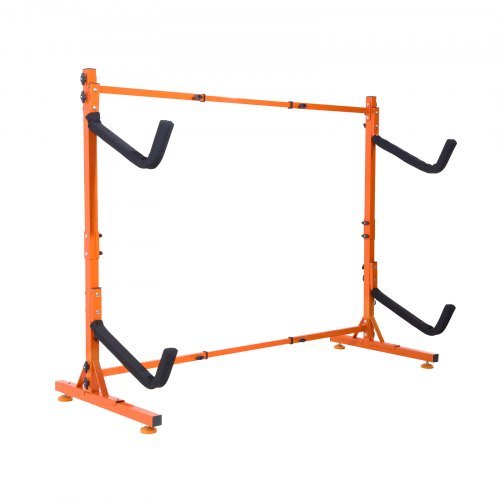
VEVOR Freestanding Kayak Storage Rack
A smaller freestanding steel rack for two boats, offering padded arms and adjustable width in a tighter footprint.
Overview
The VEVOR Freestanding Kayak Storage Rack is a compact floor rack designed to hold two kayaks, canoes or paddleboards. Built from Q235B steel with an anti-rust finish and fitted with padded arms to protect hulls, it follows the same design language as VEVOR’s larger multi‑boat racks but in a scaled‑down package. With an adjustable width range and an advertised maximum load of around 175lbs, it targets single users or small households who want quick, floor‑level access to their boats without the hassle of ceiling fittings.
This review looks beyond the headline features to give practical guidance on who should consider this rack, how it performs as a storage solution, and what to bear in mind when deciding between floor, freestanding and ceiling options.
Who is this best for?
The VEVOR two‑boat rack suits people who need a sturdy, moveable storage solution for a small fleet. Typical scenarios where it makes sense include:
- Single paddlers or couples with one or two kayaks or SUPs who want easy, floor‑level access.
- Garages, garden sheds or carports where ceiling mountings are awkward, or where you don’t want to drill into rafters.
- Renters and households that prefer a non‑permanent solution—this rack can be disassembled and relocated more easily than fixed ceiling storage.
- Owners of varied hull shapes who need a little flexibility from adjustable supports and padded arms to reduce scratching or pressure marks.
It’s less appropriate for growing collections (more than two boats), very narrow garages where every inch of floor space is precious, or coastal installations with persistent salt spray unless you plan extra corrosion protection.
Key features
- Capacity: Designed to hold two kayaks, canoes or SUPs.
- Construction: Q235B steel frame finished with an anti‑rust coating for improved durability.
- Padded arms: Protective padding where the hulls rest, to reduce abrasion and protect gelcoat.
- Adjustable width: The rack adjusts roughly between 48.4 and 71.8 inches (about 123–182cm), allowing it to accommodate a variety of hull widths.
- Support arm length: Around 21.2 inches, giving a decent contact area for broader hulls and SUPs.
- Footprint and dimensions: Product dimensions are approximately 1265×788×1380 mm, making it smaller than four‑boat alternatives while still offering good stability.
- Rated load: Maximum combined load around 175lbs (check the retailer page for the most current specs).
Practical evaluation
When choosing a kayak rack you’re balancing capacity, footprint, accessibility and corrosion resistance. The VEVOR two‑boat freestanding rack prioritises convenience and protection over maximum capacity. Below I walk through the most relevant practical considerations and how this rack stacks up.
Footprint and placement
With dimensions under 1.4m tall and a relatively compact base, the rack fits most single‑car garages and sheds. Compared with a four‑boat freestanding rack, the smaller footprint frees up floor space while still keeping boats at a comfortable height for loading and unloading. That said, because it sits on the floor it does occupy some usable workspace. If you regularly need every inch of floor, a ceiling or wall solution will reclaim more room.
Think about door and vehicle access paths when you position the rack. Leave enough room to swing a kayak in and out without scraping the walls, and allow clear space around the rack so the boats don’t rub against shelving or bikes.
Assembly and adjustability
The design is straightforward and assembly is generally simple; the parts are lighter and fewer than a larger 4‑boat system, which helps if you’re building it solo. As with most steel racks, it relies on bolts and fixings that need careful tightening. Work methodically through the instructions and use a torque‑style approach—tighten everything, then revisit and torque to spec where provided. Proper tightening prevents wobble and keeps the load distributed correctly across the frame.
Adjustable width is a useful feature. It means you can tailor the spacing to the beam of each kayak or SUP rather than forcing hulls into a fixed cradle rhythm. This helps with stability and avoids undue pressure points on narrow or very wide designs.
Hull protection
Padded arms are arguably one of the most important features if you care about keeping gelcoat or composite finishes in good condition. The VEVOR rack’s padding gives a softer contact than bare metal and spreads the load over a larger area of the hull. That reduces dents and abrasion, especially helpful for lighter recreational kayaks and boards. If your boats sit on the rack long‑term, consider adding UV‑resistant covers or extra padding in high‑contact areas for extra protection.
Stability and load limits
Q235B steel is a common structural alloy used in rack frames; it gives a stable platform for two boats without the heavy bulk of larger racks. The advertised maximum combined load of around 175lbs is ample for most recreational kayaks and many SUPs, but pay attention to heavier touring or composite boats—these can edge closer to the rating. If you’re unsure of combined weights, check manufacturers’ hull weights or weigh them before purchase.
Corrosion resistance
The anti‑rust finish improves durability for indoor or sheltered outdoor use. That said, no generic coating is invulnerable, and Q235B can corrode over time when exposed to damp or salty environments. If you live near the coast, store boats inside where possible and consider additional rust prevention measures: touch‑up paint on scratched areas, a light coat of marine‑grade wax on exposed metal, or a stainless‑steel alternative if you want long‑term, low‑maintenance performance.
Strengths
- Compact footprint: Smaller and lighter than multi‑boat freestanding racks, so it’s easier to position and move.
- Floor‑level access: No ladders or ceiling hooks—loading and unloading is a simple, two‑person or solo task for many users.
- Padded supports: Reduce rubbing and pressure marks on hulls, a practical touch for everyday use.
- Adjustability: The width range accommodates different beam widths and some SUPs, making it versatile for mixed fleets.
- Solid construction: Steel frame provides good stability for a two‑boat setup without bulk.
Limitations
- Limited capacity: Two boats is great for couples or singles, but you’ll need a larger freestanding rack or ceiling solution if your collection grows.
- Uses floor space: Even with a smaller footprint, it takes up usable garage or shed area compared with ceiling or wall mounts.
- Corrosion risk in harsh conditions: The anti‑rust coating helps, but coastal or unventilated damp locations will still need extra care.
- Hardware care required: The bolts and fixings should be checked and tightened periodically—important to stop wobble and maintain safety.
- Load ceiling: The 175lbs rating is suitable for most recreational craft but could be restrictive for heavier touring kayaks or multiple heavy SUPs if you intend to store them together.
Pricing and value
The rack is positioned as an affordable, practical solution for two‑boat storage. The guide price provided with the product listing offers a good baseline, but note that actual prices can vary between sellers and over time. If you compare this freestanding option with ceiling systems or larger multi‑boat racks, it generally represents better value for those who prioritise ease of access and portability over maximum capacity.
To assess value against alternatives, consider these points:
- If you need to reclaim floor space and have properly accessible rafters, a ceiling hoist or swing system will cost more in installation time (and possibly materials) but frees the floor completely.
- Larger freestanding racks that hold 3–4 boats increase capacity but also increase footprint and weight; they’re useful for families or clubs that need higher capacity without ceiling fixes.
- If corrosion resistance is a top priority—coastal use or humid storage—spend more on stainless frames or purpose‑made marine racks to reduce ongoing maintenance costs.
Ultimately, the VEVOR two‑boat rack is good value if you need dependable, day‑to‑day storage that’s quick to use and inexpensive to set up. Keep an eye on price changes and check the retailer page for current availability and any accessory offers (covers, additional padding, or replacement parts).
Alternatives to consider
No single storage solution fits every situation, so here are some reasonable alternatives to weigh up against the VEVOR freestanding rack:
- Ceiling hoist systems: If your priority is to free up floor space and you don’t mind drilling into rafters, a ceiling hoist can store multiple boats compactly overhead. They suit taller garages and long‑term storage where ceiling access is practical.
- Four‑boat freestanding racks: If you anticipate growing your fleet, a larger freestanding rack increases capacity without ceiling fixings. Expect a larger footprint and heavier assembly.
- Wall racks and cradles: Wall‑mounted racks can store hulls at shoulder height, combining good access with minimal floor use. They require secure wall fixings and a suitable rental or home wall construction.
- Stainless or galvanised steel racks: For coastal locations or shared outdoor storage where exposure is constant, purpose‑made stainless or galvanised frames cost more upfront but reduce corrosion maintenance over the long term.
Think about how often you use your boats, how many you’ll own in a few years and whether you want temporary or fixed storage when choosing between these options.
Final verdict
The VEVOR Freestanding Kayak Storage Rack is a capable and pragmatic solution for anyone who needs reliable, easy access storage for up to two boats. Its padded arms and adjustable width make it adaptable to a range of hull shapes, and the steel frame provides reassuring stability without the bulk of larger units.
It’s particularly well suited to single paddlers, couples and households with limited space who prefer not to fit ceiling mounts or don’t have suitable rafters. The trade‑offs are straightforward: you sacrifice some floor space compared with overhead systems and you’re limited to two boats, so plan ahead if you expect your collection to grow.
Pay attention to corrosion protection if you store in damp or coastal conditions and be diligent about tightening fixings during assembly. If you accept those caveats, the VEVOR two‑boat rack is a sensible, cost‑effective choice that delivers practical day‑to‑day convenience.
Note: offers and prices can change—check the retailer page for current availability and the most up‑to‑date pricing before you buy.
Ready to check VEVOR Freestanding Kayak Storage Rack, Kayak Stand for 2 Kayak Canoe Paddleboard, Heavy-duty Steel Kayak Hanger Holder with Padded Arms and Adjustable Width, 175LBS Max Load, for Indoor Outdoor Garage?
Check the latest offer before buying, then return to the main comparison if you want to compare it against the other shortlisted options.
Compare this with the full shortlist
Return to the full comparison guide to see how this product compares against the other shortlisted choices.