
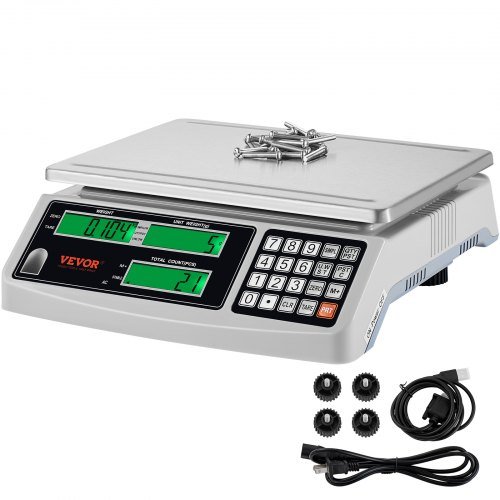
VEVOR Industrial Counting Scale
15 kg capacity with 0.5 g division. Chooses finer resolution for improved accuracy with small items and coin counts.
Overview
The VEVOR Industrial Counting Scale (15 kg x 0.5 g) is positioned as a workhorse counting scale for parts and coins. It pairs a relatively large 15 kg platform with a 0.5 g readout increment, and includes three separate LCD screens for improved visibility. An RS232 serial port is provided for connecting to printers or basic inventory systems, and the unit supports grams, kilograms and pounds. The manufacturer markets it for counting parts, coins, and other small items in settings where capacity matters but you still want reasonable per‑piece resolution.
This review looks beyond the headline figures to help you decide whether this model fits your workshop, small retail counter or hobby needs. I’ll cover who it suits, the practical trade‑offs between capacity and resolution, likely use cases, what’s included (and what might not be), and sensible alternatives to consider.
Who is this best for?
This VEVOR scale is aimed at people who regularly count medium to large batches and need a robust platform without moving up to industrial counting systems. Typical users include:
- Small repair shops and garages that count fasteners, washers and fittings in quantities that add up to several kilos.
- Coin collectors or small hobby dealers who sort and count mixed bags of coins where a 15 kg capacity removes the need to split very large batches.
- Light retail counters or market traders who want a visible display for both the operator and the customer and prefer a simple serial connection to a printer or POS box.
- Home users who want multi‑unit weighing (g/kg/lb) for occasional kitchen, jewellery or craft tasks as well as counting.
If your priority is counting hundreds of tiny, high‑value pieces (for example, jewellery beads or microelectronics), the 0.5 g resolution may be limiting. Likewise, if you need laboratory‑grade accuracy for calibration or scientific work, this is not the right class of instrument.
Key features
- 15 kg maximum capacity — generous platform for batch counting without frequent reloading.
- 0.5 g resolution — a compromise between capacity and piece‑level detail; suitable for many small parts and coin sizes.
- Three LCD screens — improves visibility, letting operator and customer or teammate read results simultaneously from different angles.
- RS232 serial port — supports connection to printers and basic inventory or reporting systems.
- Selectable units — switch between grams, kilograms and pounds to suit local preference or task needs.
- Counting functions — built for inventory and batch counting operations rather than specialised laboratory measurement.
Practical evaluation
Capacity vs resolution is the central trade‑off with this model. The 15 kg platform is large enough to handle thousands of small screws or a hefty pile of coins; that’s a clear benefit if you’re processing whole boxes or unmixed bags. The 0.5 g increment provides usable information for most small parts: you can estimate piece count reliably once the reference sample size is set and the average piece weight calculated.
In practice, counting scales work best when you create a proper reference weight (for example, a sample of 10, 20 or 50 pieces) and allow the scale to calculate the average piece weight. The 0.5 g resolution means that for very light parts — say washers or tiny electronic components weighing well under a gram each — the relative rounding error increases. For heavier small parts and common coin sizes, the resolution is usually acceptable and gives counts you can trust for stock control or packing.
The three separate LCD screens are a welcome touch in a transactional setting. One screen can face the operator, another the customer, and a third can be angled for a supervisor or next station. This avoids having to swivel the scale or relay numbers across a busy counter. It’s particularly useful at market stalls, reception desks or in shared workshop benches where visibility speeds up transactions and reduces disputes.
RS232 connectivity is practical if you already use simple printers or legacy inventory devices. While it’s not the modern convenience of USB or Ethernet, RS232 remains common on receipt printers and older stock systems — especially in small retail environments. Check that your existing printer or software supports RS232 or that you can obtain the right cable/adapter; the scale’s serial port simplifies basic automation such as printing counts or recording batch numbers without manual transcription.
Strengths
- High capacity — 15 kg removes the constraint of frequent reloading when counting larger batches.
- Good mid‑range resolution — 0.5 g increments are a practical compromise for many parts and coin sizes, giving usable piece accuracy without sacrificing platform size.
- Compared multi‑display setup — three LCD screens improve readability for multiple viewers and make transactions smoother.
- RS232 support — makes it straightforward to link to many printers and basic inventory systems used in small businesses.
- Versatile unit options — grams, kilograms and pounds provide helpful flexibility for mixed tasks.
Limitations
- Accessories not guaranteed — calibration weights, trays and RS232 cables may be sold separately; check what’s included before you buy.
- Power options unspecified — the product details here don’t confirm whether the scale runs on mains, battery or both, so verify power compatibility with your location and intended use.
- Resolution trade‑off — 0.5 g may be insufficient for very small or high‑value pieces where tighter accuracy is required.
- Not lab‑grade — this is a counting and inventory tool, not a substitute for analytical laboratory scales or certified calibration instruments.
- Connectivity limited — RS232 is useful but there’s no mention of built‑in Ethernet, USB or Wi‑Fi, which some modern setups prefer for integration.
Pricing and value
Retail prices vary between sellers and can change with promotions or bundled accessories. The value proposition of this VEVOR model rests on its balance of capacity, visible readouts and serial connectivity. If your workflow frequently requires counting large batches and you benefit from a customer‑facing display and printer integration, this model will likely deliver good value.
However, total cost can increase if you need to purchase calibration weights, a counting tray, connector cables or a compatible printer separately. Factor these potential extras into your budget. If you need finer resolution or modern network connectivity, you may face an additional outlay for a different model or adapters.
Before buying, check the exact contents of the supplier’s offer (platform, power lead, cable, tray, user manual), and whether any warranty or return policy is supplied. Those practical details will affect overall value more than the headline capacity and increment figures.
Alternatives to consider
When choosing a counting scale, the main variables are capacity, resolution, display setup and connectivity. If you decide the VEVOR 15 kg / 0.5 g model isn’t the perfect fit, consider these alternative directions:
- Higher resolution, lower capacity — if you routinely count very small or high‑value pieces, look for scales with 0.1 g or 0.01 g resolution. They usually have lower maximum capacities but give much better accuracy on tiny parts.
- Lower capacity, faster refresh — some counting scales prioritise rapid averaging and high sample counts over top capacity. If you mostly process dozens or hundreds of items rather than thousands, a lower capacity, higher precision unit may be more practical.
- More modern connectivity — if you want to link the scale directly to a cloud system, tablet or modern POS, look for units with USB, Ethernet or Bluetooth/Wi‑Fi support. These add convenience for integrated reporting and remote monitoring.
- Integrated printers or software bundles — some vendors sell counting systems bundled with label or receipt printers and software that simplifies stock control. If paperwork or labelling is a core need, a bundled option may save time and additional purchases.
- Ruggedised industrial counters — for heavy daily use in factories or warehouses, specialised industrial counters with reinforced platforms and industrial protocols might be a better long‑term investment.
When comparing alternatives, weigh not only the raw specs but also the practical extras: whether calibration weights are included, the type of display, power options, and how easy it is to integrate the scale into your existing workflow.
Final verdict
The VEVOR Industrial Counting Scale (15 kg x 0.5 g) is a sensible choice if your priority is counting relatively large batches where a 15 kg capacity reduces handling time, and where 0.5 g resolution provides acceptable piece accuracy. The three LCD screens are a thoughtful design for transactional or shared environments, and the RS232 port gives simple printer and inventory connectivity without requiring modern network hardware.
It’s not the right tool when you need laboratory precision, ultra‑fine resolution for tiny components, or modern wireless integration out of the box. Also check what accessories — calibration weights, trays, and cables — are included by your chosen seller, as these add to the total cost and ready‑to‑use convenience.
In short: choose this VEVOR if you count medium to large batches of parts or coins and value capacity, clear multi‑viewer displays and basic serial connectivity. Consider higher‑resolution, lower‑capacity alternatives if your parts are very light or require tighter accuracy, or look for models with USB/Wi‑Fi if you need modern integration with inventory software.
Note: prices, promotions and included accessories can change. Confirm the current offer and what’s included with the seller before buying to make sure the scale meets your needs and budget.
Compare this with the full shortlist
Return to the full comparison guide to see how this product compares against the other shortlisted choices.