
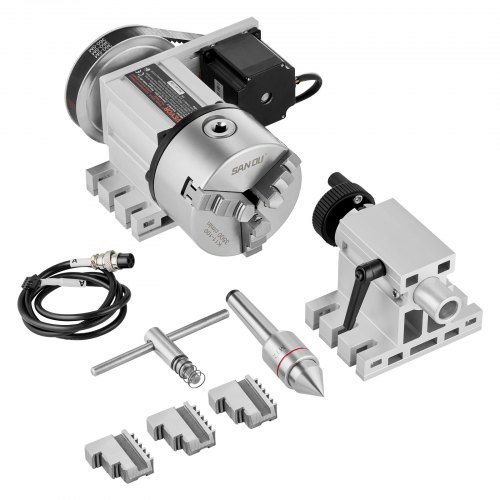
VEVOR Dividing Head
VEVOR Dividing Head, K11-100mm 3-Jaw Chuck, CNC Router Milling Machine Rotational Axis 4th Axis A Axis Indexing Head, 2.6"/65 mm Center Height MT2 Tailstock 6:1 Gear Ratio, Univer…
Overview
The VEVOR Dividing Head (model BS4-KP100-57) is presented as a universal A-axis/indexing head for CNC routers and small milling machines. It pairs a K11 100mm three-jaw chuck with an MT2 tailstock, offers a 6:1 gear ratio and a 65 mm (2.6 in) centre height, and arrives with an accessory kit intended to make installation and initial use straightforward. On paper it’s aimed at hobbyists and small workshops that want to add rotary capability for engraving, circular milling, light turning or indexing operations without the cost and complexity of industrial four-axis packages.
What you get is a compact, relatively heavy unit (net weight around 8 kg) with a decent chuck clamping range and a mechanical gearing arrangement that helps with controlled rotation. The manufacturer also highlights a powerful tailstock, easy jaw changes and an accessory kit — all useful for getting started quickly. As with any purchase in this category, suitability depends on the machine you attach it to and the kind of work you plan to do.
Who is this best for?
If you own a small CNC router or a benchtop milling machine and want to add rotational capability without a big investment, the VEVOR dividing head is squarely aimed at your workshop. It suits hobbyists, makers and small-scale fabricators who need a simple, mechanical A-axis for engraving circular features, performing light profiling around a cylinder, or doing indexed drilling and cutting.
It’s also a reasonable choice for metalworkers or woodworkers who occasionally need a dividing head rather than for continuous heavy-duty production. The modest 65 mm centre height and the MT2 tailstock indicate the unit is intended for smaller parts; you should not expect it to replace a full-size lathe or industrial fourth axis for heavy cuts or high-volume work.
Key features
- K11 100 mm three-jaw chuck – versatile grip for round or hexagonal stock, with internal and external jaw ranges.
- Clamping diameter ranges – internal jaws 2–30 mm, external jaws 30–80 mm, covering a useful spread of small-work sizes.
- Centre height – 65 mm (2.6 in) from the table to spindle centre; geared towards small components and fixtures.
- MT2 tailstock – common taper for small drills and centres, helping support longer workpieces.
- Gear ratio – 6:1 reduction for finer control during manual indexing or when coupling to a motor drive.
- Accessory kit – supplied to assist installation and jaw changing (accepts the manufacturer’s accessories to simplify set-up).
- Compact, solid construction – net weight around 8 kg gives a stable platform for light milling and engraving tasks.
- Model and electrical note – listed as Item Model Number BS4-KP100-57, with a DC voltage spec shown in the product brief; check motor compatibility when using powered drives.
Practical evaluation
This review deliberately focuses on practical guidance rather than hands-on claims. Based on the specification and intended use, the VEVOR dividing head should be treated as a mechanically straightforward, value-oriented option for adding rotary capability to small machines.
The K11 100 mm three-jaw chuck is a pragmatic choice for many hobby applications. Three-jaw chucks grip round or hex stock quickly and are convenient for repetitive work. The internal and external clamping ranges – 2–30 mm internally and 30–80 mm externally – cover typical small parts used in engraving, light turning and indexed cutting. If you need highly accurate gripping of irregular shapes, you may prefer a four-jaw chuck, but for concentric work the three-jaw is usually faster and easier.
The 65 mm centre height puts a practical limit on the diameter of work that can be clamped and cleared in typical drill or mill setups. For many engraving or decorative milling tasks this is adequate, but larger-diameter workpieces will be constrained by the centre height and the jaws’ external range.
The 6:1 gear ratio is useful because it reduces the rotation speed coming from any manual handle or motor coupling, offering finer angular control for indexing and for slow, precise rotational motion. On its own this doesn’t tell you the absolute accuracy you’ll achieve — that depends on mounting rigidity, spindle runout, chuck quality and how you couple the head to your controller or stepper motor — but a reduction gear is generally helpful in improving practical control for manual or motorised operation.
The MT2 tailstock is a common taper and makes it easy to use standard live or dead centres and small drill arbors. The manufacturer notes a powerful tailstock; in practice, the ability of the tailstock to hold a workpiece firm will depend on the tailstock’s fit and how well the head is mounted and aligned on your machine table.
VEVOR packages typically include accessories that help begin work without sourcing every part separately. Expect jaws, mounting fixtures and basic hardware to be present, but check the contents list on the retailer page before buying to ensure you have everything required for your machine and workflow.
Strengths
- Good value for a small dividing head: the combination of three-jaw chuck, MT2 tailstock and gear reduction is convenient for hobbyists.
- Wide clamping range for small parts: internal and external jaws cover from 2 mm to 80 mm, useful for many small projects.
- 6:1 gear ratio provides finer angular control, which helps with accurate indexing and smoother rotation when motorised.
- Compact and heavy enough (approx. 8 kg) to offer decent stability on a bench or router table without large fixtures.
- Accessory kit and apparent ease of installation make it accessible for those adding a rotary axis for the first time.
Limitations
- Not intended for heavy-duty or industrial continuous cutting work — the centre height and construction are aimed at light to medium hobby use.
- Spec sheet alone can’t confirm real-world accuracy or runout; performance depends heavily on mounting, jaw quality and alignment.
- Three-jaw chucks prioritise quick concentric gripping over the precision of independent four-jaw chucks for irregular parts.
- If you plan to motorise the head, you’ll need to check the coupling and electrical compatibility carefully; the product brief lists a DC voltage, so confirm motor and controller requirements with the retailer.
- Limited to parts that fit within the 65 mm centre height; larger components will need a bigger dividing head or different approach.
Pricing and value
The product information includes a guide price in US dollars; as always, actual prices and availability vary between retailers and over time. For a dividing head that bundles a 100 mm three-jaw chuck, an MT2 tailstock and an accessory kit, the offering sits in the budget to mid-range segment for hobby and light workshop equipment.
Value depends on what you need: if your projects involve small-scale engraving, decorative milling, single-piece fixtures or occasional indexed operations, this unit should represent a cost-effective way to add those capabilities without investing in a full industrial fourth axis. If you need high-precision indexing for production work or want to turn larger diameters, you should consider stepping up to a larger, purpose-built rotary axis or a dedicated lathe or four-axis controller with proven accuracy.
Tip: check what’s included in the accessory kit and whether soft jaws, a chuck key or extra mounting hardware are supplied. If you need a motor kit, cables or a custom coupling, add those costs into your total budget before deciding.
Alternatives
If the VEVOR unit looks close to what you need but you have different priorities, here are a few generic alternatives to consider when comparing options:
- Larger dividing heads — designed for higher centre heights and larger-diameter work, these are a better match if you regularly handle larger parts or require greater rigidity.
- Motorised 4th-axis units — some suppliers offer fully integrated motor-driven rotary tables with encoder feedback and controller compatibility, suited to CNC machines that need precise, programmable rotation.
- Dedicated indexing heads from machine-tool brands — typically more expensive but often with better documented accuracy and service support for demanding production use.
- Four-jaw chucks or compound chucks — if gripping irregular shapes or off-centre work is frequent, a four-jaw chuck lets you independently adjust jaws for true-centre alignment.
Which alternative makes sense depends on whether you prioritise raw precision, larger capacity, motorisation or quick-change convenience. The VEVOR head is a sensible entry point if you want a compact, manual-friendly solution that can be adapted to motorised use with the right coupling and controller.
Final verdict
The VEVOR K11-100mm dividing head is a practical, cost-aware option for hobbyists and small workshops that want to add a rotary axis to their CNC router or benchtop mill. It brings together a familiar three-jaw chuck, MT2 tailstock and a 6:1 gear ratio in a compact package that’s useful for engraving, light turning and indexed milling. The included accessories and the stated ease of installation make it attractive for those new to rotary axes.
Bear in mind the limitations: the modest centre height, the usual uncertainty about real-world runout from a spec sheet alone, and the fact that it isn’t designed to replace a dedicated lathe or heavy-duty four-axis system. If your projects fit within its size and performance envelope, it’s a sensible, affordable tool to expand what your small machine can do. If you need industrial-grade accuracy, larger capacities or continuous heavy cutting, look at higher-end motorised rotary axes or purpose-built dividing heads from specialist suppliers.
Before you click buy: double-check the retailer’s product page for the latest price, full accessory list and compatibility notes (particularly any motor or controller requirements). Offers and prices can change, so verify availability and shipping terms before committing.
Ready to check VEVOR Dividing Head, K11-100mm 3-Jaw Chuck, CNC Router Milling Machine Rotational Axis 4th Axis A Axis Indexing Head, 2.6"/65 mm Center Height MT2 Tailstock 6:1 Gear Ratio, Universal for Engraving?
Check the latest offer before buying, then return to the main comparison if you want to compare it against the other shortlisted options.
Also featured in
This product also appears on these price comparison pages:
Compare this with the full shortlist
Return to the full comparison guide to see how this product compares against the other shortlisted choices.