
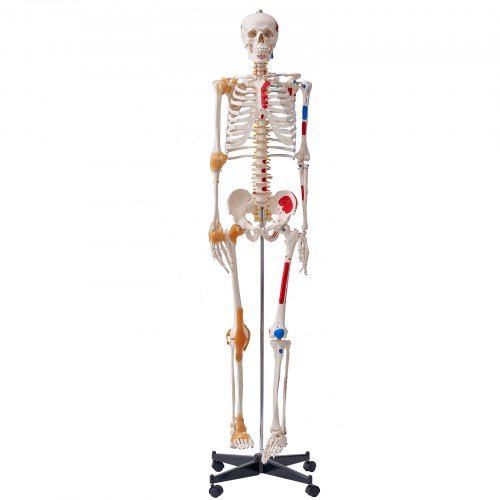
VEVOR Human Skeleton Model for Anatomy
A 1.82 m life‑size PVC skeleton with movable joints, ligaments and marked muscle origin/insertion points on a stainless‑steel stand — suited to teaching and lab demonstrations.
Overview
The VEVOR Human Skeleton Model is a life-size classroom skeleton built to show the full skeletal structure at 1820 mm. Moulded from durable PVC, mounted on a stainless-steel stand and fitted with movable arms, legs and jaw, it’s designed for repeated handling in education and training settings. The model also includes marked muscle origin and insertion points and a detachable design to help with occasional transport or partial storage.
This review covers the practical strengths and weaknesses of the VEVOR skeleton for teachers, students and clinical educators, and offers guidance on when it’s a sensible buy and what to watch out for before you order.
Who is this best for?
The VEVOR life-size skeleton is aimed squarely at classrooms, lecture theatres and anatomy labs where a large, visual teaching aid is needed. It’s well suited to:
- Secondary school science departments and college anatomy classes that need a clear, full-body visual reference.
- Physiotherapy, osteopathy and sports therapy tutors demonstrating joint mechanics, posture and musculoskeletal relationships to small groups.
- Medical students or training centres that want a durable, hands-on skeleton for group demonstrations and basic palpation exercises.
It’s less appropriate where fine cranial detail is required — a dedicated anatomical skull or high-detail cranial model will serve specialist neuroanatomy or dental teaching better — and it’s not designed as a hand-held prop for individual bedside demonstrations where portability and single-hand use are priorities.
Key features
Here are the model’s confirmed features and what they mean in practical terms:
- Life-size 1820 mm scale: This is an adult-size skeleton, large enough for accurate visual comparison with a human subject and for demonstrating posture and overall skeletal proportions.
- Durable PVC construction: PVC is a common material for teaching models because it balances detail with robustness; it resists knocks and classroom wear better than delicate plaster or resin alternatives.
- Stainless-steel stand: A sturdy floor stand adds stability during demonstrations and reduces wobble, which helps in front-of-class lessons. The stand height is around 1000 mm, providing a reliable base.
- Movable arms, legs and jaw: Articulated joints let instructors show ranges of motion and joint mechanics. A movable jaw is useful for explaining temporomandibular joint movement and simple functional anatomy.
- Marked muscle origin and insertion points: Labels for muscle origins and insertions add educational value, permitting more structured lessons on muscle attachments, lever arms and basic biomechanics.
- Detachable design: Select parts can be removed to aid transport or storage. This helps if the model needs to be moved between locations infrequently or boxed for shipping.
- Approximate weight and dimensions: The model (with stand) weighs roughly 9.5 kg, and the stand makes it a substantial floor display that requires adequate space.
Practical evaluation
What does owning and using this skeleton look like in everyday teaching? The VEVOR model is straightforward in concept: an easy-to-see, resilient full-body skeleton that survives classroom use. The combination of life-size scale and muscle attachment labels means it works well as a focal point for group teaching. Lecturers can demonstrate posture, spinal curvatures, joint angles and the broad relationships between bones and muscles without needing a specialist housing or fragile handling procedures.
Movable limbs and a functional jaw are particularly useful. They let an instructor physically demonstrate flexion, extension, abduction and rotation in a way that diagrams or photos cannot. For students who learn best by watching movement, those articulated joints create opportunities for clearer explanations — for example, showing how the scapula and humerus articulate during shoulder movements, or how hip rotation affects gait mechanics.
Assembly and handling: the skeleton is detachable, which helps with shipping and occasional storage, but first-assembly can be fiddly. Expect to set aside time to attach limbs and fit the skeleton onto its stainless-steel stand. If you plan to move it between rooms frequently, consider whether you have staff or equipment (a trolley) to help — the model plus stand isn’t something you’ll comfortably carry alone for long distances despite its moderate overall weight.
Label clarity and scale: the marked muscle origin and insertion points are a practical asset for planned lessons, but when used as a distant visual aid in a large lecture theatre some labels may be hard to read without a pointer or close-up images. Teachers should pair the skeleton with projected slides or close-up models for detailed label reading. Also, while PVC captures gross anatomy well, it doesn’t replace high-resolution specialist models for micro-anatomical structures.
Strengths
Several of the model’s advantages make it a compelling choice for many educational settings:
- Large, clear educational presence: Being life-size, the skeleton provides an immediate visual reference for body proportions and postural demonstrations. This scale helps students transition from textbook diagrams to real-world anatomy concepts.
- Durability for repeated use: PVC and a stainless-steel stand mean the model is built to survive regular handling in classrooms, clinics and student labs without brittle breakage.
- Practical articulation: Movable arms, legs and jaw make biomechanics understandable in real time, rather than only theoretically. Demonstrations of range-of-motion and joint relationships become hands-on.
- Educational labelling: Muscle origin and insertion points give teachers a ready-made reference for anatomy lessons, streamlining lesson planning and classroom explanations.
- Detachable for transport: While not ultra-portable, the ability to detach parts reduces shipping costs and allows partial storage when needed, which suits schools with limited permanent display space.
Limitations
No product is perfect for every situation, and the VEVOR life-size skeleton has a few practical limitations to consider before you buy:
- Size and mobility: The model needs floor space and a stable stand; it’s relatively heavy when assembled and can be awkward to move between rooms without assistance. If your teaching spaces are small or you need frequent mobility, a smaller or wheeled alternative might be better.
- Not a specialist cranial model: Although the skull is included as part of the full skeleton, the model isn’t intended for in-depth cranial or dental study. For detailed skull sutures, inner ear anatomy or dental occlusion teaching, a dedicated skull model is preferable.
- Assembly and handling: Initial assembly and detaching parts for transport can be fiddly. Allocate time and a clean workspace when you first unbox it and follow any fitting instructions closely.
- Label visibility at distance: Muscle origin and insertion markings add value, but they may be too small to read from the back of a large lecture theatre without supplementary visual aids.
- Check delivery and warranty details: As with any classroom equipment, confirm shipping arrangements and warranty terms on the retailer page before purchase — the product description suggests durability but specific delivery and warranty details should be verified.
Pricing and value
The listed guide price for this VEVOR skeleton is GBP 210.90. Whether it represents good value depends on how you plan to use the model. For many schools and training centres, a single life-size, durable skeleton that survives daily handling and supports joint demonstrations and labelled muscle points is a cost-effective core teaching tool.
Consider the following value questions before you buy:
- Will you use the model frequently for whole-class demonstrations where the life-size scale and movable joints are genuinely needed? If yes, the purchase is likely worthwhile.
- Do you require high-detail cranial or dental anatomy? If so, budget for a dedicated skull or specialist cranial model in addition to this skeleton.
- Is storage and occasional movement manageable? The detachable design helps, but if you need daily portability consider a lighter or wheeled option.
- Are you purchasing multiple units for small-group work? If you need several skeletons for hands-on student practice, total cost rises quickly — in that case a mix of full-size skeletons for demonstration and smaller portable models for group work might be better value.
Finally, note that offers and prices can change. Always check the retailer page for the most current price and delivery details before buying.
Alternatives and complementary models
Even if this skeleton meets most of your needs, it’s worth thinking about how it will sit within a broader teaching resource set. Two practical directions are common:
- Dedicated skull model: A separate anatomical skull is a useful complement where more detailed cranial study is required. Specialist skulls show sutures, foramina and inner structures more clearly than a general full-body skeleton can.
- Smaller, portable skeletons or joint models: For group practicals or lessons that move between rooms, lighter classroom skeletons or individual joint models (shoulder, knee, hip) can give students hands-on practice while the life-size skeleton remains the demonstration piece.
If you’re on a tighter budget but still require visual anatomy aids, consider investing in a mix of one robust life-size model for lecturer-led demonstrations and several smaller, cheaper models for student use. This blended approach balances durability, visual impact and hands-on learning opportunities.
Final verdict
The VEVOR 1820 mm life-size skeleton is a pragmatic, classroom-focused anatomy model. Its durable PVC construction, stainless-steel stand and articulated limbs make it a reliable demonstration aid for posture, joint mechanics and muscle attachment lessons. The marked muscle origin and insertion points add useful structure to teaching sessions, and the detachable design helps when transport or storage is occasionally needed.
That said, the model is not a specialist cranial tool and labels may be hard to read at a distance in very large lecture halls. It’s also not designed for frequent single-person portability, so factor in how often you’ll move it and whether you have the staff to assist.
For most schools, colleges and therapy training centres looking for a robust, life-size skeleton to anchor practical anatomy teaching, the VEVOR model represents a well-rounded choice. If your needs are more specialised — detailed skull anatomy, constant portability, or multiple student units — plan complementary purchases or choose different models accordingly.
Remember: product offers and prices can change, so check the retailer page for the latest availability, delivery and warranty information before you buy.
Ready to check VEVOR Human Skeleton Model for Anatomy, 1820 mm Life Size, Accurate PVC Anatomy Skeleton Model with Ligaments, Movable Arms, Legs & Jaw, with Muscle Origin & Insertion Points, for Professional Teaching?
Check the latest offer before buying, then return to the main comparison if you want to compare it against the other shortlisted options.
Compare this with the full shortlist
Return to the full comparison guide to see how this product compares against the other shortlisted choices.