
Overview
These two Vevor UK models represent common choices for anatomy teaching and demonstration. The life‑size skeleton gives a complete, mobile reference for whole‑body structure and joint movement, while the painted multi‑part skull focuses on cranial detail and removable brain elements for close study.
Both are PVC models designed for repeated handling and classroom use. The skeleton includes ligaments and marked muscle origins/insertions to support lessons on movement and attachment, whereas the skull breaks down into multiple parts to show sutures, foramina and internal brain anatomy.
Space, purpose and the age of your learners matter. A full skeleton requires a floor stand and storage space, and is best for practical demonstrations and anatomy labs. A small detachable skull is compact, affordable and ideal for desk‑based study, small group handling and neurological lectures.
Use the summary cards below to compare features, pros and cons at a glance, then read the buying guide for practical tips on matching a model to your needs.
Recommended

VEVOR Human Skeleton Model for Anatomy, 1820 mm Life Size, Accurate PVC Anatomy Skeleton Model with Ligaments, Movable Arms, Legs & Jaw, with Muscle Origin & Insertion Points, for Professional Teaching
Classroom demonstrations and whole‑body anatomy lessons where joint movement and muscle attachment need illustrating
A 1.82 m life‑size PVC skeleton with movable joints, ligaments and marked muscle origin/insertion points on a stainless‑steel stand — suited to teaching and lab demonstrations.
Pros
- Comprehensive whole‑body reference for anatomy lessons
- Marked muscle origins/insertions aid teaching of biomechanics
- Movable joints let educators demonstrate range of motion
- Durable PVC and metal stand suit regular classroom use
- Detachable design simplifies replacement of parts
- Good visual scale for group demonstrations
Cons
- Requires significant floor space and a stable stand
- Heavier and less portable than tabletop models
- May be more than needed for courses focused on a single region
- Detailed accuracy is limited by being a PVC model vs cadaveric specimens
- Some assembly and careful handling required to avoid damage
- Check retailer for what accessories or mounting hardware are included
/10
Overall score
Guide price: GBP 210.90 — check the retailer page for current price and availability.
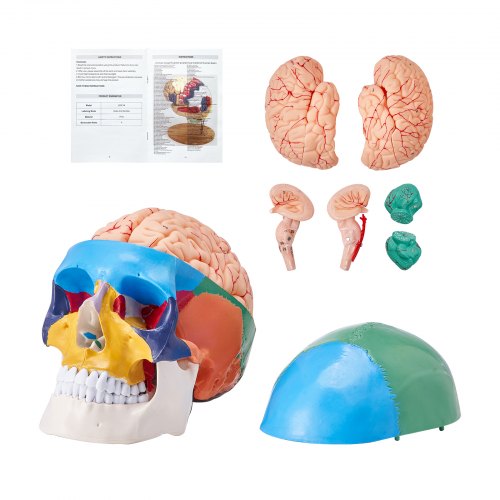
VEVOR Human Skull Model, 8 Parts Brain & 3 Parts Skull, Life-Size Painted Anatomy Skull Model, PVC Anatomical Skull, Detachable Learning Skull Model for Professional Teaching, Researching and Learning
Small‑group teaching, desk study and neurological or cranial anatomy demonstrations where compact detail is needed
A life‑size painted PVC skull that separates into multiple parts, including an 8‑part brain and 3‑part skull, offering close‑up study of cranial structures.
Pros
- Excellent for focused study of cranial anatomy and neuroanatomy
- Compact and easy to store or transport between sessions
- Detachable brain parts allow detailed internal study
- Painted landmarks improve visual clarity for learners
- Lower cost and space requirement than a full skeleton
- Suitable for small‑group handling without a floor stand
Cons
- Doesn’t provide whole‑body context or joint demonstration
- Small detachable parts can be misplaced if not stored carefully
- Less useful for biomechanics or musculoskeletal lessons
- Paint may wear with heavy handling over time
- Not a substitute for full‑scale anatomical labs for advanced students
- Check what mounting hardware or base (if any) is supplied
/10
Overall score
Guide price: GBP 26.90 — check the retailer page for current price and availability.
Comparison table
| Rank | Product | Best for | Price/value | Rating | CTA |
|---|---|---|---|---|---|
| #1 | VEVOR Human Skeleton Model for Anatomy, 1820 mm Life Size, Accurate PVC Anatomy Skeleton Model with Ligaments, Movable Arms, Legs & Jaw, with Muscle Origin & Insertion Points, for Professional Teaching | Classroom demonstrations and whole‑body anatomy lessons where joint movement and muscle attachment need illustrating | Guide price: GBP 210.90 — check the retailer page for current price and availability. | 9.6 | View product page |
| #2 | VEVOR Human Skull Model, 8 Parts Brain & 3 Parts Skull, Life-Size Painted Anatomy Skull Model, PVC Anatomical Skull, Detachable Learning Skull Model for Professional Teaching, Researching and Learning | Small‑group teaching, desk study and neurological or cranial anatomy demonstrations where compact detail is needed | Guide price: GBP 26.90 — check the retailer page for current price and availability. | 8.9 | View product page |
Detailed reviews
#1 VEVOR Human Skeleton Model for Anatomy, 1820 mm Life Size, Accurate PVC Anatomy Skeleton Model with Ligaments, Movable Arms, Legs & Jaw, with Muscle Origin & Insertion Points, for Professional Teaching
This VEVOR life‑size skeleton is a full‑body teaching model made from durable PVC and mounted on a stainless‑steel stand. It includes movable arms, legs and jaw plus ligament detail and markings for muscle origins and insertions, which helps when explaining biomechanics and attachments. The model is presented as a realistic 3D reference for classrooms and training rooms, and its detachable design makes some parts easier to replace or transport if required. Given its weight and height, it’s intended for floor display rather than tabletop use.
Key features
- Life‑size 1820 mm human skeleton on stainless‑steel stand
- Durable PVC construction designed for repeated classroom use
- Movable arms, legs and jaw for joint demonstration
- Ligament detail and muscle origin/insertion markings
- Detachable components for maintenance and transport
- Approx. 9.5 kg product weight; stand height around 1000 mm
#2 VEVOR Human Skull Model, 8 Parts Brain & 3 Parts Skull, Life-Size Painted Anatomy Skull Model, PVC Anatomical Skull, Detachable Learning Skull Model for Professional Teaching, Researching and Learning
This compact VEVOR skull model is a detailed, painted PVC replica that disassembles into an 8‑part brain and a 3‑part skull. Its life‑size scale and detachable elements make it useful for tabletop demonstrations, small group handling and individual study. The painted finish helps highlight sutures, foramina and other landmarks, which supports lessons in neuroanatomy and cranial anatomy. Lightweight and easy to store, the model is a practical choice for lecture theatres, clinics and home study where a full skeleton would be unnecessary.
Key features
- Life‑size 1:1 skull with painted anatomical detail
- Detachable 8‑part brain plus a 3‑part skull for hands‑on study
- Durable PVC material for classroom handling
- Compact dimensions suitable for tabletop use and storage
- Realistic 3D detail highlighting sutures and foramina
- Lightweight product weight around 1.27 kg for easy transport
Buying guide
Decide what you need to teach before choosing. Pick a life‑size skeleton if you need whole‑body reference, joint movement demonstrations or marked muscle origins/insertions. Choose a multi‑part skull if you need close study of cranial anatomy, removable brain components or a compact hands‑on model. Consider material and durability — PVC is common for classroom models because it’s durable and easy to clean. Check dimensions and stand requirements: full skeletons need floor space and a robust stand; skulls are tabletop items. Think about transport and storage: smaller models are far easier to move between classrooms. Finally, verify what’s included (stand, mounting hardware, numbered parts) and check the retailer page for the latest price, warranty and delivery options.
FAQs
Can students handle these models in class?
Yes. Both models are designed for handling, but supervise younger students to avoid damage. The skeleton is heavier and has moving joints, so handle with care; the skull has small detachable parts that can be misplaced if not stored properly.
Are PVC anatomy models accurate enough for teaching?
PVC models provide visual and tactile accuracy useful for most teaching settings. They’re durable and low‑maintenance, though they won’t replace cadaver work for advanced clinical training.
Our recommended choice
For broad classroom use the life‑size VEVOR skeleton is the more versatile teaching tool because it covers whole‑body structure and joint movement. If you need a compact, cost‑effective option focused on cranial anatomy, the multi‑part VEVOR skull is a better match.