
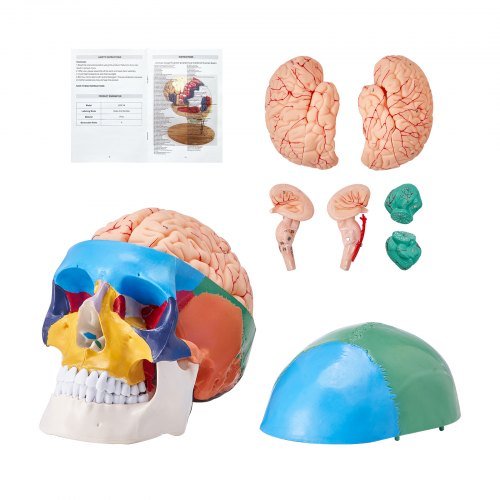
VEVOR Human Skull Model
A life‑size painted PVC skull that separates into multiple parts, including an 8‑part brain and 3‑part skull, offering close‑up study of cranial structures.
Overview
The VEVOR Human Skull Model is a life-size, 1:1 PVC anatomical skull designed for teaching and learning cranial anatomy. It separates into three skull sections and includes an eight-part removable brain assembly, with painted detail to highlight key structures. At roughly 215 x 130 x 160 mm and weighing around 1.27 kg, it’s a compact, lightweight model intended for close-up study, small-group demonstrations and desktop reference rather than whole-body context.
This review looks at how the model performs as a teaching aid: who it suits, what it shows well, practical considerations when using it in lessons or revision, and where it might fall short compared with larger or more expensive anatomical models.
Who is this best for?
The VEVOR skull is clearly aimed at learners and instructors who need a focused, portable tool for cranial anatomy. Typical users include:
- Undergraduate and A-level biology or anatomy students who want a hands-on study aid for revision.
- Teachers and tutors running small-group demonstrations or workshops where passing a compact model around is useful.
- Medical or healthcare trainees needing a desktop reference to visualise brain–skull relationships without the space or budget for larger models.
- Hobbyists or home learners who want a tactile, labelled object to support textbook study.
It’s not designed to replace a full-size skeleton when you need joint relationships, posture or the context of the cranial bones within the entire skeleton. If you need a large lecture-room display that students must view from a distance, or a model built to withstand heavy, repeated handling in a busy lab, a more robust or larger budget model would be a better choice.
Key features
- Life-size 1:1 PVC skull with painted anatomical detail to aid identification of features.
- Three-part separation of the skull for internal views and easier access to the base and cranial cavity.
- Eight-part removable brain assembly allowing examination of major brain structures and their spatial relationships within the skull.
- Lightweight and portable design suitable for passing round classes or storing between lessons.
- Durable PVC material intended to cope with repeated handling for education and revision contexts.
- Compact dimensions (approx 215 x 130 x 160 mm) and modest weight (approx 1.27 kg) for easy desktop use.
Practical evaluation
The VEVOR skull’s selling point is its combination of compactness, clear visual detail and a removable brain. In a classroom or study setting it performs well as a close-up demonstration tool. The three-part skull separation gives you quick access to the cranial vault and base, while the eight-part brain assembly lets students handle individual components and see how lobes, cerebellum and brainstem fit together.
Painted detail improves visual clarity compared with plain white models; subtle colour coding can speed up identification during a timed lab exercise or revision session. The model’s size makes it easy to pass between students, which is a genuine benefit for small-group teaching where tactile engagement improves retention.
Because the skull is PVC and relatively light, it’s also straightforward to store in cupboards or carry between rooms — useful for visiting tutors or schools with limited on-site storage. The detachable parts allow close inspection without needing specialised tools or handling techniques, which lowers the barrier for less confident users.
On the other hand, the compact nature that makes it portable is also a limitation. Details that would be obvious on a larger, higher-end skull may be less pronounced here; if you need micro-anatomical clarity for advanced neuroscience teaching, this model may not suffice. The absence of a full skeleton context means students must mentally map cranial features to the rest of the skeleton using supplementary materials or a separate skeleton model.
Strengths
- Excellent portability: At around 1.27 kg and modest dimensions, the skull is easy to pass around and store, making it practical for classroom rotation or home study.
- Removable brain assembly: The eight-part brain is a strong teaching feature — it clarifies the spatial relationships between different brain regions and the skull, and makes hands-on revision possible.
- Three-part skull separation: Internal cranial views are accessible without risk of damaging the model, and teachers can demonstrate meninges and cranial fossae relationships more easily.
- Painted anatomical detail: Coloured features help beginners pick out sutures, foramina and cranial landmarks more quickly than a monochrome model.
- Good value for focused cranial study: For anyone whose primary need is skull and brain anatomy rather than full-skeleton context, the VEVOR model provides the essential elements in a compact package.
Limitations
- Not a whole-body aid: If your teaching requires skeletal context, joint mechanics or posture, you’ll need a separate full skeleton model.
- Smaller detail and durability limits: Finer anatomical markings may be less distinct than on premium models, and rough handling could accelerate wear — important to consider in busy labs or for younger learners.
- Limited labelling: The product listing notes labels and numbering may be minimal; instructors relying on integrated numbering for tests or self-guided study should confirm what’s included.
- Mounting options may be basic or require confirmation at purchase. If you intend to display the skull on a stand or wall bracket, check with the retailer what mounting hardware (if any) is supplied.
How it works in common teaching scenarios
For small-group tutorials and revision sessions, the VEVOR skull shines. The removable brain makes it easy to illustrate how the cerebrum, cerebellum and brainstem occupy the cranial cavity. Students can examine the base of the skull, trace cranial nerve exits, and inspect features such as the foramen magnum and orbital cavities at close quarters.
In a classroom where a lecturer wants every student to touch and inspect a model, you could reasonably use one or two of these skulls per group of students. Their portability means they can be shared between classes and stored away when not in use — a practical consideration for schools with limited space.
For self-directed study, the model works well as a desktop companion. The painted features speed up revision and reduce reliance on constant textbook cross-referencing. However, if you need demonstrations visible to a whole lecture theatre, this compact skull won’t offer the scale required; bigger demonstration models or projection resources would be necessary.
Maintenance and handling advice
PVC is a sensible choice for an education model because it balances weight, cost and durability. To prolong the life of the painted surfaces and detachable joints, handle the skull with clean hands and discourage rough play. Store the pieces in a padded box or a cupboard to avoid scuffs, and keep it away from prolonged direct sunlight which can fade painted markings over time.
When removing and replacing brain parts, encourage students to follow a methodical order — this preserves joints and reduces the chance of cracking. If you plan to mount the skull, verify whether the product includes a stand; if not, use a stable holder that supports the base evenly to avoid stress on any detachable parts.
Pricing and value
The VEVOR Human Skull Model is offered as a budget-friendly anatomical tool for targeted cranial study. Its combination of life-size scale, painted detail and removable brain gives it strong value for learners and educators who need a usable, tactile resource without the cost and space demands of a full skeleton or premium medical models.
Keep in mind that lower price inevitably reflects compromises: finer anatomical nuance, more extensive labelling, and ultra-robust construction are typically found on higher-priced models. For many classroom and home-study contexts, however, those trade-offs are acceptable — the VEVOR skull gives you the essentials of cranial anatomy in a portable, easy-to-use form.
Note: product availability and prices can change. Check the retailer’s page for the latest information before buying.
Alternatives to consider
Before deciding, think about the exact teaching goals you have. If you need cranial detail plus full skeletal context, a life-size skeleton model (with detachable skull) will serve both purposes but will be larger and more costly. If the priority is high-detail neuroanatomy for advanced students, specialist brain models with finer dissections and labelling may be a better fit.
Other compact skull models at similar price points may trade off a removable brain for more extensive surface labelling, or offer different mounting options. If you want a set for repeated classroom use, consider the number of students who should be able to examine a model simultaneously and whether it makes sense to buy more than one.
For tutors on a budget, pairing the VEVOR skull with a basic skeleton model (or even a single full-size skeleton shared across modules) can give you the best of both worlds: focused cranial study alongside whole-body skeletal context when needed.
Final verdict
The VEVOR Human Skull Model is a pragmatic, well-considered tool for focused cranial anatomy teaching and revision. Its life-size proportions, painted detail and detachable eight-part brain make it particularly useful for small-group demonstrations and individual study where portability and hands-on inspection are priorities.
It’s not a replacement for a full skeleton or for high-end clinical models, but it doesn’t try to be. Instead, it occupies a clear niche: a compact, affordable skull that does the essential job of teaching skull and basic brain anatomy. For teachers, students and home learners who need a durable, portable resource that supports tactile learning, this model represents good value — provided you accept the limits on fine detail, labelling and whole-body context.
If your needs are strictly cranial — for basic anatomy courses, revision sessions or demonstrations — the VEVOR skull is a sensible and practical choice. If you require more comprehensive skeletal relationships or specialist neuroanatomical detail, consider pairing it with larger models or specialist resources.
Remember to check the retailer page for the most up-to-date price and availability before buying.
Ready to check VEVOR Human Skull Model, 8 Parts Brain & 3 Parts Skull, Life-Size Painted Anatomy Skull Model, PVC Anatomical Skull, Detachable Learning Skull Model for Professional Teaching, Researching and Learning?
Check the latest offer before buying, then return to the main comparison if you want to compare it against the other shortlisted options.
Compare this with the full shortlist
Return to the full comparison guide to see how this product compares against the other shortlisted choices.