
Overview
A full life-size skeleton is a demonstration tool for whole-body anatomy: joint mechanics, limb relationships, posture and surface landmarks. It works well in classrooms, labs and clinics when you need a physical reference for bone structure, articulation and muscle attachments.
A multi-part skull model zeroes in on cranial anatomy and the brain. Detachable sections, painted detail and separate brain parts make it a compact, hands-on resource for neurology, dental training and targeted study of cranial foramina, sutures and inner structures.
Both products from the same manufacturer share construction materials (durable PVC) and detachable designs, but their classroom roles differ. The skeleton is about scale, movement and whole-body context; the skull is about focused, repeatable exploration of head anatomy.
Which to choose depends on your teaching goals, budget, storage and how students will interact with the model. Below you’ll find practical notes, feature lists and pros/cons to help you decide.
Recommended

VEVOR Human Skeleton Model for Anatomy, 1820 mm Life Size, Accurate PVC Anatomy Skeleton Model with Ligaments, Movable Arms, Legs & Jaw, with Muscle Origin & Insertion Points, for Professional Teaching
Whole-body anatomy demonstrations, joint mechanics, and classroom teaching where scale and articulation matter
Life-size PVC skeleton with movable limbs, labelled muscle origins/insertions and a sturdy stand — suited to classrooms and clinics needing a full-body reference.
Pros
- Excellent for whole-body demonstrations and posture lessons
- Movable joints let students explore articulation and range
- Muscle origin/insertion markings add extra teaching value
- Sturdy stand keeps the model stable during group demos
- Detachable parts make maintenance and transport easier
- Same-brand manufacturing means consistent materials and finish
Cons
- Large footprint requires storage space when not in use
- Heavier than smaller models, so not ideal for frequent moving
- Level of detail is broad rather than microscopically anatomical
- May require assembly and occasional tightening of joints
- PVC finish can look less authentic than cast resin or real bone
- Check exact inclusions (accessories/warranty) with retailer
/10
Overall score
Guide price: GBP 210.90. Check current price and availability before buying.
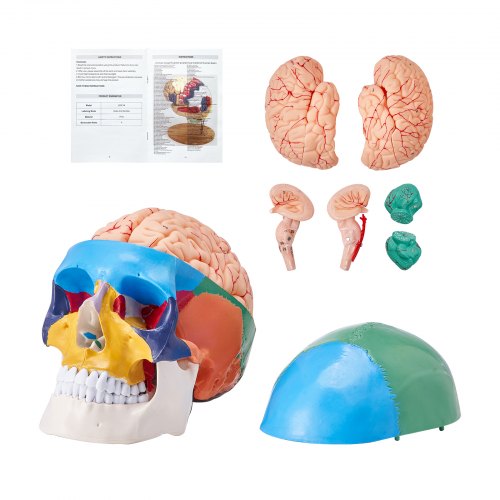
VEVOR Human Skull Model, 8 Parts Brain & 3 Parts Skull, Life-Size Painted Anatomy Skull Model, PVC Anatomical Skull, Detachable Learning Skull Model for Professional Teaching, Researching and Learning
Focused study of cranial anatomy and brain structures in small-group teaching or clinic reference
A life-size, multi-part skull with separately removable brain sections and painted detail — ideal for targeted cranial lessons and compact study spaces.
Pros
- Excellent for neurology, dentistry and focused cranial lessons
- Removable brain parts let students inspect internal structures
- Small and portable — easy to store or use in small rooms
- Painted landmarks aid quick identification during lessons
- Durable PVC tolerates frequent handling by students
- Budget-friendly compared with full-size specialised models
Cons
- Not suitable for whole-body anatomy demonstrations
- Smaller size limits its use as a large-group visual aid
- Painted detail may wear with heavy handling over time
- Less useful where joint mechanics or posture are needed
- May lack the fine tactile realism of higher-end models
- Confirm included parts and labelling with retailer before purchase
/10
Overall score
Guide price: GBP 26.90. Check current price and availability before buying.
Comparison table
| Rank | Product | Best for | Price/value | Rating | CTA |
|---|---|---|---|---|---|
| #1 | VEVOR Human Skeleton Model for Anatomy, 1820 mm Life Size, Accurate PVC Anatomy Skeleton Model with Ligaments, Movable Arms, Legs & Jaw, with Muscle Origin & Insertion Points, for Professional Teaching | Whole-body anatomy demonstrations, joint mechanics, and classroom teaching where scale and articulation matter | Guide price: GBP 210.90. Check current price and availability before buying. | 9.6 | View product page |
| #2 | VEVOR Human Skull Model, 8 Parts Brain & 3 Parts Skull, Life-Size Painted Anatomy Skull Model, PVC Anatomical Skull, Detachable Learning Skull Model for Professional Teaching, Researching and Learning | Focused study of cranial anatomy and brain structures in small-group teaching or clinic reference | Guide price: GBP 26.90. Check current price and availability before buying. | 8.9 | View product page |
Detailed reviews
#1 VEVOR Human Skeleton Model for Anatomy, 1820 mm Life Size, Accurate PVC Anatomy Skeleton Model with Ligaments, Movable Arms, Legs & Jaw, with Muscle Origin & Insertion Points, for Professional Teaching
This Vevor life-size skeleton model is built to serve as a broad teaching aid. At around 1.82 m it represents human skeletal proportions while offering movable joints, a jaw that opens and closes, and printed or sculpted muscle origin and insertion points for faster demonstration. Constructed from PVC with a stainless-steel stand, it’s specified as detachable for transport and repair. The weight and dimensions make it a prominent classroom fixture rather than a portable prop; it’s designed for repeated handling and visual demonstration during lessons.
Key features
- Full life-size skeleton approximately 1820 mm tall
- PVC construction with detachable components for repair and transport
- Movable arms, legs and articulated jaw for joint demonstration
- Marked muscle origin and insertion points for teaching reference
- Stainless-steel stand included for stable classroom display
- Durable design intended for repeated handling in teaching environments
#2 VEVOR Human Skull Model, 8 Parts Brain & 3 Parts Skull, Life-Size Painted Anatomy Skull Model, PVC Anatomical Skull, Detachable Learning Skull Model for Professional Teaching, Researching and Learning
This compact Vevor skull model breaks the head into removable parts for hands-on study. Painted detail and detachable brain components make it straightforward to demonstrate internal structures and relationships between cranial bones and the brain. Its 1:1 scale preserves real-world proportions while remaining small and light enough for table-top group work or one-to-one tuition. Made from PVC, the model emphasises durability and repeatability rather than museum-grade realism.
Key features
- Life-size 1:1 scale skull and brain components
- Eight-part brain assembly and three-part skull for disassembly
- Painted detail highlights anatomical landmarks and foramina
- Durable PVC construction suitable for classroom handling
- Compact, lightweight design for table-top or portable use
- Detachable design supports repeated close-up study and demos
Buying guide
Decide what you need to teach. Choose a life-size skeleton if you want whole-body demonstrations, joint articulation and muscle origin/insertion reference. Pick a multi-part skull model when lessons focus on the brain, cranial nerves, dental anatomy or compact hands-on practice. Consider who will handle the model: classrooms and repeated handling favour sturdy stands and robust joints; small-group study benefits from lightweight, removable parts. Check dimensions and storage needs before buying, and confirm what's included (stand, mounting hardware, labelled parts). If budget is limited, the skull is a low-cost specialist tool; if you need broad capability, the skeleton covers more topics at once.
FAQs
Do these models come ready to use?
Both models are supplied as assembly-ready teaching models. Expect some basic assembly (mounting on a stand for the skeleton, fitting skull sections) and check the retailer page for included accessories and instructions.
Are these suitable for GCSE, A‑level or university teaching?
Yes. The skeleton supports general anatomy and kinesiology topics useful at GCSE through undergraduate levels. The multi-part skull is especially useful where detailed cranial or neurological study is required.
How do I clean and maintain PVC models?
Wipe with a soft cloth and mild detergent; avoid solvents or abrasive cleaners. For moving joints, check manufacturer guidance on tightening or lubrication if needed.
Our recommended choice
For broad classroom use the life-size skeleton is the more versatile visual aid. For targeted cranial or neurological teaching, the multi-part skull is a compact, cost-effective complement. If you can, buy the one that matches your core teaching aims — skeleton for whole-body anatomy, skull for concentrated head/brain study.