
Overview
A full skeleton and a focused skull model serve different teaching purposes. The skeleton is a broad reference model that shows bone relationships across the whole body, often used in classroom demonstrations, labs or physiotherapy teaching. The multi‑part skull is a compact, detailed model that concentrates on cranial anatomy and the brain, useful for neurology, dentistry or smaller study spaces.
Both models from Vevor UK are injection‑moulded PVC, designed to be durable and repeatedly handled. The skeleton is life‑size and includes movable limbs, ligaments and marked muscle origin/insertion points; the skull is a life‑size, painted model with an eight‑part brain and three removable skull sections for close study.
Choosing between them depends on the focus of study, available storage and teaching style. A full skeleton is more versatile for whole‑body lessons but needs more space and budget. The multi‑part skull is economical, portable and ideal when your priority is cranial detail.
Below we list practical details, feature highlights and honest pros and cons to help you decide which model best suits your classroom, study desk or demonstration needs.
Recommended

VEVOR Human Skeleton Model for Anatomy, 1820 mm Life Size, Accurate PVC Anatomy Skeleton Model with Ligaments, Movable Arms, Legs & Jaw, with Muscle Origin & Insertion Points, for Professional Teaching
Best for whole‑body teaching, anatomy labs and classroom demonstrations
Life‑size 1.82 m PVC skeleton with movable limbs, ligaments and marked muscle origin/insertion points — designed for teaching and demonstration.
Pros
- Comprehensive whole‑body reference for classrooms
- Movable joints make demonstrations clearer
- Muscle markers help explain biomechanics
- Sturdy stainless steel stand for stability
- Durable PVC tolerates regular use
- Detachable components aid transport and storage
Cons
- Requires floor space and a stand for display
- Relatively heavy to move — assembly may need two people
- Higher guide price than compact models — check budget
- May include small parts that need secure storage
- Printed muscle markings may fade over many years
- Not a substitute for hands‑on clinical experience
/10
Overall score
Guide price: GBP 210.90. Check the retailer page for the latest price and availability.
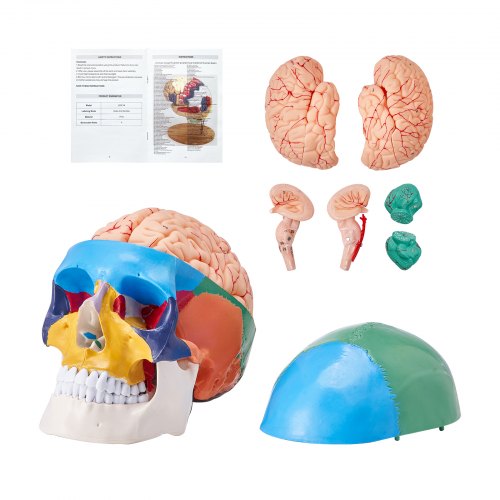
VEVOR Human Skull Model, 8 Parts Brain & 3 Parts Skull, Life-Size Painted Anatomy Skull Model, PVC Anatomical Skull, Detachable Learning Skull Model for Professional Teaching, Researching and Learning
Best for focused cranial anatomy, dental teaching and compact study spaces
Life‑size painted skull with an 8‑part removable brain and three detachable skull sections — compact, portable and detailed for cranial study.
Pros
- Affordable specialist model for cranial anatomy
- Removable brain parts aid hands‑on learning
- Compact size fits small desks and shelves
- Painted details improve visual clarity
- Durable PVC tolerates regular handling
- Lightweight — easy to transport between classes
Cons
- Limited to cranial anatomy — not a whole‑body tool
- Small removable parts could be misplaced in busy classes
- Less useful for teaching joint mechanics or limbs
- Painted details may wear if handled roughly
- Not suitable as a primary resource for general anatomy courses
- May need multiple copies for larger student groups
/10
Overall score
Guide price: GBP 26.90. Check the retailer page for the latest price and availability.
Comparison table
| Rank | Product | Best for | Price/value | Rating | CTA |
|---|---|---|---|---|---|
| #1 | VEVOR Human Skeleton Model for Anatomy, 1820 mm Life Size, Accurate PVC Anatomy Skeleton Model with Ligaments, Movable Arms, Legs & Jaw, with Muscle Origin & Insertion Points, for Professional Teaching | Best for whole‑body teaching, anatomy labs and classroom demonstrations | Guide price: GBP 210.90. Check the retailer page for the latest price and availability. | 9.6 | Check latest price |
| #2 | VEVOR Human Skull Model, 8 Parts Brain & 3 Parts Skull, Life-Size Painted Anatomy Skull Model, PVC Anatomical Skull, Detachable Learning Skull Model for Professional Teaching, Researching and Learning | Best for focused cranial anatomy, dental teaching and compact study spaces | Guide price: GBP 26.90. Check the retailer page for the latest price and availability. | 9.0 | View product page |
Detailed reviews
#1 VEVOR Human Skeleton Model for Anatomy, 1820 mm Life Size, Accurate PVC Anatomy Skeleton Model with Ligaments, Movable Arms, Legs & Jaw, with Muscle Origin & Insertion Points, for Professional Teaching
This VEVOR life‑size skeleton is a comprehensive PVC anatomy model that covers the entire human skeletal system with added teaching details. It includes movable arms, legs and jaw, visible ligaments and printed muscle origin and insertion points to help explain biomechanics and muscle attachments. The model comes with a stainless steel stand and is substantial in size and weight, making it a stable classroom reference. It’s aimed at educators, training centres and students who need a hardwearing, full‑body visual aid rather than a small specialised model.
Key features
- Life‑size 1,820 mm full skeleton in PVC
- Movable arms, legs and functioning jaw for demonstrations
- Marked muscle origin and insertion points for teaching
- Includes stainless steel stand for floor display
- Durable PVC material suited to repeated handling
- Detachable parts for closer inspection and transport
#2 VEVOR Human Skull Model, 8 Parts Brain & 3 Parts Skull, Life-Size Painted Anatomy Skull Model, PVC Anatomical Skull, Detachable Learning Skull Model for Professional Teaching, Researching and Learning
This VEVOR skull model is a compact, painted PVC anatomy model that concentrates on the head. It includes a life‑size skull with three detachable skull sections plus an eight‑part brain that separates for detailed study of cranial cavities and brain structures. The model is light and portable, making it suitable for desk‑based study, small seminar rooms or dental and neurology demonstrations. As a specialist tool it delivers close‑up detail without the space requirements of a full skeleton.
Key features
- Life‑size 1:1 painted PVC skull
- Eight‑part removable brain for sectional study
- Three detachable skull pieces for inner cranial views
- Compact and lightweight — easy to store
- Durable PVC construction for classroom use
- Suitable for dentistry, neurology and student study
Buying guide
Decide what you need to teach or study: whole‑body relationships and surface anatomy require a full skeleton; focused cranial anatomy needs a multi‑part skull. Consider space and handling — skeletons need floor space and a stand, skulls sit on a shelf or desk. Look for durable PVC if models will be handled often, and removable parts if hands‑on disassembly is useful for your lessons. Check the seller’s latest price, delivery and included stand or mounting hardware. For classroom sets, budget for multiple skulls or smaller, more robust models; for single‑user study, a multi‑part skull is compact and good value.
FAQs
Can these models be used for exam study?
Yes. Both models are useful visual aids for revision. The skeleton helps with spatial relationships and joint movement; the multi‑part skull is good for detailed cranial and brain structure revision. They should complement, not replace, cadaveric or clinical study where required.
Are the models durable for repeated classroom handling?
Both are made from durable PVC, which is designed to withstand regular handling. Expect some wear over long periods; stored correctly and handled reasonably, PVC models last well for teaching use.
Our recommended choice
For most classroom or lab settings the VEVOR life‑size skeleton is the better single purchase because it covers whole‑body anatomy, is marked with muscle origins and insertions, and has movable joints for demonstration. If your focus is strictly cranial anatomy or you need a compact, budget option, the multi‑part skull is an effective specialist tool.