
Overview
Both models come from Vevor UK and are built from durable PVC with detachable elements to support hands-on study and demonstrations. The full skeleton offers a complete, life-size representation with movable joints and indicated muscle origin and insertion points, while the skull model breaks down into multiple parts and includes a removable brain replica for focused cranial study.
The skeleton is sized at around 1820 mm and includes a stainless-steel stand, making it suitable for classroom displays and practical demonstrations where the whole body context matters. It’s heavier and needs more space, but it supports broad teaching objectives from basic anatomy to biomechanics.
The multi-part skull is compact and portable, modelled at life size but small enough for individual or small-group study. Its detachable sections let students inspect cranial sutures, inner skull structures and the brain model, which is useful for neurology or dental-focused modules.
Choosing between them depends on your teaching goals: pick the skeleton for whole-body lessons and physical demonstrations; choose the skull for detailed cranial study, compact storage or as a supplement to broader anatomical resources.
Recommended

VEVOR Human Skeleton Model for Anatomy, 1820 mm Life Size, Accurate PVC Anatomy Skeleton Model with Ligaments, Movable Arms, Legs & Jaw, with Muscle Origin & Insertion Points, for Professional Teaching
Best for classrooms that need a full, life-size reference for whole-body anatomy and demonstrations
A life-size PVC skeleton with movable joints, muscle origin/insertion markings and a stainless-steel stand — built for teaching and display.
Pros
- Comprehensive whole-body reference useful across many modules
- Marked muscle points help link structure to function
- Articulated joints make demonstrations straightforward
- Stainless-steel stand provides stable display
- Durable PVC tolerates frequent classroom handling
- Detachable parts support close-up study of key areas
Cons
- Large footprint requires dedicated display space
- Heavier model may need two people to move safely
- May be overkill for exclusively cranial or dental courses
- Some smaller parts could be fragile with rough handling
- Doesn’t replace the detail of specialised bone or dental models
- Check seller details for exactly which accessories are included
/10
Overall score
Guide price: GBP 210.90. Check the retailer page for the latest price and availability.
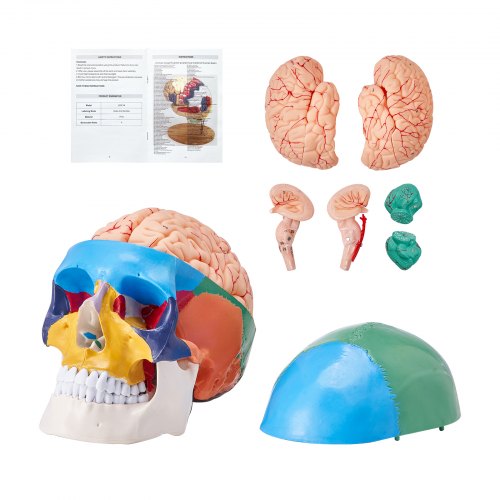
VEVOR Human Skull Model, 8 Parts Brain & 3 Parts Skull, Life-Size Painted Anatomy Skull Model, PVC Anatomical Skull, Detachable Learning Skull Model for Professional Teaching, Researching and Learning
Best for focused cranial, dental or neurological study where portability and fine detail matter
A life-size multi-part skull with detachable brain and skull sections — compact and portable for detailed cranial study.
Pros
- Excellent for detailed study of cranial anatomy and sutures
- Removable brain parts support neurology lessons
- Small and portable — easy to pass around a class
- Painted landmarks improve visual learning
- Durable enough for repeated handling in labs
- Relatively affordable compared with full-body models
Cons
- Doesn’t provide whole-body context for general anatomy lessons
- Smaller detachable pieces can be lost or damaged if not stored carefully
- Less useful for teaching joint movement or posture
- Scale alone may not cover specialised dental detail
- May be insufficient as the sole model for mixed-discipline courses
- Check product listings for included mounting or storage accessories
/10
Overall score
Guide price: GBP 26.90. Check the retailer page for the latest price and availability.
Comparison table
| Rank | Product | Best for | Price/value | Rating | CTA |
|---|---|---|---|---|---|
| #1 | VEVOR Human Skeleton Model for Anatomy, 1820 mm Life Size, Accurate PVC Anatomy Skeleton Model with Ligaments, Movable Arms, Legs & Jaw, with Muscle Origin & Insertion Points, for Professional Teaching | Best for classrooms that need a full, life-size reference for whole-body anatomy and demonstrations | Guide price: GBP 210.90. Check the retailer page for the latest price and availability. | 9.6 | Check latest price |
| #2 | VEVOR Human Skull Model, 8 Parts Brain & 3 Parts Skull, Life-Size Painted Anatomy Skull Model, PVC Anatomical Skull, Detachable Learning Skull Model for Professional Teaching, Researching and Learning | Best for focused cranial, dental or neurological study where portability and fine detail matter | Guide price: GBP 26.90. Check the retailer page for the latest price and availability. | 9.0 | Check latest price |
Detailed reviews
#1 VEVOR Human Skeleton Model for Anatomy, 1820 mm Life Size, Accurate PVC Anatomy Skeleton Model with Ligaments, Movable Arms, Legs & Jaw, with Muscle Origin & Insertion Points, for Professional Teaching
This VEVOR life-size skeleton is a classroom-focused anatomy model made from durable PVC and supplied with a stainless-steel stand. It’s about 1820 mm tall and includes movable arms, legs and jaw along with marked muscle origin and insertion points to aid instruction. The model is designed to be multi-functional: detachable parts allow closer inspection, while the articulated joints support demonstrations of posture and basic biomechanics. It’s relatively heavy and needs floor space for display, but it gives students a clear, accurate reference for whole-body anatomy.
Key features
- Life-size 1820 mm PVC skeleton with articulated joints
- Marked muscle origin and insertion points for teaching
- Movable arms, legs and jaw for demonstrations
- Durable PVC construction with stainless-steel stand
- Detachable components for closer inspection
- Suitable for classroom displays and practical lessons
#2 VEVOR Human Skull Model, 8 Parts Brain & 3 Parts Skull, Life-Size Painted Anatomy Skull Model, PVC Anatomical Skull, Detachable Learning Skull Model for Professional Teaching, Researching and Learning
The VEVOR multi-part skull is a compact, life-size PVC model split into multiple detachable sections, including an 8-part brain and a 3-part skull. It is painted to highlight anatomical landmarks and is intended for teaching, research and student study. Lightweight and portable, the model works well for small-group demonstrations, lab sessions and personal revision. While it lacks the broad context of a full skeleton, its detail and removable components make it a strong choice for cranial-focused modules or as a complement to larger anatomy resources.
Key features
- Life-size 1:1 PVC skull with painted anatomical detail
- Includes an 8-part brain replica and 3-part skull sections
- Detachable design for hands-on study of internal features
- Compact and lightweight for easy handling and storage
- Durable PVC suitable for classroom use
- Helpful for neurology, dentistry and focused anatomy lessons
Buying guide
Decide what you need to teach: whole-body anatomy, joint movement and muscle attachments require a life-size skeleton; focused study of cranial anatomy, sutures and brain relations is best served by a multi-part skull. Consider durability (PVC is standard for classroom use), mounting and storage — stands make skeletons easier to display but add footprint, whereas skulls are portable. Check the level of detachable detail you need: countable parts and labelled landmarks help lesson planning. Finally, confirm what’s included with the seller (stand, mounting hardware, labelled charts) and check current price and delivery before buying.
FAQs
Are these models suitable for classroom use?
Yes. Both PVC models are designed for teaching and demonstration. The skeleton suits whole-class displays; the skull is better for close-up study and small groups.
Can parts be removed for study?
Yes. The skull model is explicitly multi-part with detachable sections and a removable brain replica. The skeleton has detachable components and movable joints for demonstration purposes.
How durable are PVC anatomy models?
PVC is a common, durable material for educational models and stands up to regular handling, but treat smaller detachable parts carefully to avoid breakage.
Our recommended choice
For general teaching and demonstrative use in classrooms, the VEVOR life-size skeleton is the most versatile single investment. If your teaching is cranial- or brain-specific, or you need a compact option for group study, add the multi-part skull or choose it as an alternative.