
Overview
MPPT (Maximum Power Point Tracking) controllers squeeze more usable power from solar panels than basic PWM regulators, especially when panel voltage is significantly higher than battery voltage. Both VEVOR models here are MPPT devices with automatic 12V/24V detection and similar protection and charging modes, but they differ primarily in maximum charge current and input power.
The 20A controller is aimed at smaller systems — think single batteries, small camper setups or modest off-grid kits — where panel arrays are limited by space or budget. It offers good MPPT efficiency and basic communications options for monitoring.
The 50A controller suits larger 12V or 24V battery banks and higher wattage arrays. If you plan to expand panels, run heavier DC loads, or want a single controller to handle a multi-panel array, the higher amp rating and greater input power make it the logical choice.
Beyond amp rating, consider the controller's max open-circuit voltage, supported battery chemistries, temperature compensation and communications (Bluetooth/RS232). These features affect real-world convenience and longevity, so weigh them alongside current capacity when choosing.
Recommended
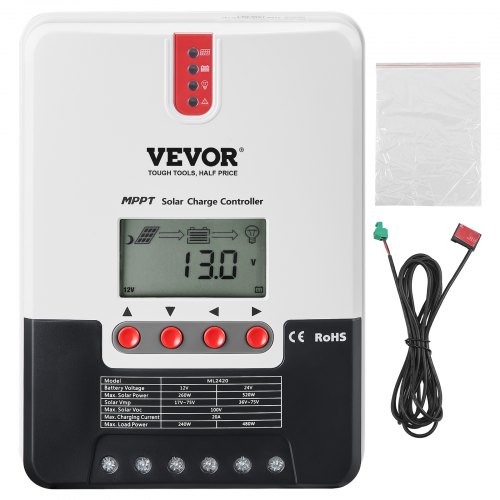
VEVOR 20A MPPT Solar Charge Controller, 12V / 24V Auto DC Input, Solar Panel Regulator Charger with LCD Display Temperature Sensor Cable, for Sealed(AGM), Gel, Flooded and Lithium Battery Charging
Smaller 12V/24V systems, campers and single-battery off-grid setups where budget and compact size matter
20A MPPT controller with auto 12V/24V, LCD display, temperature sensor input and support for common battery chemistries.
Pros
- Compact and lightweight for small installations
- Good MPPT efficiency improves energy harvest
- Includes temperature sensor and LCD for local monitoring
- Supports a range of battery chemistries
- Optional Bluetooth available via separate module
- Lower price point suited to tight budgets
Cons
- Limited to 20A — not suitable for larger arrays
- No built-in Bluetooth (requires optional module)
- May need careful sizing margin for midday peaks
- RS232 communication may feel dated to some users
- Fewer watts supported at 12V compared with 50A unit
- Installation guidance and warranty details vary by seller
/10
Overall score
Guide price: USD 57.90. Check current price and stock on the retailer page before buying.

VEVOR 50A MPPT Solar Charge Controller, 12V / 24V Auto DC Input, Solar Panel Regulator Charger with Bluetooth Module, 98% Charging Efficiency for Sealed(AGM), Gel, Flooded and Lithium Battery Charging
Larger 12V/24V battery banks, expandable panel arrays and installations needing higher continuous charge current
50A MPPT controller with built-in Bluetooth, high input power handling and support for multiple battery chemistries.
Pros
- High continuous current for larger battery banks
- Built-in Bluetooth for easy remote monitoring
- Handles substantially higher panel wattage than 20A unit
- Supports temperature compensation for safer charging
- Same MPPT efficiency as the 20A model
- Compact for its capacity and relatively lightweight
Cons
- Higher cost than the 20A option
- May be oversized for small systems, adding unnecessary expense
- Requires appropriately sized wiring and fusing for 50A
- Built-in Bluetooth depends on app compatibility and updates
- Still limited to 100V open-circuit panel input
- Warranty and support terms should be confirmed with seller
/10
Overall score
Guide price: USD 127.90. Often priced as a premium option; check current offers and compatibility with your system.
Comparison table
| Rank | Product | Best for | Price/value | Rating | CTA |
|---|---|---|---|---|---|
| #1 | VEVOR 20A MPPT Solar Charge Controller, 12V / 24V Auto DC Input, Solar Panel Regulator Charger with LCD Display Temperature Sensor Cable, for Sealed(AGM), Gel, Flooded and Lithium Battery Charging | Smaller 12V/24V systems, campers and single-battery off-grid setups where budget and compact size matter | Guide price: USD 57.90. Check current price and stock on the retailer page before buying. | 9.6 | View product page |
| #2 | VEVOR 50A MPPT Solar Charge Controller, 12V / 24V Auto DC Input, Solar Panel Regulator Charger with Bluetooth Module, 98% Charging Efficiency for Sealed(AGM), Gel, Flooded and Lithium Battery Charging | Larger 12V/24V battery banks, expandable panel arrays and installations needing higher continuous charge current | Guide price: USD 127.90. Often priced as a premium option; check current offers and compatibility with your system. | 9.1 | View product page |
Detailed reviews
#1 VEVOR 20A MPPT Solar Charge Controller, 12V / 24V Auto DC Input, Solar Panel Regulator Charger with LCD Display Temperature Sensor Cable, for Sealed(AGM), Gel, Flooded and Lithium Battery Charging
This VEVOR 20A MPPT controller targets compact solar installations that need efficient charging without a big upfront cost. It automatically detects 12V or 24V battery systems, includes an LCD for status and settings, and supports sealed (AGM), gel, flooded and lithium batteries. MPPT control efficiency is rated at 98% and the unit handles up to 100V open-circuit panel input. Communication is available via an RS232 interface and an optional Bluetooth module for remote monitoring. Typical roles include small camper or boat installs, single domestic battery banks and modest cabin systems where panel wattage stays within the controller’s input limits.
Key features
- Maximum charging current: 20A
- Automatic 12V/24V battery detection
- MPPT efficiency rated ≥98%
- LCD display and temperature sensor cable included
- Max solar open-circuit voltage: 100V DC
- Supports AGM, gel, flooded and lithium chemistries
#2 VEVOR 50A MPPT Solar Charge Controller, 12V / 24V Auto DC Input, Solar Panel Regulator Charger with Bluetooth Module, 98% Charging Efficiency for Sealed(AGM), Gel, Flooded and Lithium Battery Charging
The VEVOR 50A MPPT controller is built for more demanding off-grid systems where higher charging currents are required. It automatically detects 12V or 24V battery banks and offers built-in Bluetooth for app-based monitoring and configuration. With MPPT efficiency around 98% and a maximum open-circuit panel voltage of 100V, it supports significantly higher array wattages (up to 660W at 12V and 1,320W at 24V rated input power). Charging modes include fast, balance and float; an external temperature sensor is supported to help with temperature-compensated charging. This model suits larger camper installs, multiple-battery setups and small domestic off-grid systems that expect array expansion.
Key features
- Maximum charging current: 50A
- Automatic 12V/24V battery detection
- Built-in Bluetooth and app control (Neutral APP)
- MPPT efficiency rated ≥98% and supports external temp sensor
- Max solar open-circuit voltage: 100V DC
- Rated input power: up to 660W (12V) / 1320W (24V)
Buying guide
Match the controller’s continuous charge current to the maximum charging current your panels can deliver at the battery voltage. For a 12V system, divide the panel array wattage by 12 to estimate current; for 24V divide by 24. Allow a margin (typically 25–30%) so the controller isn’t running at its limit, and factor in future expansion. Check max open-circuit voltage (both listed here as 100V), battery chemistries supported (AGM, gel, flooded, lithium) and whether you need Bluetooth or remote monitoring. Also consider installation space — larger controllers can require more clearance and ventilation — and look for temperature compensation if your batteries will be exposed to wide temperature swings. Finally, confirm warranty and aftercare with the seller before buying.
FAQs
Can I use a 50A controller on a small 12V battery?
Yes — a higher-amp controller will work with a small battery as long as wiring and fuses are sized correctly. The main downside is cost and size; the controller will simply cap charging at the battery’s ability to accept current.
How do I decide between 12V and 24V operation?
Choose 24V when you have higher panel wattage or longer cable runs to reduce current and losses. A 24V battery bank also halves charge current for the same wattage, which may let you use thinner cable or a lower-amp controller.
Our recommended choice
For most small off-grid rigs, campervans and single-battery systems the 20A VEVOR is a sensible, cost-effective choice. If you expect to expand panels, charge larger battery banks or want headroom for additional loads, the 50A controller is the better long-term option.