
Overview
MPPT (Maximum Power Point Tracking) charge controllers squeeze more usable energy from your solar panels than traditional PWM units, and the main decision left to make is how much continuous charging current you need. A 20A unit suits small off-grid kits and modest 12V/24V battery banks, while a 50A unit is aimed at larger arrays and heavier battery loads.
Both VEVOR controllers here support 12V and 24V systems, have high MPPT efficiency and common safety protections. The main differences are in rated input power and maximum charging current, and the 50A model adds built-in Bluetooth for easier monitoring.
When deciding which to buy, consider the total wattage of your panels, the voltage of your battery bank, and any expected expansion. Oversizing a controller gives headroom but costs more; undersizing risks throttling your array on sunny days.
Below we compare the two models side by side with clear feature lists, pros and cons and practical use-cases so you can pick the most appropriate controller for your system.
Recommended
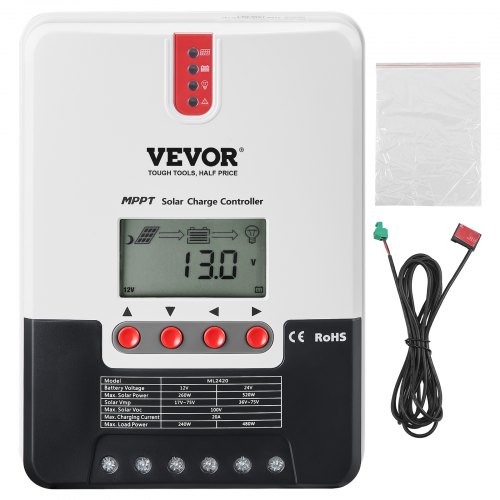
VEVOR 20A MPPT Solar Charge Controller, 12V / 24V Auto DC Input, Solar Panel Regulator Charger with LCD Display Temperature Sensor Cable, for Sealed(AGM), Gel, Flooded and Lithium Battery Charging
Small off-grid systems and 12V/24V battery banks up to ~260W (12V) or ~520W (24V) where compact size and value matter.
A compact 20A MPPT controller with an LCD, temperature sensor support and broad battery compatibility — good for modest solar setups with clear cost-to-capacity balance.
Pros
- Good value for small systems
- High MPPT efficiency for better panel harvesting
- Compact size and modest weight for easy mounting
- Includes LCD and temperature sensor for smarter charging
- Supports common battery types including lithium
- Optional Bluetooth module available for remote monitoring
Cons
- Max 20A limits larger arrays and future expansion
- No built-in Bluetooth — requires optional module for wireless monitoring
- Rated input power may be insufficient for some 24V installations with growth plans
- Basic communications (RS232) may not suit all users
- Build materials are ABS+PC which is standard but not premium
- Warranty and support details depend on the retailer — check before buying
/10
Overall score
Guide price: USD 57.90. Check current price and availability before buying.

VEVOR 50A MPPT Solar Charge Controller, 12V / 24V Auto DC Input, Solar Panel Regulator Charger with Bluetooth Module, 98% Charging Efficiency for Sealed(AGM), Gel, Flooded and Lithium Battery Charging
Larger off-grid arrays and multi-battery systems where higher charging current and built-in Bluetooth monitoring are useful.
A higher-capacity 50A MPPT unit with built-in Bluetooth, suitable for bigger arrays and users who want easier remote monitoring and expansion headroom.
Pros
- Higher current capacity for larger arrays and heavier loads
- Built-in Bluetooth simplifies monitoring and setup
- Substantially higher rated input power for expansion headroom
- High MPPT efficiency improves energy harvest
- Supports multiple battery chemistries including lithium
- Compact footprint relative to its capacity
Cons
- Higher upfront cost compared with lower-amp controllers
- Slightly heavier and larger — needs more installation space
- May be overkill for small 12V systems with little expansion planned
- App and Bluetooth features rely on vendor app support and updates
- Still limited to 100V Voc — larger panel strings must be arranged accordingly
- As with the 20A unit, warranty and accessory inclusion vary by seller
/10
Overall score
Guide price: USD 127.90. Often priced as a premium option; check latest offers.
Comparison table
| Rank | Product | Best for | Price/value | Rating | CTA |
|---|---|---|---|---|---|
| #1 | VEVOR 20A MPPT Solar Charge Controller, 12V / 24V Auto DC Input, Solar Panel Regulator Charger with LCD Display Temperature Sensor Cable, for Sealed(AGM), Gel, Flooded and Lithium Battery Charging | Small off-grid systems and 12V/24V battery banks up to ~260W (12V) or ~520W (24V) where compact size and value matter. | Guide price: USD 57.90. Check current price and availability before buying. | 9.6 | Check latest price |
| #2 | VEVOR 50A MPPT Solar Charge Controller, 12V / 24V Auto DC Input, Solar Panel Regulator Charger with Bluetooth Module, 98% Charging Efficiency for Sealed(AGM), Gel, Flooded and Lithium Battery Charging | Larger off-grid arrays and multi-battery systems where higher charging current and built-in Bluetooth monitoring are useful. | Guide price: USD 127.90. Often priced as a premium option; check latest offers. | 9.1 | Check latest price |
Detailed reviews
#1 VEVOR 20A MPPT Solar Charge Controller, 12V / 24V Auto DC Input, Solar Panel Regulator Charger with LCD Display Temperature Sensor Cable, for Sealed(AGM), Gel, Flooded and Lithium Battery Charging
This VEVOR 20A MPPT controller provides a practical, budget-friendly way to get MPPT efficiency into small off-grid systems. It supports automatic 12V/24V detection, includes an LCD for status and programming, and accepts an external temperature sensor to improve charging accuracy. The unit lists a high MPPT control efficiency (≥98%) and multiple charging modes (fast, balance, float), and it offers standard protections against overcharge, short circuit and reverse polarity. External communication is available via an RS232 port and an optional Bluetooth module can be added. Overall, it’s designed for homeowners or hobbyists who need reliable MPPT behaviour without the higher cost of larger controllers.
Key features
- Rated charging current: up to 20A
- Supports 12V/24V automatic detection
- Rated input power: 12V/260W; 24V/520W
- LCD display and temperature sensor cable included
- MPPT control efficiency ≥98%
- Max solar open-circuit voltage: 100V DC
#2 VEVOR 50A MPPT Solar Charge Controller, 12V / 24V Auto DC Input, Solar Panel Regulator Charger with Bluetooth Module, 98% Charging Efficiency for Sealed(AGM), Gel, Flooded and Lithium Battery Charging
The VEVOR 50A MPPT controller brings the capacity you need for larger solar setups while keeping the same core features as the 20A model. It supports automatic 12V/24V detection, offers a high MPPT efficiency (≥98%) and carries a much higher rated input power (up to 660W at 12V, 1320W at 24V). Built-in Bluetooth allows control and monitoring through a mobile app, making setup and performance checks simpler. The unit also supports an external temperature sensor and includes multiple charging modes to suit different battery chemistries. If you plan to run several panels or build a larger battery bank, a 50A controller reduces the chance of limiting your array on bright days.
Key features
- Rated charging current: up to 50A
- Supports 12V/24V automatic detection
- Rated input power: 12V/660W; 24V/1320W
- Built-in Bluetooth for app monitoring and control
- MPPT control efficiency ≥98%; max Voc 100V DC
- External temperature sensor supported for accurate charging
Buying guide
Match the controller's max current and input power to your solar array. For 12V systems, divide panel watts by 12 to estimate the current; for 24V, divide by 24. Add a safety margin (25–30%) to avoid running the controller at its limit. Check battery chemistry compatibility and whether you need remote monitoring. If you plan to expand panels or batteries, choose the higher-amp controller now to avoid an early upgrade. Also confirm the controller's max open-circuit voltage (Voc) is compatible with your panel string and check cooling/installation space.
FAQs
How do I choose between a 20A and 50A MPPT controller?
Estimate the max current your panels can produce at your system voltage and add around 25–30% safety margin. If the calculated peak current is under 20A a 20A controller is fine; if it approaches or exceeds that, choose a 50A unit.
Can these controllers be used with lithium batteries?
Both controllers list compatibility with sealed, gel, flooded and lithium batteries, but always confirm charge profiles and protections match your specific battery manufacturer's recommendations.
Do I need Bluetooth or remote monitoring?
Bluetooth or app monitoring is a convenience that helps with setup and troubleshooting. It’s more useful on larger systems where monitoring performance and trends is important, but not essential for a simple small off-grid kit.
Our recommended choice
For most small to medium off-grid setups the 20A model offers strong value and high MPPT efficiency. If you expect to run a larger array, higher loads or want built-in Bluetooth monitoring, the 50A model is the better long-term choice.