
Overview
MPPT (Maximum Power Point Tracking) controllers are the best choice when you want more efficient charging from PV panels compared with basic PWM regulators. Both VEVOR models here support 12V and 24V battery banks, have MPPT efficiency listed at ≧98% and offer multiple charge stages for common battery chemistries.
The key difference is continuous charging current and input power: the 20A unit is sized for modest arrays and smaller battery banks; the 50A unit is intended for larger arrays or when you expect significantly higher daily generation and faster recharge.
Choosing between them comes down to system sizing: calculate expected panel output and battery charging needs, factor in safety margins and cable sizing, then pick the controller that covers peak charge current without being constantly overloaded.
Both models include protections and monitoring options (LCD or Bluetooth) and support common battery types. If you already know your panel wattage and battery capacity, the decision is usually straightforward — otherwise the buying guide below will help with the calculations.
Recommended
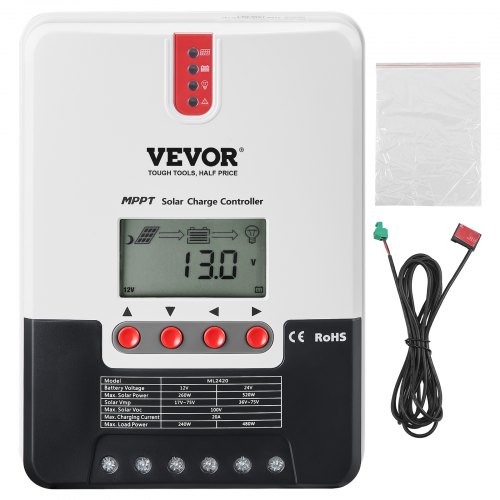
VEVOR 20A MPPT Solar Charge Controller, 12V / 24V Auto DC Input, Solar Panel Regulator Charger with LCD Display Temperature Sensor Cable, for Sealed(AGM), Gel, Flooded and Lithium Battery Charging
Small 12V or 24V systems and modest panel arrays where budget and space are priorities
20A MPPT controller with LCD, 12V/24V auto detection, up to 100V Voc and ≧98% MPPT efficiency — suitable for smaller battery banks and modest PV arrays.
Pros
- Compact, lightweight design suitable for small installations
- Good MPPT efficiency for reliable panel performance
- LCD display provides local status and settings
- Supports common battery types including lithium
- Lower price point for budget-conscious buyers
- Includes temperature sensor for more accurate charging
Cons
- 20A limit restricts usable panel wattage on larger systems
- No built-in Bluetooth for remote monitoring (optional module referenced)
- May be undersized if you plan future expansion of panels
- ABS/PC case offers limited heat dissipation vs larger metal units
- External comms use RS232 which is less convenient than modern apps
- Check product page for exact warranty and accessory list
/10
Overall score
Guide price: USD 57.90 — check the retailer page for current price and availability.

VEVOR 50A MPPT Solar Charge Controller, 12V / 24V Auto DC Input, Solar Panel Regulator Charger with Bluetooth Module, 98% Charging Efficiency for Sealed(AGM), Gel, Flooded and Lithium Battery Charging
Larger 12V/24V battery banks, higher panel wattage or systems likely to expand
50A MPPT controller with built-in Bluetooth, high input power and support for multiple battery chemistries — designed for bigger arrays and faster recharge.
Pros
- Substantially higher current capacity for larger systems
- Built-in Bluetooth simplifies monitoring and setup
- Supports multiple battery chemistries including lithium
- Higher input power lets you use bigger PV arrays
- Compact physical size relative to its current rating
- Includes support for external temperature sensing
Cons
- Higher cost than the 20A model — check value for your needs
- Requires careful cable sizing and fusing for 50A continuous use
- Same 100V Voc limit restricts very large series strings
- ABS/PC case may need good ventilation under heavy loads
- Bluetooth app quality and support can vary by region
- Confirm warranty and included accessories on the product page
/10
Overall score
Guide price: USD 127.90 — often priced as a premium option; check latest offers before buying.
Comparison table
| Rank | Product | Best for | Price/value | Rating | CTA |
|---|---|---|---|---|---|
| #1 | VEVOR 20A MPPT Solar Charge Controller, 12V / 24V Auto DC Input, Solar Panel Regulator Charger with LCD Display Temperature Sensor Cable, for Sealed(AGM), Gel, Flooded and Lithium Battery Charging | Small 12V or 24V systems and modest panel arrays where budget and space are priorities | Guide price: USD 57.90 — check the retailer page for current price and availability. | 9.6 | Check latest price |
| #2 | VEVOR 50A MPPT Solar Charge Controller, 12V / 24V Auto DC Input, Solar Panel Regulator Charger with Bluetooth Module, 98% Charging Efficiency for Sealed(AGM), Gel, Flooded and Lithium Battery Charging | Larger 12V/24V battery banks, higher panel wattage or systems likely to expand | Guide price: USD 127.90 — often priced as a premium option; check latest offers before buying. | 9.1 | Check latest price |
Detailed reviews
#1 VEVOR 20A MPPT Solar Charge Controller, 12V / 24V Auto DC Input, Solar Panel Regulator Charger with LCD Display Temperature Sensor Cable, for Sealed(AGM), Gel, Flooded and Lithium Battery Charging
This VEVOR 20A MPPT charger is a compact, cost-conscious unit intended for small off-grid or backup systems. It supports both 12V and 24V battery banks with automatic detection and offers multiple charge modes (fast, balance and float) to suit sealed, flooded and lithium batteries. The controller lists a high MPPT efficiency figure and a maximum PV open-circuit voltage of 100V, making it compatible with typical small string and panel configurations. An LCD display and temperature sensor cable are supplied for local status monitoring, and the unit includes common protection functions for short circuit, reverse polarity and over-temperature.
Key features
- Rated charging current: 20A (continuous)
- Auto-detect 12V / 24V battery systems
- MPPT efficiency ≥98% for improved energy harvest
- Max PV open-circuit voltage: 100V DC
- Includes LCD display and temperature sensor cable
- Rated input power: 12V/260W; 24V/520W
#2 VEVOR 50A MPPT Solar Charge Controller, 12V / 24V Auto DC Input, Solar Panel Regulator Charger with Bluetooth Module, 98% Charging Efficiency for Sealed(AGM), Gel, Flooded and Lithium Battery Charging
The VEVOR 50A MPPT unit increases continuous charging capacity for users with larger arrays or faster recharge requirements. It supports automatic 12V/24V detection, lists MPPT efficiency at ≧98% and accepts up to 100V Voc from PV arrays. Built-in Bluetooth allows app-based monitoring and control via the vendor's supported app, which is useful for remote status checks. The 50A rating gives significantly higher input power allowance (up to 660W at 12V and 1,320W at 24V), making it a better match for medium-sized systems and installations that may grow over time.
Key features
- Rated charging current: 50A (continuous)
- Auto-detect 12V / 24V battery systems
- Built-in Bluetooth and app control for remote monitoring
- MPPT efficiency ≥98% and external temp sensor supported
- Max PV open-circuit voltage: 100V DC
- Rated input power: 12V/660W; 24V/1320W
Buying guide
1) Match controller current to expected charge current: for a 12V system divide the total panel wattage by 12 (for 24V divide by 24) to estimate maximum current; pick a controller rated higher than that number with headroom (typically 25–30%). 2) Consider battery capacity and recharge goals: larger banks or faster recharge needs favour higher-amp controllers. 3) Check maximum PV open-circuit voltage and MPPT input power limits to ensure your panel string is compatible. 4) Plan cable sizes and fusing for the continuous current rating. 5) Decide whether you want built-in Bluetooth or a display for local monitoring. 6) Remember operating environment: both models list similar temp ranges, but installation location and ventilation affect heat dissipation and longevity.
FAQs
How do I know whether I need 20A or 50A?
Estimate your maximum charging current by dividing panel wattage by battery system voltage (12V or 24V). Add a safety margin (about 25–30%) and choose the controller rated above that figure. If in doubt, choose the higher-amp option for future expansion.
Our recommended choice
For most small systems the 20A controller is the sensible, budget-friendly option — it handles modest arrays and keeps installation simple. If you expect to run larger arrays, recharge faster or may expand in future, the 50A model is the safer pick despite the higher upfront cost.